Passenger incident claims on coaches and buses cover a different risk profile from road traffic incidents. The primary claim categories — slip and trip on boarding steps, door entrapment, falls from seat during harsh braking, assaults by other passengers — occur entirely within the vehicle or at the boarding zone, in spaces where the driver has partial or no visibility and where traditional external cameras provide no evidence at all. Preventing and documenting these incidents requires cameras positioned for the interior environment, not the road environment.
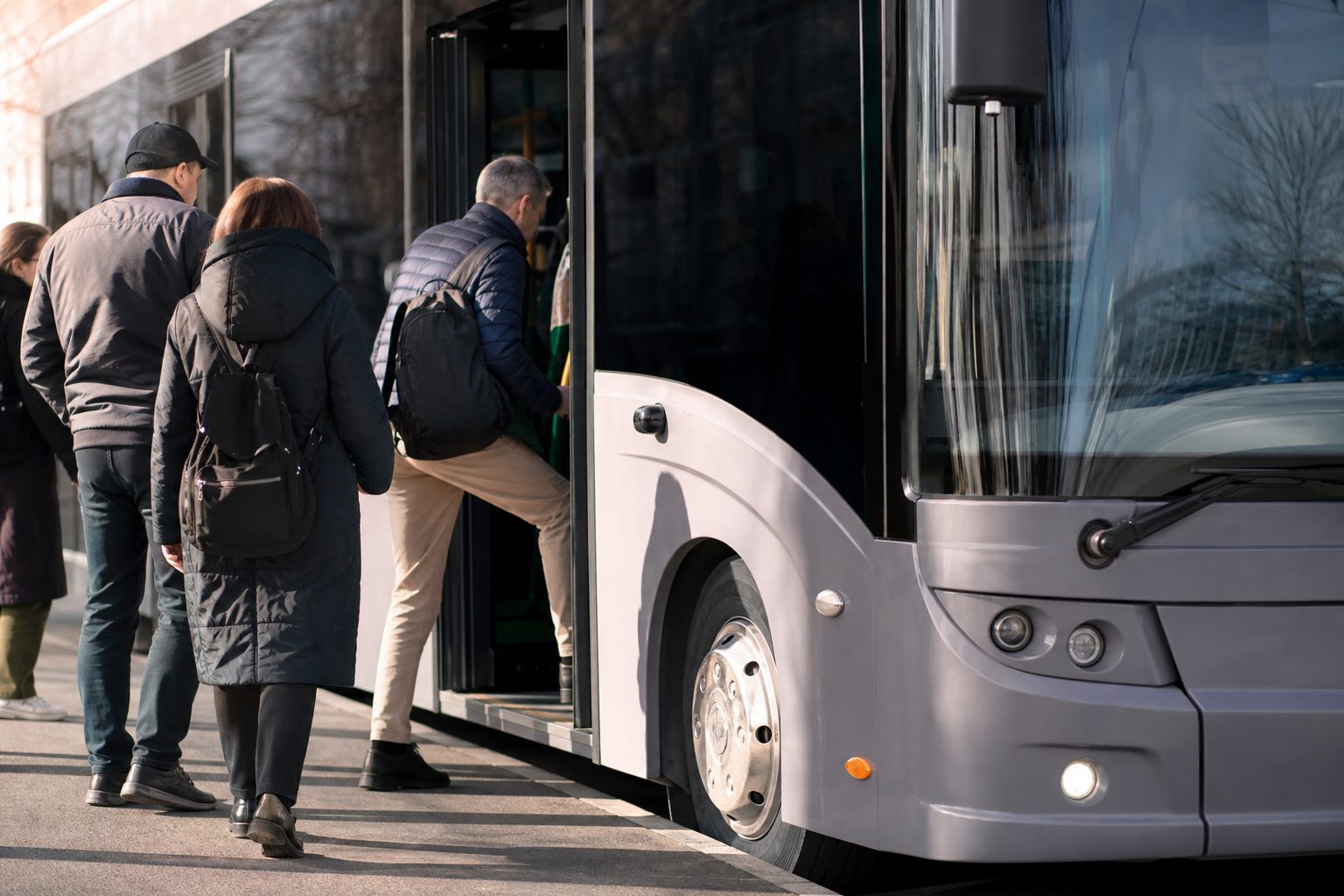
The highest frequency of passenger injury claims on coaches and buses occurs during boarding and alighting. Wet steps, an unexpected height differential at an unfamiliar stop, a passenger moving before the vehicle has fully stopped, or a door closing on a passenger who is still in the doorway: these are the mechanisms that produce the most common passenger injury claims.
Camera coverage of the boarding zone serves two purposes. First, a camera positioned to show the driver the passenger door area — either an interior camera facing the door, or an exterior door zone camera — provides the driver with awareness of whether the doorway is clear before the door closes and before the vehicle moves. A door that the driver cannot see from the cab is a door that closes on passengers based on timing alone. Camera visibility changes this — the driver has visual confirmation.
Second, boarding zone camera footage resolves the factual dispute in slip and trip claims. A claimant who alleges the step was wet, the lighting was inadequate, or the door closed before they had fully alighted is making a claim that either the footage supports or it does not. A camera that captures the boarding sequence from first door opening to last passenger departure creates an irrefutable record of the conditions and the sequence of events.
Interior saloon cameras — typically covering the full length of the lower deck and the stairwell on double-deck vehicles — provide the evidence base for three categories of passenger incident claim:
Passenger falls during transit. A passenger who falls from their seat or falls in the aisle during braking or a sharp turn may claim that the driver’s driving caused the fall. Footage showing the vehicle’s conditions at the moment of the fall — whether a genuine harsh event occurred or whether the passenger moved without holding on — provides the factual record. Interior camera footage from the saloon, combined with g-sensor data from the MDVR showing the vehicle’s actual movement at the relevant time, produces the complete picture.
Passenger-on-passenger incidents. Assaults, disputes, and anti-social behaviour on coaches and buses — particularly on night services — are documented by interior cameras and reported to police with the footage as evidence. Without interior cameras, the driver’s account and any passenger witness accounts are the only evidence of what occurred; the victim may be disbelieved or the perpetrator untraceable. Footage from interior cameras has a high evidence yield in police prosecutions of coach and bus assaults.
Property damage and theft. Claims that property was damaged or stolen on the coach are resolved by footage showing the occupancy of the relevant seats and any interactions near the claimant’s property. Without interior footage, property damage claims are resolved by the operator’s goodwill rather than evidence.
Wheelchair users boarding via the manual or electric ramp present a specific camera coverage requirement. The ramp deployment zone — the area immediately outside the passenger door at the kerbside — is typically not visible to the driver from the cab. The ramp-to-floor transition inside the vehicle may be obstructed by seated passengers’ view lines.
A door zone camera showing the ramp deployment area provides the driver with a live feed of the boarding process for wheelchair users: whether the ramp is properly positioned, whether the wheelchair user is fully secured before the ramp retracts, and whether the area is clear before the door closes. This camera serves both safety (the driver can see the boarding process is complete before moving) and evidential (footage of the ramp operation resolves any subsequent claim about the boarding process).
Driver-facing cameras on coaches and buses serve the same coaching and incident documentation function as on other vehicle types, but with a PSV-specific dimension: distraction during passenger-intensive operations. A driver on a busy city bus route who is simultaneously managing fare payment, passenger questions, and traffic conditions is operating in a higher distraction environment than a truck driver on a motorway. Driver-facing footage that shows the driver’s engagement during an incident — what they were looking at, whether the incident was preceded by a distraction event — is directly relevant to the operator’s liability position in a subsequent claim.
UK GDPR and employment law apply to driver-facing camera data on PSV vehicles as they do on other vehicle types. The operator’s CCTV policy should cover driver-facing cameras explicitly, including the trigger conditions for accessing footage and the process for using footage in coaching conversations and disciplinary proceedings.
Interior cameras on coaches and buses capture passengers who are identifiable individuals and are therefore processing personal data under UK GDPR. The lawful basis for this processing is typically legitimate interests — passenger safety, incident investigation, and security. The obligations that flow from this:
Both, in different ways. The presence of visible cameras in the saloon has a documented deterrent effect on anti-social behaviour and passenger-on-passenger incidents — passengers who know they are on camera modify their behaviour. The camera itself does not prevent mechanical incidents (falls, door entrapment) — but the driver’s access to a live door-zone camera feed before closing the door is an active prevention measure, not just a recording function.
A full-size single-deck touring coach requires at minimum: one camera covering the passenger door zone (interior or exterior), one covering the front third of the saloon, and one covering the rear two-thirds. For a 53-seat coach, two to three saloon cameras provide adequate coverage without blind spots. A double-deck coach additionally requires stairwell coverage and an upper-deck camera. The relevant specification is eliminating blind zones within the passenger areas that could prevent incident documentation.
Yes, provided the footage is unedited, has accurate timestamps, is in its original format, and has a documented chain of custody from recording to presentation. The privacy notice on the vehicle establishes that passengers were aware of recording, which is relevant to admissibility questions. Interior footage from coaches and buses is regularly used in criminal cases (assault), civil personal injury cases (slip and trip, falls), and employment proceedings (driver behaviour).
This is a Subject Access Request under UK GDPR. The operator must respond within one calendar month, provide the footage featuring the requesting passenger, and redact or obscure other passengers who also appear in the footage (if reasonably practicable). The operator can charge a fee only if the request is manifestly unfounded or excessive. Failure to respond is a reportable breach to the ICO. If the footage has been deleted under the normal retention cycle before the request is received, the operator should explain this and document the standard deletion procedure.
Yes. A CCTV privacy notice is required — it must be clearly visible before passengers board, explaining that CCTV is in operation, who the data controller is, and how passengers can access their rights under UK GDPR. The Information Commissioner’s Office provides guidance on the required content of CCTV notices for transport operators. Failure to provide adequate notice is a GDPR compliance failure, not just a transparency issue.
Download this free checklist to apply the guidance in this article to your fleet.
Tell us what vehicles you run and what you need — we will come back with a recommendation and a price. Prefer to talk? Call 01656 721871.
Related guides: Camera Requirements for Coaches and Buses · Best Camera Setup for Public Service Vehicles
4 August 2026
Monday to Friday:
8.30am-5.30pm