
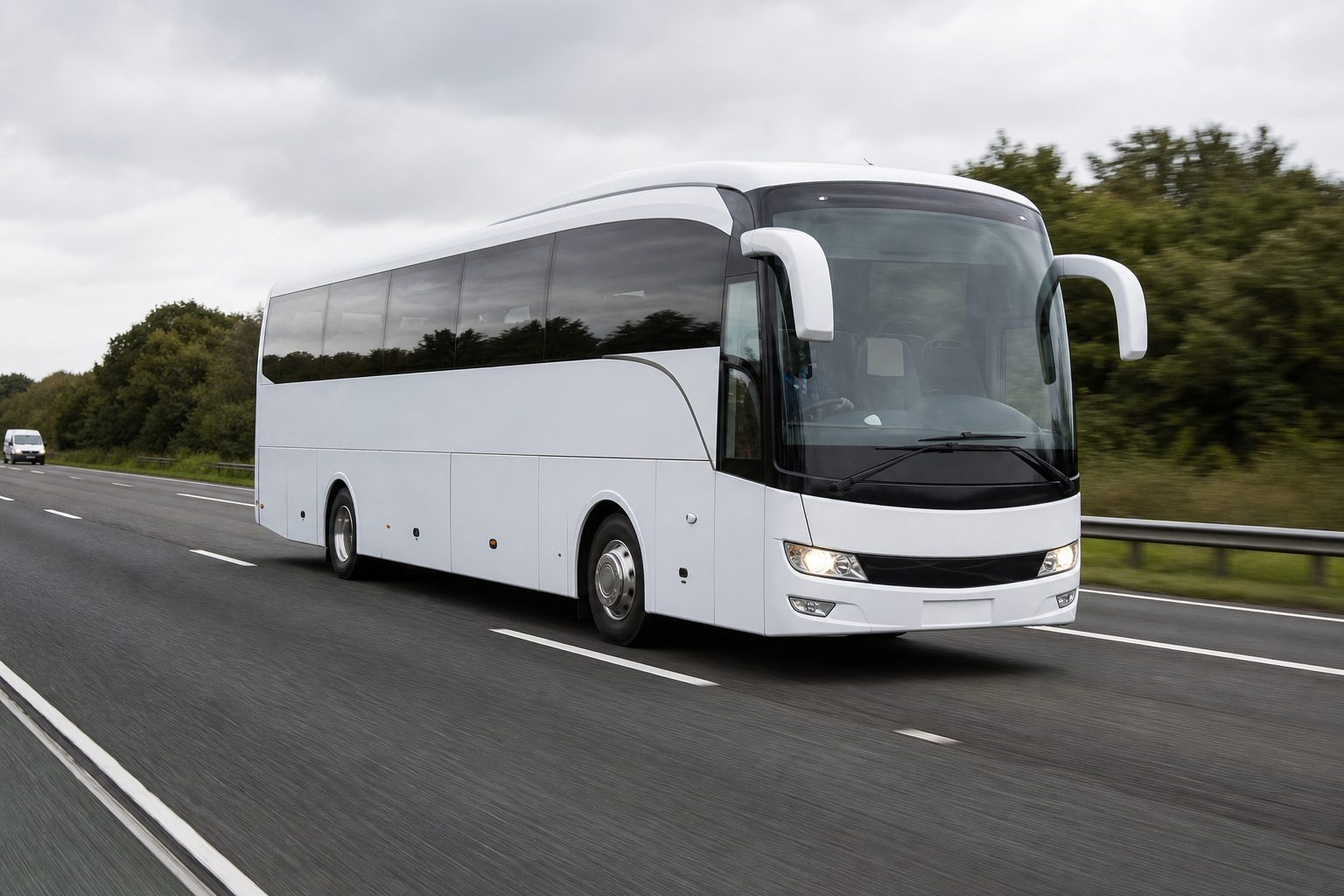
A coach operator asking which cameras their vehicles legally need will receive different answers depending on where those vehicles operate, how many passengers they carry, and whether they access London. The compliance framework for coaches and buses overlaps several different regulatory domains — FORS, the PSV licensing regime, the Equality Act’s provisions on accessible transport, and DVS, which is often assumed to apply to coaches but in fact covers only goods vehicles — and none of them gives a single clean specification that covers all cases.
This guide maps the camera requirements that apply to coach and bus operators in the UK, identifies where the standards overlap and where they conflict, and explains what each framework actually requires rather than what installers sometimes claim it requires.
The Direct Vision Standard applies to goods vehicles (HGVs) over 12 tonnes operating in Greater London. Coaches and buses are passenger vehicles, not goods vehicles, so they are outside the scope of DVS and the Progressive Safe System — a coach does not need an HGV Safety Permit to operate in London. Fitting the equivalent systems voluntarily is good practice, particularly for coaches working dense urban routes.
The systems PSS specifies for in-scope HGVs — worth considering as voluntary good practice on coaches — are:
The coach-specific consideration is the extreme length of a full-size touring coach — typically 12–15 metres. The nearside CMS must provide coverage of the full vehicle length, not just the cab zone. A single mirror-arm camera does not cover a 15-metre nearside; a second nearside camera at the rear of the body is the typical solution for full coverage.
FORS accreditation is a supplier condition for many contracts serving infrastructure projects, airports, and major event venues. Its vehicle safety-equipment requirements are written for HGVs (over 3.5 tonnes under FORS) and do not apply to PSVs — coach operators can join FORS, but the only equipment element that applies to their vehicles is the blind-spot warning signage. The camera requirements at FORS Silver: nearside camera with minimum 7-inch in-cab monitor; a side sensor system; external audible left-turn warning; reversing alarm.
FORS Gold uses the same camera specification as FORS Silver — the additional Gold requirement is a published case study demonstrating the operator’s safety practice in use, rather than any extra camera hardware. For a coach operator with a mixed-age fleet, working toward Gold is therefore about evidencing how camera systems are used, not fitting additional equipment.
FORS Version 7 (effective January 2025) requires that sensor systems on articulated vehicles — including articulated coaches and bendy buses — do not generate false alerts from articulation movements. Coach operators with articulated vehicles should review their pre-V7 sensor configurations against this updated requirement.
Interior CCTV in coaches and buses is not mandated by DVS or FORS — these frameworks address external vehicle safety. Interior CCTV is increasingly specified by:
Interior CCTV on coaches and buses is personal data under UK GDPR, as it captures passengers who are identifiable individuals. The lawful basis is typically legitimate interests — passenger safety and security. A CCTV privacy notice must be displayed on the vehicle, and the retention period for standard (no incident) footage must be specified in the operator’s data protection policy.
The passenger boarding and alighting zone — the kerbside area beside the main passenger door — is a specific hazard zone on coaches and buses. Passengers alighting into a cycle lane, passengers boarding from a busy pavement, wheelchair ramp deployment on a narrow road: all create conflicts between the vehicle and the road environment that the driver cannot fully observe from the cab.
Door zone cameras mounted above or beside the passenger door provide the driver with a live feed of the boarding area during boarding and alighting operations. These cameras are not required by DVS or FORS frameworks but are recommended in TfL guidance for bus operations and are increasingly standard on new-build coaches serving airport and transfer routes where the boarding environment is predictably complex.
A 15-metre touring coach has a rear blind zone that standard rear camera systems designed for 12-metre rigid HGVs do not fully address. The camera must cover the full rear width and sufficient distance to be useful for motorway lane changes and the approach to service areas and coach parks. A rear-facing camera with wide-angle lens (minimum 120° field of view) mounted at the highest practical point on the rear panel provides the best coverage of the rear zone and the approach of overtaking vehicles.
For double-deck coaches, upper deck camera coverage adds a monitoring channel that provides overview of the full seating area and the stairwell — relevant for passenger incident documentation.
No. DVS PSS applies to goods vehicles (HGVs) over 12 tonnes — minibuses, like all passenger vehicles, are outside the DVS framework regardless of weight. However, minibuses operating under PSV licence and serving London contracts (school transport, airport transfers) may have contract-specific camera requirements imposed by the client organisation rather than by DVS. The DVS non-applicability does not mean cameras are optional for minibuses, only that the DVS framework does not mandate them.
Interior cameras are not required by DVS or FORS frameworks. They may be required by contract conditions (TfL bus franchises; airport transfer contracts) or by operator licence conditions imposed by the Traffic Commissioner in specific circumstances. For most coach operators, interior cameras are fitted for commercial reasons — passenger incident claim management, passenger security, and insurance premium reduction — rather than regulatory compliance.
Specific camera requirements for wheelchair accessible vehicles are not imposed by the Equality Act or the Disabled Persons Transport Advisory Committee guidance. However, wheelchair ramp deployment and the boarding zone for wheelchair users are specific hazard points where door zone camera coverage is particularly valuable for both passenger safety and incident documentation. Operators running accessible transport services should consider door zone cameras as standard specification regardless of regulatory requirement.
No. A BSIS sensor is specifically calibrated for the nearside blind zone alongside the vehicle — the zone where cyclists and pedestrians are present during left turns. A rear radar sensor covers the reversing zone — a different geometry with different alert parameters. The two functions are not interchangeable. A vehicle that uses its reversing sensor as a BSIS substitute leaves the nearside blind zone uncovered — and an in-scope HGV doing so would not be DVS PSS-compliant.
For standard route footage with no incident, 30 days is the typical documented retention period — long enough to cover late-reporting passenger incident claims. For footage relating to a specific incident or claim, retention should continue until the matter is formally resolved, which in passenger liability claims may be two to five years. The retention decision should be documented when footage is preserved — date, reason, and responsible person — so that a deliberate decision trail exists if the footage is later requested.
Download this free checklist to apply the guidance in this article to your fleet.
Tell us what vehicles you run and what you need — we will come back with a recommendation and a price. Prefer to talk? Call 01656 721871.
Related guides: Compliance Requirements for Coach and PSV Operators · Preventing Passenger Incidents With Cameras
4 August 2026
Monday to Friday:
8.30am-5.30pm