
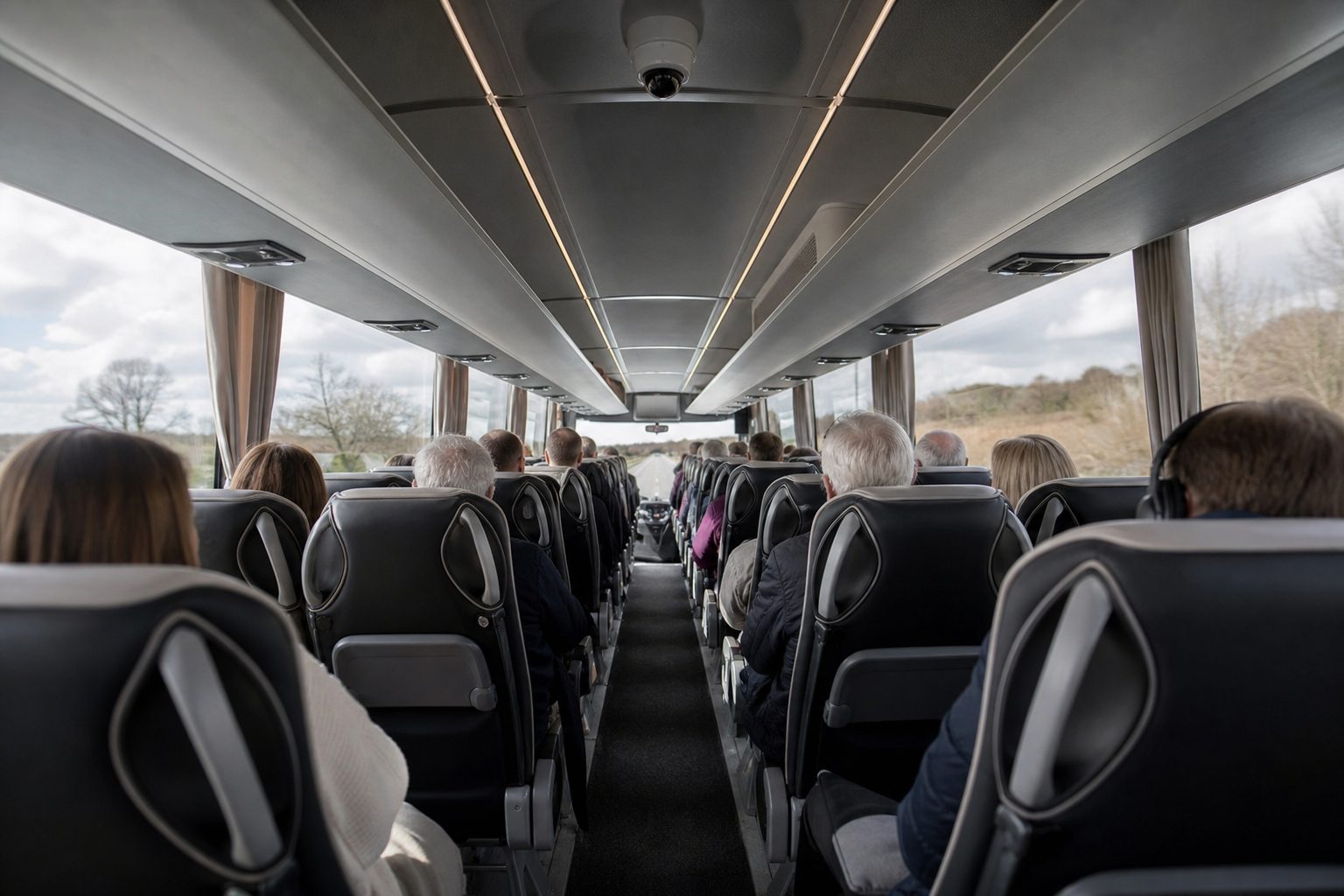
A public service vehicle — whether a 53-seat coach, a city bus, or a minibus — carries more people than any other vehicle type in the fleet category, and presents a camera specification challenge that is both external and internal. The external cameras address the road and pedestrian environment; the interior cameras address the passenger environment; and the two systems need to work as a single integrated record that covers the full operating lifecycle from depot departure to final stop.
This guide specifies the full camera system for a PSV, position by position, explaining what each camera does, what standard it satisfies, and where the PSV-specific requirements differ from a standard HGV specification.
Function: Supplements nearside mirrors (mirrors remain required); provides the driver with a live feed of the left-side zone during left turns and at stops where pedestrians and cyclists are alongside the vehicle.
Placement: Mirror arm or nearside body, typically at cab height, angled to cover from the front axle rearward. On full-size coaches (12–15 metres), a second nearside camera at the rear body is required to cover the full vehicle length — a single mirror-arm camera does not cover a 15-metre nearside zone.
Compliance: Mandatory under DVS PSS only for goods vehicles (HGVs) over 12 tonnes operating in London — passenger vehicles are not in scope, so for PSVs this is good practice rather than a requirement. FORS sensor-system requirements likewise apply to HGVs only (over 3.5 tonnes under FORS). Activated by left indicator.
Specification: Minimum 720 AHD resolution; IP69K-rated housing; wide-angle lens (minimum 120° horizontal field of view); anti-glare shroud to prevent monitor washout in direct sunlight (WISH equivalent for PSV: DVSA guidance on CMS display quality).
Function: Nearside blind spot detection aligned with UNECE Regulation 151 — a standard that relates to new-vehicle type approval, not a mandatory retrofit requirement for buses. Detects pedestrians and cyclists in the left-side zone and provides an audible/visual alert when the left indicator is engaged and an object is detected.
Placement: Lower nearside body, typically below mirror height, positioned to cover the ground-level zone alongside the vehicle where a pedestrian or cyclist would be standing or riding.
Compliance: Mandatory under DVS PSS for in-scope HGVs only — not a requirement for passenger vehicles, though good practice to fit. For HGVs over 3.5 tonnes, FORS Silver specifies a “blind spot information system” and a side sensor system — the performance standard aligns with the BSIS specification.
PSV note: Full-size coaches have a wider footprint than most HGVs. Sensor detection angle should extend to the full body width — a sensor calibrated for a 2.5-metre body width is too narrow for a 2.55-metre coach body.
Function: Moving Off Information System. Front-facing camera with AI person-detection, providing an audible alert when a person is detected in the path of the vehicle before it moves forward.
Placement: Centrally above the windscreen or on the front bumper assembly, covering the zone directly ahead and to the sides of the front of the vehicle.
Compliance: Mandatory under DVS PSS only for goods vehicles over 12 tonnes operating in London — not for PSVs. PSV operators who move off at bus stops where passengers and pedestrians are present have a strong practical safety case for fitting MOIS voluntarily.
PSV calibration: The AI detection model must exclude the vehicle’s own front profile — bonnet, bumper, destination display, front camera housing. On coaches with complex front profiles (roof-mounted air conditioning, front-mounted luggage storage), the exclusion model requires specific configuration for the vehicle’s actual geometry.
Function: Covers the reversing zone behind the vehicle; provides evidence of rear-end incidents; assists with manoeuvring in coach parks and service areas.
Placement: Rear panel, highest practical point, wide-angle lens covering the full vehicle width and 3–8 metres behind. For double-deck coaches, rear cameras at both deck levels provide better coverage of the trailing vehicle zone.
Compliance: Not explicitly mandated by DVS PSS or FORS Silver (though FORS Silver requires a reversing alarm — the camera complements the alarm). Best practice for all PSV types.
Function: Documents passenger incidents, anti-social behaviour, and the passenger environment during transit.
Placement: Front-to-rear-facing cameras at the front of the vehicle covering the full saloon. A single wide-angle camera at the front typically covers a 12-metre single-deck saloon; two cameras are required for 15-metre coaches. Double-deck vehicles require separate saloon cameras for each deck.
Compliance: Required by TfL bus franchise conditions; typically required by airport transfer and event transport contracts; not mandated by DVS or FORS. Interior cameras process passenger data under UK GDPR — CCTV privacy notices required on vehicle.
Function: Provides the driver with a live view of the passenger door and boarding zone during boarding and alighting operations.
Placement: Mounted above or adjacent to the passenger door, angled to show the full doorway, step zone, and kerbside boarding area.
Compliance: Not mandated by any specific framework, but recommended by TfL guidance for bus operations and increasingly standard in airport transfer coach specifications. Critical for wheelchair ramp operations where the ramp deployment zone is not visible from the driver’s seat.
Function: Documents driver behaviour and distraction; supports coaching programmes; provides evidence in incidents where driver behaviour is disputed.
Placement: Fixed above the dashboard facing the driver, covering face and upper body.
Compliance and GDPR: Not mandated by any framework but increasingly standard in well-managed PSV fleets. UK GDPR requires driver notification and an explicit policy covering access conditions for driver-facing footage.
A full PSV camera system — 4–6 external cameras plus 2–3 interior cameras — requires an MDVR with sufficient channel count, storage, and processing capacity. The recommended specification:
The external camera hardware is largely the same — the DVS PSS component set, FORS-style nearside and rear coverage — but the compliance position differs: DVS PSS and FORS sensor requirements bind HGVs, while for PSVs the same external systems are voluntary good practice. The key difference is the interior camera requirement. HGVs do not carry passengers and do not require saloon or door zone cameras. PSVs must address the passenger environment as well as the road environment, doubling the camera channel count and adding GDPR compliance obligations for passenger data that do not apply to cargo-carrying vehicles.
No — DVS PSS applies only to goods vehicles (HGVs) over 12 tonnes; minibuses and other passenger vehicles are not in scope regardless of weight. Fitting equivalent nearside cameras is good practice, and some contracts specify camera equipment in their own terms — so the practical answer is to check the contract conditions rather than DVS, which does not apply.
TfL bus franchise conditions require interior CCTV covering the saloon, stairwells, and passenger doors. The footage must be retained for a minimum period and must be accessible to TfL investigators following an incident. The specific technical requirements are set out in TfL’s Bus Quality Assurance Framework and the individual franchise agreement. Operators who do not meet these requirements face contract penalties or contract termination rather than statutory fines.
Yes. The HGV Safety Permit scheme, DVS ratings, and PSS requirements apply to goods vehicles over 12 tonnes — a PSV does not need a permit to operate in London, and MOIS is not a legal requirement for passenger vehicles. Fitting MOIS is nonetheless good practice for vehicles that move off from busy bus stops, which is exactly the scenario the system is designed for.
Display a CCTV privacy notice at the vehicle entrance before passengers board. Document the retention period in your data protection policy (30 days standard; until resolution for incident footage). Respond to Subject Access Requests within one calendar month, providing the footage featuring the requesting individual with other passengers’ faces redacted where reasonably practicable. Restrict access to interior footage to authorised personnel — fleet managers, safety officers, legal advisers — under documented conditions.
Download this free checklist to apply the guidance in this article to your fleet.
Tell us what vehicles you run and what you need — we will come back with a recommendation and a price. Prefer to talk? Call 01656 721871.
Related guides: Preventing Passenger Incidents With Cameras · Live View Monitoring for Coach Operators
4 August 2026
Monday to Friday:
8.30am-5.30pm