
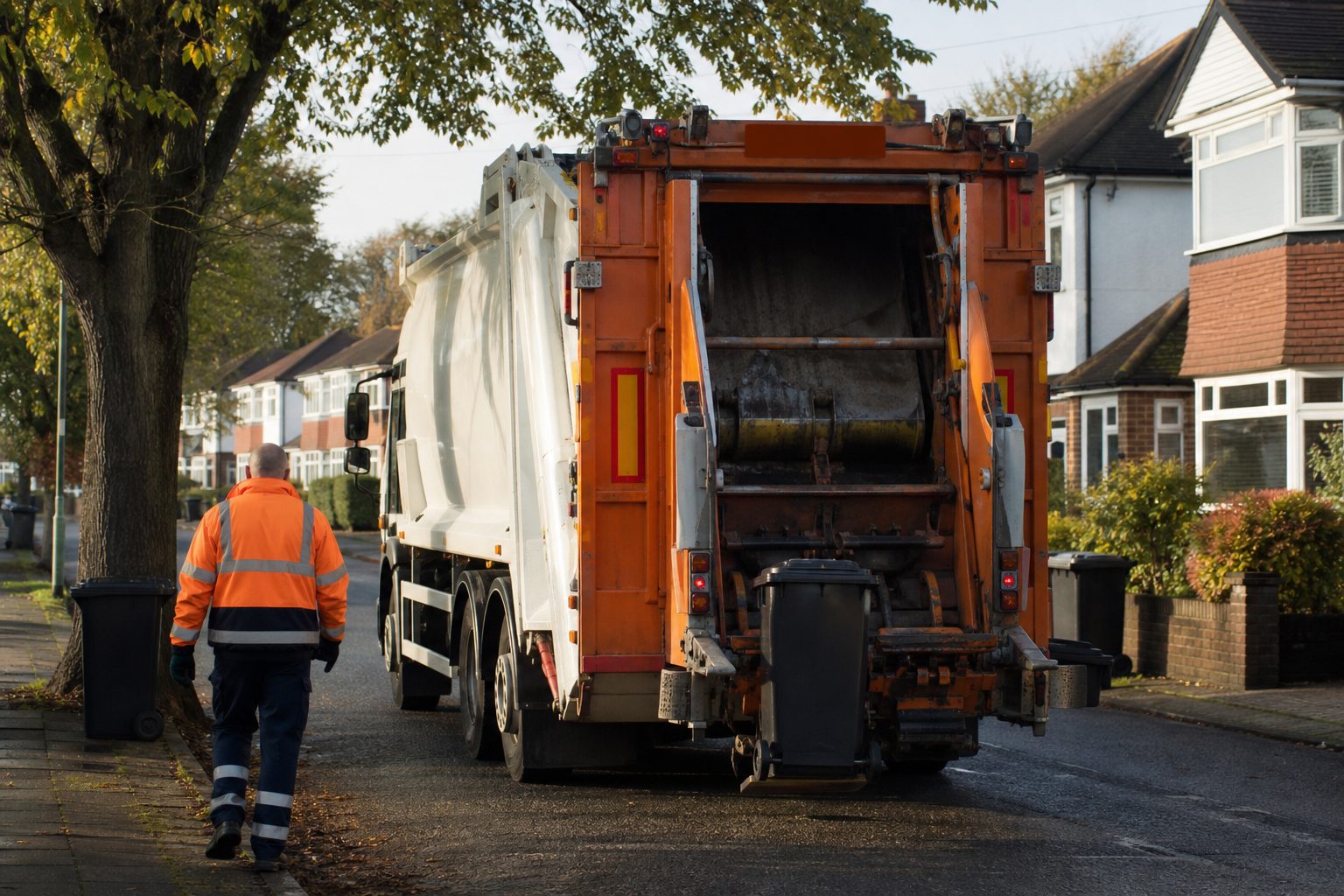
No sector of commercial vehicle operation has a worse serious injury and fatality rate than waste and recycling. The combined fatal and major injury rate in the waste sector is more than four times the average across all UK industries — a figure that reflects not bad luck but a structural operating environment where people on foot are in constant proximity to heavy moving vehicles, on every shift, on every route. The camera requirements that apply to waste and refuse vehicles are higher than those for most other commercial vehicle types because the risk profile is genuinely different: more hazard zones, more crew exposure, more pedestrian contact, and a regulatory framework that has responded to the accident data with specific mandates.
The HSE identifies the waste and recycling sector as one of the most dangerous industries in the UK by injury rate. Refuse collection vehicles (RCVs) operate in residential environments where pedestrian density is high, sightlines are restricted by parked vehicles, and the vehicle is required to stop, load, and move repeatedly along narrow streets. Each stop creates a hazard window: crew members dismount, move alongside and behind the vehicle, and return to board — a sequence that happens hundreds of times per shift.
The reversing hazard is acute. Unlike HGVs that reverse primarily at depots or delivery bays, refuse vehicles reverse into residential streets, shared driveways, cul-de-sacs, and service roads as a routine part of collection. The HSE specifically identifies reversing as one of the most dangerous manoeuvres in waste operations, advising that good all-round vision should be achieved through a combination of cameras, sensors, and audible warnings — not mirrors alone.
A question that comes up consistently among waste fleet operators is whether their vehicles need more camera coverage than, for example, a logistics HGV on the same chassis. The answer is yes — and the reason is not the vehicle type but the operation: the frequency of pedestrian contact, the presence of crew on foot alongside the vehicle, and the operational need to reverse in environments that were not designed for 26-tonne vehicles.
A standard forward-facing and rear camera configuration — adequate for many commercial vehicle operations — does not address the hazard profile of a refuse vehicle. The specific geometry of RCV operations creates camera requirements in zones that other HGV types rarely need to monitor actively.
The nearside zone during kerbside collection is the most significant difference. Crew members collecting bins walk alongside the nearside of the vehicle, cross behind it, and approach the hopper during loading. A nearside kerb-level camera addresses a risk that standard wing mirrors cannot resolve — particularly at the rear corner where the sight line to the ground is most compromised.
The rear zone during reversing carries higher weight in waste operations because the reversing frequency is dramatically higher than in other fleet types. A logistics vehicle may reverse once or twice per delivery run into a defined loading area. A refuse vehicle may reverse thirty to forty times per shift into varied residential environments, each with different pedestrian and obstruction profiles. The sensor and camera system that triggers once a week for a logistics vehicle triggers continuously for a refuse vehicle throughout every shift.
The offside zone during road positioning is a specific hazard on narrow collection roads where oncoming traffic must pass at close range. A side-facing camera or sensor provides crew and driver with clearance-gap awareness during these manoeuvres.
The Direct Vision Standard (DVS), which applies to HGVs over 12 tonnes operating in Greater London, has a specific impact on refuse fleets because many RCVs are designed with cabs that produce low direct-vision star ratings. A refuse vehicle with a DVS rating below 3 stars must fit a Progressive Safe System (PSS) to operate in London — which includes a combination of camera systems to detect the driver’s blind spots, proximity sensors covering the nearside and front zones, and audible warnings. For waste fleets operating in or supplying services to London boroughs, DVS compliance is not optional.
FORS (Fleet Operator Recognition Scheme) Silver accreditation requires operators to demonstrate camera systems covering nearside blind spots as a minimum, and mandates MOIS (Motorcycle and Intelligent Speed Adaptation) sensors for vehicles operating in urban environments. Waste and refuse fleets operating under local authority contracts commonly hold FORS Silver as a condition of their contract — which means the camera and sensor standard is effectively contractually mandated, not just recommended.
CLOCS (Construction Logistics and Cyclist Safety) applies when waste vehicles operate on or adjacent to construction sites, which is a more common scenario than it appears — skip collection, demolition waste removal, and aggregate disposal all bring refuse vehicles into CLOCS-compliant site environments. CLOCS Standard v5 aligns with DVS requirements and adds site-specific protocols around cyclist and pedestrian detection.
The minimum camera configuration for a compliant waste vehicle covers five positions:
Higher-specification configurations for vehicles operating in urban environments or under DVS PSS requirements add a front-nearside camera covering the cyclist blind spot, a 360-degree bird’s-eye view stitching all four external cameras into a single overhead composite image on the in-cab monitor, and integration with proximity sensors that overlay distance alerts directly on the camera feed.
The bin-lifting mechanism introduces a hazard category that does not exist for other vehicle types. During a rear-loader collection, the bin travels upward on the lift mechanism to the hopper — a movement that creates a crush zone at the rear of the vehicle. During a side-loader operation, the mechanical arm sweeps across the pavement-level zone to collect and tip the bin.
Camera systems integrated with bin-lift operations detect personnel in the crush zone before the lift cycle activates. AI-powered detection systems can halt the bin-lift cycle automatically when a person is identified in the hazard zone, providing a fail-safe that reduces reliance on the driver or loader operator having a direct sightline to the lift area at the point of activation. For fleets operating fully automated side-loaders — where there is no crew member physically operating the lift — this detection-and-halt capability is the primary pedestrian safety mechanism during the loading cycle.
The recording requirement for bin-lift incidents is also distinct. Where a malfunction or crush incident occurs, footage of the lift cycle, the sensor detection status, and the driver cab at the moment of activation is the primary investigation evidence for HSE inquiries and civil claims.
There is no single statutory requirement that mandates cameras on all refuse vehicles. However, DVS PSS requirements apply to refuse vehicles over 12 tonnes operating in Greater London with a star rating below 3 stars. FORS Silver contracts require nearside camera coverage. HSE guidance strongly recommends cameras as a primary reversing aid. Most local authority waste contracts specify camera requirements as a condition of operation — meaning cameras are effectively mandatory for most commercially operated refuse fleets.
DVS PSS (Progressive Safe System) requires cameras or sensors covering the nearside blind spot, the front blind spot (cyclist zone), and a means of detecting and warning of pedestrians and cyclists in these zones. For waste vehicles, this typically means a front nearside camera, nearside proximity sensors, and a rear-facing camera with audible warning — integrated with an in-cab monitor that shows the driver the active detection zones during low-speed manoeuvres in London.
Crew members on foot move alongside the nearside of the vehicle during kerbside collection. The nearside ground-level camera covers the zone between the vehicle and the kerb at the level where crew members’ feet and legs are visible, which standard mirrors cannot resolve at close range. This camera is the primary safety mechanism for crew-on-foot incidents during collection operations — the most frequent cause of serious crew injuries in waste operations.
Yes. FORS Silver v7 (January 2025) requires operators to fit camera systems covering nearside blind spots as a minimum, and mandates MOIS sensors on vehicles operating in urban environments — which includes virtually all refuse collection routes. Operators holding or seeking FORS Silver accreditation who do not have these systems fitted will fail the accreditation audit on vehicle safety equipment.
Retain all footage from the shift in which an incident or near-miss occurred: bin-lift cycle footage, rear-facing footage from the reversing manoeuvre, and nearside footage from the crew operation zone. For PSS-equipped vehicles, retain sensor alert logs alongside the footage. HSE investigations and civil claims in the waste sector routinely request this evidence — footage not retained in time cannot be produced and leaves the operator unable to contest a disputed account of events.
Camera positions, DVS and FORS requirements, bin-lift safety, and incident recording retention guidance for waste and refuse fleet operators.
Tell us what vehicles you run and what you need — we will come back with a recommendation and a price. Prefer to talk? Call 01656 721871.
Related guides: How Evidence Footage Reduces Claims in Waste Fleets · Best Camera Setup for Refuse Trucks
4 August 2026
Monday to Friday:
8.30am-5.30pm