
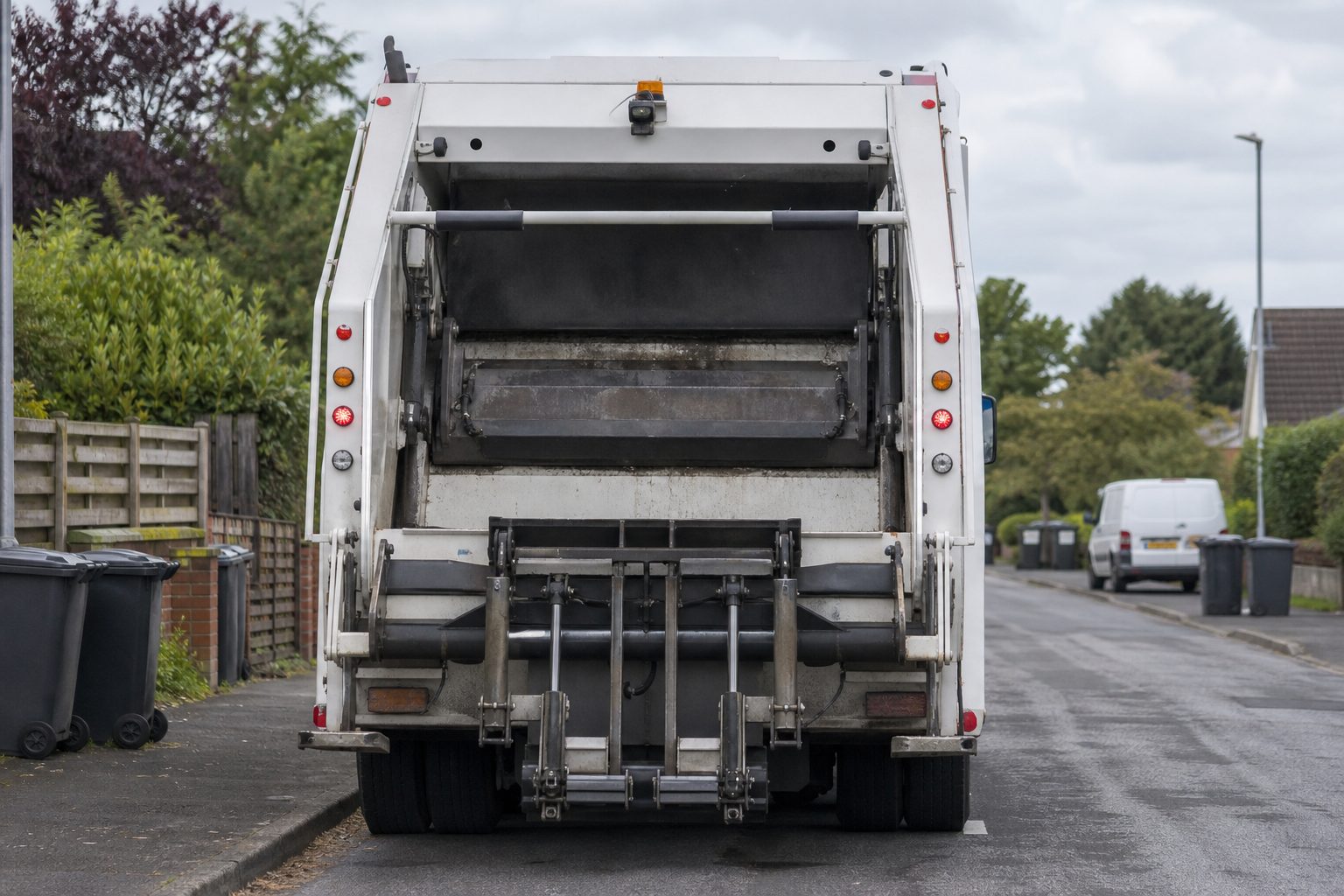
Camera configurations borrowed from logistics HGV specs do not fit refuse truck operations. A logistics HGV reverses into defined bays, carries no crew on foot alongside the vehicle, and does not have a mechanical loading arm that creates a crush zone at the rear. Refuse collection vehicles do all of these things, on every shift, on every route. The best camera setup for a refuse truck is one designed around the actual hazard profile of refuse operations — not a generic commercial vehicle template applied by default.
A compliant and operationally appropriate refuse truck camera system covers five positions. These are not optional additions to a basic setup — they are each addressing a specific hazard zone that the vehicle’s operating pattern creates.
The five core positions apply across all RCV body types, but the loading mechanism introduces additional camera requirements specific to the body configuration.
Rear loaders — the most common RCV type — require a hopper camera showing the rear loading aperture and the lift mechanism. This camera monitors the crush zone at the point where the bin travels upward into the hopper body. On AI-integrated systems, this camera feeds detection software that halts the lift cycle if a person is identified in the hazard zone. The hopper camera position varies slightly between manufacturers: on some vehicles it mounts above the hopper aperture looking down; on others it mounts on the body side with a wide-angle view of the entire rear loading zone. Either position is valid provided it gives unobstructed coverage of the lift mechanism travel path.
Side loaders — both manual and automated — require a camera covering the mechanical arm sweep zone on the nearside. For automated side loaders with no crew member physically operating the collection arm, this camera is the primary pedestrian safety mechanism during the loading cycle. The sweep zone extends from the vehicle’s nearside out to approximately two metres at pavement level — a wide-angle nearside camera mounted above the arm travel height should cover this zone adequately.
Roll-off skip trucks generate a different claim profile: driveway approach and gate-clearance damage. A rear-facing camera with wide-angle coverage of the skip placement zone, combined with a forward-facing camera showing the approach, creates a complete record of the delivery and collection. Skip operators consistently deal with disputed driveway damage claims where footage either exonerates the driver or confirms contact — a camera gap at the skip placement point leaves these claims unresolvable on evidence.
Refuse vehicles are routinely pressure-washed between shifts. External cameras must be rated to a minimum of IP67 — submersion to one metre for 30 minutes — to survive the wash cycle. For vehicles operating in coastal or exposed environments, IP69K rating (high-pressure, high-temperature jet wash resistance) is the appropriate specification.
A question that comes up consistently from fleet engineers is whether consumer or semi-professional camera units are adequate for refuse vehicle mounting. They are not. The combination of vibration from compaction mechanisms, chemical exposure from waste residue, wash-down cycles, and temperature extremes exceeds the operating tolerances of non-industrial units. IP67-rated industrial cameras with sealed, locking connectors will outlast consumer dashcams in the same mounting position by years — RCA connectors in particular degrade rapidly in external refuse vehicle environments.
The recording unit for a refuse truck should be an MDVR (mobile digital video recorder) rather than a basic DVR, for two reasons specific to refuse operations. First, 4G connectivity allows remote footage access without requiring the vehicle to return to depot — a fleet manager can review a bin-lift incident or a reversing contact remotely and get ahead of a potential claim before the vehicle finishes its round. Second, shock detection triggers automatic event flagging when a g-force threshold is exceeded, marking the relevant footage in the library without requiring the driver to manually log an incident.
Channel count for the five-camera setup plus hopper or arm camera is typically six. An eight-channel MDVR provides headroom for system expansion — useful if the vehicle is later reconfigured or if a 360-degree bird’s-eye view function is added. Storage for a refuse vehicle operating two shifts per day requires a minimum of 256GB to hold 48 hours of footage before overwriting — adequate retention for overnight incident review without requiring daily downloads.
The in-cab monitor should support split-screen display — a four-way view showing forward, rear, nearside, and offside simultaneously. Proximity sensor alerts should trigger automatic full-screen switching to the relevant camera, so the driver is not manually navigating channels during a manoeuvre.
Refuse vehicles over 12 tonnes operating in Greater London with a DVS star rating below 3 stars require a Progressive Safe System. For most older-cab RCVs, this is mandatory — refuse vehicle cabs are not designed for the direct vision that DVS rewards, and many fleet operators with London-area contracts are already running on PSS requirements.
A DVS-compliant PSS must include: nearside blind-spot detection; a front nearside camera or sensor covering the cyclist zone; proximity sensors alerting to pedestrians and cyclists; and an in-cab warning during low-speed London manoeuvres. The nearside kerb-level camera satisfies the side element — the front nearside requires a separate camera or radar unit at the front bumper or cab corner.
Forward and nearside cameras on refuse trucks serve an operational function beyond safety: they create a verifiable record of whether a collection was completed. A camera showing the driver pulling up to a property, the crew dismounting, the bin being collected and returned, and the vehicle moving off is the evidence base for responding to missed collection complaints — an operationally significant use case for local authority fleets where disputed collections generate significant administrative cost.
Fleets operating under local authority contracts use the term “positive service verification” for this function. It is not a safety feature — it is an operational one. But it depends on the same camera infrastructure as the safety system, and it provides a return on investment that fleet managers can articulate directly to contract managers: footage closes disputed collection cases without requiring driver statements, supervisor call-backs, or manual route checking.
A compliant minimum is five: forward-facing, rear-facing, nearside kerb-level, offside, and cab-forward interior. Rear loaders should add a sixth camera covering the hopper and bin-lift zone. Side loaders need coverage of the mechanical arm sweep area. DVS PSS compliance in Greater London adds a front nearside camera as a seventh position. Eight-channel MDVRs are the standard recording unit for refuse fleets to accommodate the full camera set with headroom for expansion.
Partially. The nearside kerb-level camera covers the side of the vehicle during kerbside collection stops — this contributes to the nearside blind-spot element of DVS PSS requirements. However, DVS PSS also requires front nearside coverage (the cyclist zone at the front of the vehicle), which the kerb-level camera positioned at the rear corner does not cover. A fully DVS-compliant PSS typically requires both the kerb-level camera and a separate front nearside camera or sensor.
External cameras on refuse vehicles should be rated to a minimum of IP67 (dust-tight, submersion to one metre for 30 minutes) to survive pressure-wash cycles. IP69K (high-pressure, high-temperature jet wash) is the appropriate specification for vehicles washed with industrial pressure washers or in coastal operating environments. Internal cameras and the MDVR itself require IP54 minimum — splash-proof and dust-resistant — reflecting the cab environment on a working refuse vehicle.
Yes. Footage is routinely used to contest false damage claims — parked vehicle contact, driveway damage during skip delivery, and pedestrian incidents. The footage must be original and unedited. Fleets with MDVR 4G access can retrieve and preserve footage before the vehicle completes its round. Footage not preserved promptly risks overwriting — standard refuse MDVR retention is 24-72 hours.
Specify by function rather than unit count: forward-facing (120-degree FOV, night vision); rear-facing with sensor integration; nearside kerb-level with downward angle; offside; hopper or arm zone for the body type. Specify IP67 minimum external rating and an MDVR with sufficient channels. Fitting during the vehicle build is significantly cheaper than retrofitting after delivery.
A printable checklist covering all five core camera positions, body-type specific cameras for rear loaders and side loaders, technical specifications, DVS PSS compliance, and installation sign-off.
Tell us what vehicles you run and what you need — we will come back with a recommendation and a price. Prefer to talk? Call 01656 721871.
Related guides: Why Waste Vehicles Have Higher Camera Requirements · Live Monitoring for Waste Collection Fleets: Live View Use Cases
4 August 2026
Monday to Friday:
8.30am-5.30pm