
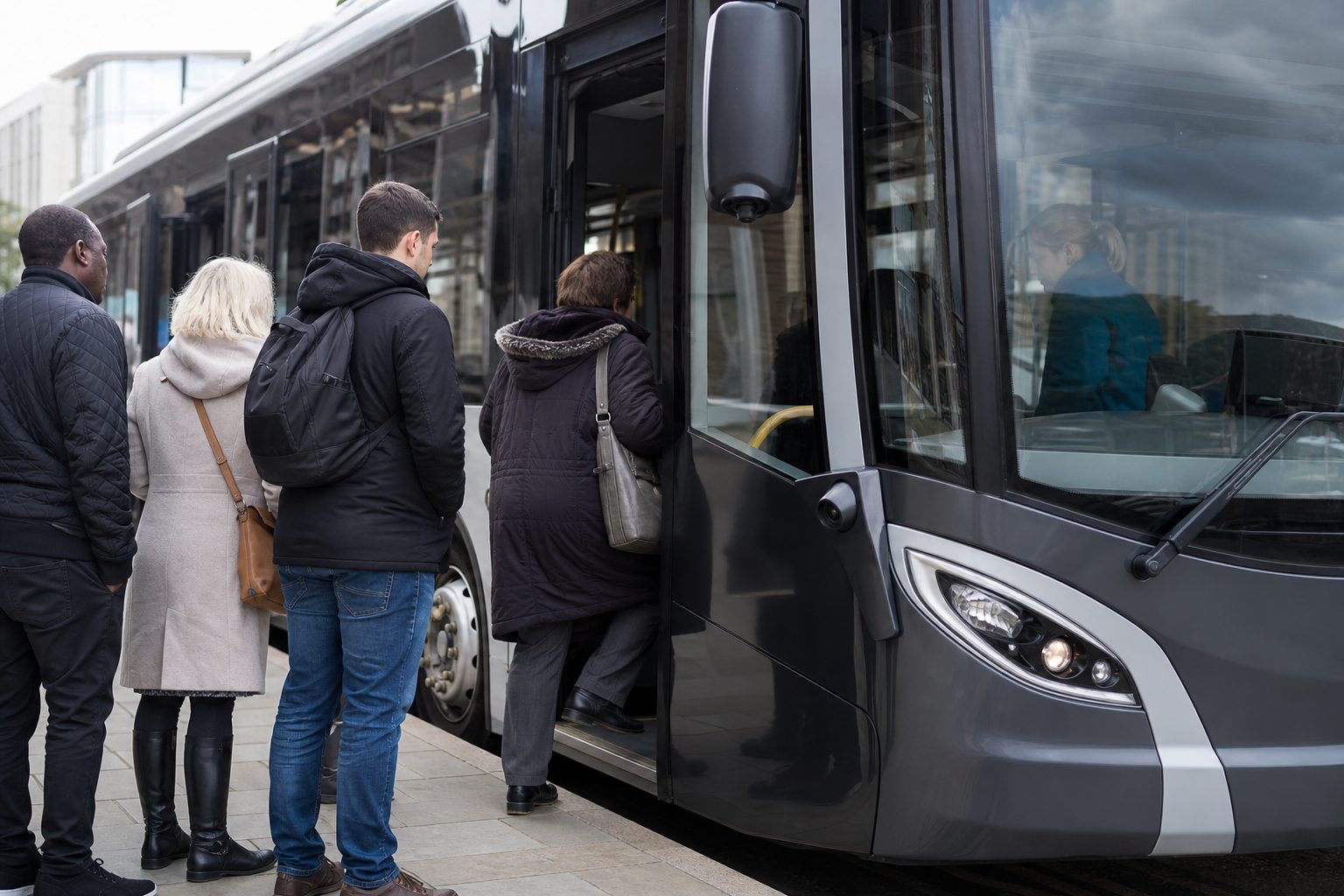
The sensor systems that protect the external road environment on a coach — BSIS for the nearside blind spot, MOIS for moving-off detection — are well-established in the DVS and FORS compliance frameworks that apply to HGVs — passenger vehicles are not in scope of either, though fitting the equivalent systems is good practice. The sensor systems that protect passengers within the vehicle and at the boarding zone are less standardised, less regulated, and equally important: a passenger whose foot is in the doorway when the door closes is not protected by a nearside BSIS sensor designed to detect cyclists.
This guide covers both categories — the external sensor systems that DVS and FORS specify for HGVs (not a requirement for passenger vehicles, but good practice to fit voluntarily), and the passenger-specific sensors that address the hazard zones that compliance frameworks do not yet fully specify.
The DVS Progressive Safe System applies to goods vehicles (HGVs) over 12 tonnes — coaches and buses are not in scope, and there is no requirement for passenger vehicles to fit these systems. The PSS specification is still a sensible template for voluntary fitment, covering three sensor/camera systems:
BSIS (Blind Spot Information System) — UNECE Regulation 151 compliant. A radar or ultrasonic sensor on the nearside covering the left-side blind zone, activated by the left indicator. The sensor detects pedestrians and cyclists alongside the vehicle and generates an in-cab audible and visual alert. For full-size coaches, the sensor detection zone must cover the full vehicle length — a sensor positioned for a 7.5-metre rigid HGV does not cover a 15-metre coach body. Calibration for the vehicle’s actual length and body width is essential.
MOIS (Moving Off Information System) — UNECE Regulation 159 compliant. A front-facing camera with AI person-detection covering the zone ahead of the vehicle before it moves. In bus operations, this sensor is particularly relevant at bus stops where passengers who have just alighted may walk in front of the vehicle as the driver prepares to pull away. The MOIS generates an audible alert that the driver must acknowledge before moving; the alert clears when no person is detected in the forward zone.
Rear proximity sensor — Not specifically mandated by DVS PSS (which focuses on left-side and front-detection), but standard practice — and, for in-scope HGVs over 3.5 tonnes, required under FORS Silver as part of the reversing alarm requirement. A rear radar sensor with audible alert provides automatic detection during reversing manoeuvres in coach parks, service areas, and terminus bays where the reversing zone is less visible than on an open road.
No major compliance framework currently mandates sensors specifically for the passenger door zone on coaches and buses. This is a significant gap, given that the door zone — the area immediately outside and immediately inside the passenger door during boarding and alighting — is the highest-frequency injury location for bus and coach passengers.
Door zone sensors serve two functions:
Door obstruction detection: A sensor mounted in the door frame or adjacent to the door mechanism detects an object (a limb, a bag, a wheelchair) in the door zone as the door closes. If an obstruction is detected, the door halt mechanism is triggered automatically — the door stops closing, or reverses. This sensor is already standard on electric doors on city buses; it is less consistently implemented on manual or semi-automatic doors on touring coaches.
Boarding zone proximity detection: A sensor covering the external kerbside zone beside the passenger door detects whether the boarding area is clear before the driver closes the door and moves off. A passenger who has just alighted and is standing behind the door on the pavement, in the coach’s blind zone, is detectable by a door zone sensor configured for the kerbside proximity area.
Operators who specify door zone sensors alongside door zone cameras create a dual protection system: the camera provides visual confirmation for the driver, and the sensor provides an automatic alert that does not depend on the driver watching the monitor at the moment the door closes.
For bus operators with fixed routes and designated stops, proximity sensor technology can extend beyond the vehicle itself. Pole-mounted sensors at designated bus stops in pedestrianised areas detect passengers standing in the bus zone and can relay this to connected vehicle systems. This is emerging technology rather than current standard practice, but several urban operators have piloted fixed-stop sensor integration as part of smart city transport infrastructure projects.
For coach operators without fixed stops, vehicle-mounted proximity sensors that activate during low-speed approach to a stop — triggered by speed below 10 mph — provide equivalent awareness at temporary stop positions.
The wheelchair ramp deployment zone — the area directly beneath and beside the ramp as it extends — is an operational blind spot for the driver that cameras can show but that sensors can actively monitor. A sensor mounted on the ramp mechanism that detects objects below and beside the deployed ramp provides an automatic halt trigger if a person is in the ramp zone when the ramp is in motion.
This sensor integration is not standardised across PSV manufacturers, and retrofit options vary significantly by vehicle type. The operational principle — that the ramp should not operate if a person is in its deployment zone — is consistent with LOLER’s requirements for lifting operations. The fact that ramp mechanisms on coaches are not yet universally subject to the same sensor requirements as bin lift mechanisms on refuse vehicles represents a regulatory gap that has not yet been closed.
PSV sensor calibration must account for the passenger environment in ways that HGV calibration does not. Door sensors that generate false alerts from passenger bags, wheelchair accessories, or standing passengers leaning against the door frame will be disabled by operators within days of installation. The calibration must distinguish between expected door-zone occupancy during boarding (passengers passing through the door zone in sequence) and unexpected door-zone occupancy that represents a genuine closure hazard (a limb in the closing path).
External sensors on long coaches must be calibrated for the vehicle’s actual dimensions — body width, overhang, and the detection zone appropriate to the operating environment (urban stop with close kerbside clearance versus rural road with wider operating margins). A sensor configured for a standard HGV profile will be miscalibrated on a 2.55-metre-wide touring coach operating in tight urban bus lanes.
MOIS is designed to detect persons in the zone ahead of the vehicle before it moves and alert the driver with an audible warning that persists until the zone is clear. If a person walks in front of the bus and is detected by the MOIS camera, the alert sounds and the driver should not move until the alert clears. This provides a safety layer, but it does not physically prevent the driver from moving — it is an alert system, not a brake override. On advanced systems with automatic brake hold, the vehicle cannot move until the MOIS alert clears.
Door obstruction sensors (sensors that detect an object in the closing path of the door) are standard on electric door systems on city buses supplied new in the UK. They are less consistently implemented on touring coaches and minibuses with manual or semi-automatic door systems. There is no current regulatory requirement for door zone proximity sensors on coaches outside of London bus franchise contracts. Operators running airport transfer, school transport, or accessible transport services with high-risk boarding environments are the most likely early adopters.
A BSIS sensor is calibrated to detect the nearside blind zone alongside the vehicle — the zone where cyclists and pedestrians are present during left turns and at stops. It is activated by the left indicator. A rear proximity sensor covers the reversing zone behind the vehicle and is activated by reverse gear. The detection zones, alert logic, and operating conditions are entirely different — they serve different hazard scenarios and cannot substitute for each other.
No — sensor systems are passive, operating in the background without driver interaction during normal boarding. The only scenario where a sensor system affects boarding speed is if a false alert is triggered during normal operations, causing the driver to pause. Well-calibrated door zone sensors that are configured for the expected occupancy patterns at the vehicle’s passenger door do not generate false alerts during normal boarding sequences.
Yes. BSIS and MOIS alert logs can be exported from the MDVR as event records showing when the system detected a hazard at each location and time. This data contributes to route safety analysis — identifying stops where MOIS alerts are consistently generated, which may indicate that the bus stop design creates pedestrian-forward-zone conflicts — and to regulatory reporting where specific incident investigations require vehicle sensor data.
Download this free checklist to apply the guidance in this article to your fleet.
Tell us what vehicles you run and what you need — we will come back with a recommendation and a price. Prefer to talk? Call 01656 721871.
Related guides: Live View Monitoring for Coach Operators · Monitoring Driver Behaviour in PSV Fleets
4 August 2026
Monday to Friday:
8.30am-5.30pm