
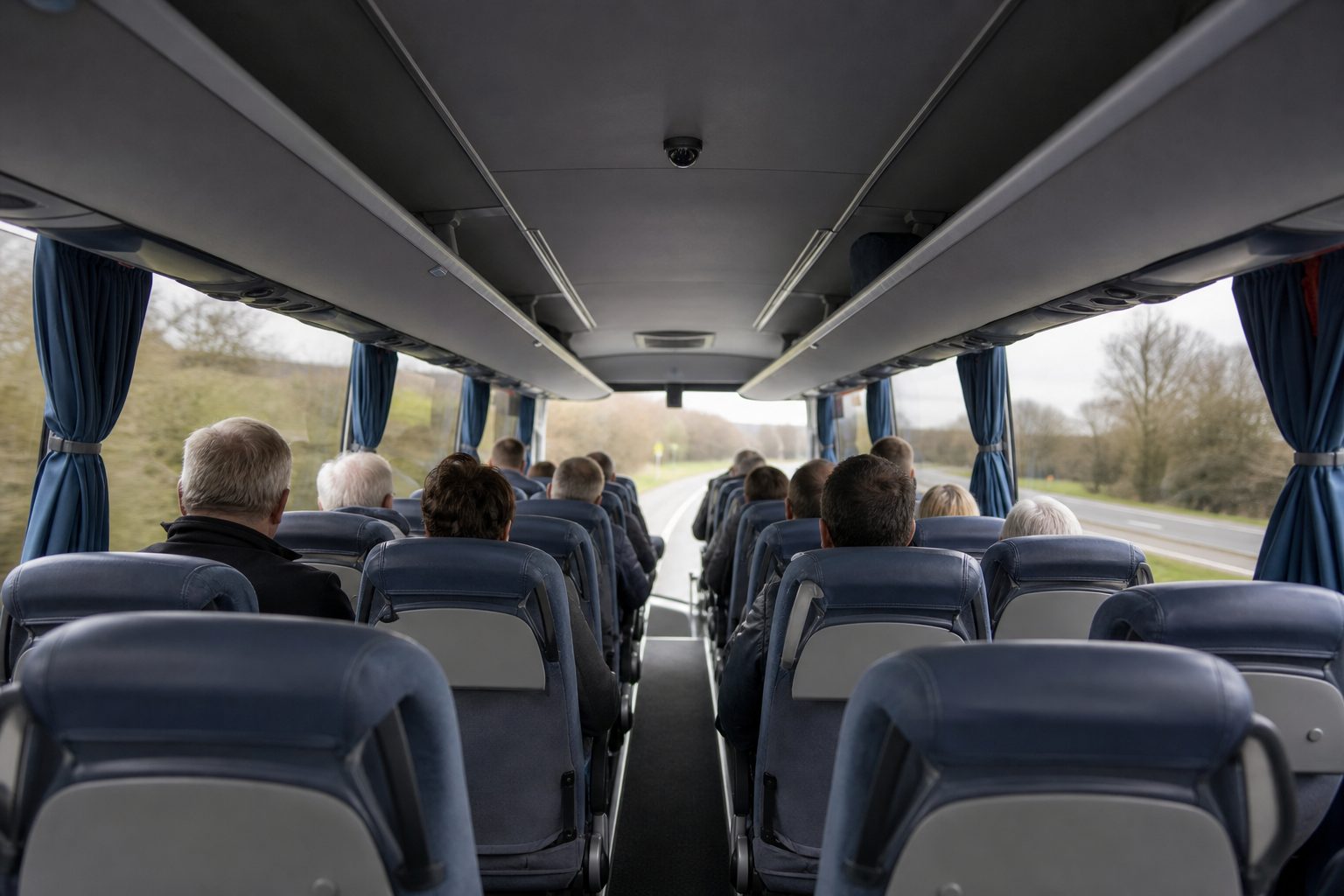
Driver behaviour monitoring in a PSV fleet operates under a set of constraints that other commercial vehicle sectors do not face in the same combination. The driver is a licensed PSV driver subject to DVSA standards; they operate under a tachograph requirement; they carry passengers whose complaints can reach a Traffic Commissioner; and they are monitored by a combination of regulatory inspection, passenger feedback, and camera data that creates a more complex accountability environment than most HGV drivers experience.
Camera-based behaviour monitoring in this context is not just about safety coaching — it is about providing an objective evidence base for a workforce environment where the customer’s account of the driver’s behaviour is routinely weighed against the driver’s account, and where the Traffic Commissioner can revoke an operator’s licence on the basis of a sustained pattern of driver misconduct.
Behaviour monitoring in a PSV fleet uses camera and sensor data to assess four distinct risk categories:
Harsh driving events. Harsh braking, harsh acceleration, and cornering events are recorded by the MDVR‘s g-sensor and linked to footage clips. In a passenger-carrying vehicle, these events have a direct safety consequence — passengers who are standing, boarding, or not securely seated are at injury risk during harsh events. Monitoring harsh events and coaching drivers to reduce their frequency addresses both passenger safety and the operator’s insurance claims record simultaneously.
Distraction and mobile phone use. Driver-facing AI cameras detect phone use, extended gaze-away events, and fatigue signatures. In a PSV context, distraction detection has a regulatory dimension as well as a safety one: a driver using a handheld device while operating a PSV faces a £200 fine and 6 penalty points, and the operator who did not have monitoring in place may face questions from the Traffic Commissioner about their management practices.
Unauthorised stops and route deviations. GPS data combined with camera footage provides fleet managers with objective information about whether drivers are following authorised routes and making authorised stops. In private hire coach operations, route deviation claims from clients are resolved by GPS evidence rather than driver account.
Passenger interactions at stops. Door zone cameras and exterior footage document how the driver manages boarding and alighting — whether doors are closed before the vehicle moves, whether boarding is completed before pulling away from stops. These are the driver behaviour elements most directly connected to passenger injury risk during boarding operations.
PSV drivers operating commercially must comply with tachograph regulations. Tachograph data records driving time, rest periods, and speed history. Camera footage provides the context that tachograph data alone cannot give: what was the driver doing during a recorded stationary period? Why was there a harsh event at a specific time and location?
A fleet manager reviewing a driver’s tachograph record in conjunction with the MDVR event log has a more complete picture of the driver’s day than either data source provides alone. A speed infringement at a specific time and location on the tachograph is either explained or compounded by camera footage showing the road conditions at that moment.
PSV operators are licensed by Traffic Commissioners. A Traffic Commissioner can call an operator to a public inquiry following a pattern of driver conduct issues, complaints from the public or other operators, or adverse DVSA inspection findings. The operator’s ability to demonstrate a systematic driver behaviour monitoring programme — not just hardware installation but regular data review and documented coaching — is the evidence that distinguishes an operator managing their drivers from one allowing misconduct to persist.
Camera and sensor data used in a coaching programme produces documentary evidence: the event records, the coaching conversations, the driver’s response over time. This documentation is the basis on which an operator defends their reputation at a Traffic Commissioner hearing. An operator who has cameras but does not use the data systematically is in a weaker position than one without cameras — they cannot demonstrate the data was unavailable, only that it was ignored.
PSV driver coaching using camera data requires sensitivity to the employment and regulatory environment. A PSV driver is a licensed professional whose licence is their livelihood. A coaching approach that positions the camera data as surveillance generating disciplinary risks will produce resistance, union involvement, and compliance culture degradation.
The approach that works in PSV coaching programmes follows the same principles as effective coaching in other fleet sectors:
Passenger complaints about driver behaviour are a specific evidence challenge in PSV operations. A passenger who alleges the driver was aggressive, distracted, or drove dangerously is making a claim that is hard to investigate without footage. A driver who denies the allegation is in a word-against-word position without footage.
Camera data from the relevant journey — interior footage of the driver-passenger interaction, driver-facing footage of the driver’s behaviour at the relevant time, g-sensor data of the vehicle’s movement — provides the objective evidence base for investigating the complaint. The majority of well-specified complaints can be resolved within hours of receipt if the footage is promptly retrieved and reviewed.
No. Camera monitoring as part of a fleet safety system is a lawful employer requirement, provided the monitoring is disclosed to the driver (through the employment contract or a written policy) and is proportionate to the legitimate business purpose. Refusing to operate a vehicle because it is fitted with cameras is a refusal of a lawful instruction. Drivers who object to specific aspects of monitoring — such as continuous live access to driver-facing cameras — may raise these through the employment relationship, but the existence of camera monitoring itself is not a refusable instruction.
Any harsh event (braking, acceleration, cornering) above the calibrated threshold; any distraction alert from the driver-facing camera; any speed infringement above a defined threshold; any proximity sensor alert that indicates a near-miss; and any passenger complaint. For PSV fleets, a driver with more than a defined number of events in a calendar month should be in a coaching conversation before the event frequency becomes a disciplinary or regulatory issue.
Yes. Traffic Commissioner hearings are regulatory proceedings at which a wide range of evidence can be presented. Camera footage, MDVR event logs, and driver coaching records are all appropriate evidence in a public inquiry into driver conduct or fleet safety management. An operator who can produce systematic monitoring records demonstrating how driver behaviour was identified, addressed, and improved is in a substantially better position than an operator who cannot account for their oversight of driver conduct.
Yes. Driver event data — harsh braking logs, GPS records, driver-facing footage — is personal data under UK GDPR because it relates to identifiable individuals. Drivers have the right to access this data under a Subject Access Request. The fleet operator’s data protection policy should specify the retention period for driver behaviour data, the lawful basis for processing it, and the access controls. Retention beyond the period necessary for operational use (typically 90 days for event data not linked to an active coaching case or incident) is not justified under UK GDPR.
Refusal to cooperate with a coaching programme that uses camera data — attending coaching conversations, engaging with feedback — is a conduct matter that should be managed through the operator’s standard disciplinary process. The coaching programme is a legitimate management activity and refusal to engage is a performance or conduct issue. Legal advice on the appropriate procedure is recommended before initiating disciplinary proceedings related to camera monitoring compliance — this is an area where employment law and data protection law intersect in ways that require careful handling.
Download this free checklist to apply the guidance in this article to your fleet.
Tell us what vehicles you run and what you need — we will come back with a recommendation and a price. Prefer to talk? Call 01656 721871.
Related guides: Sensor Systems for Passenger Safety · Blind Spot Reduction for Large Passenger Vehicles
4 August 2026
Monday to Friday:
8.30am-5.30pm