
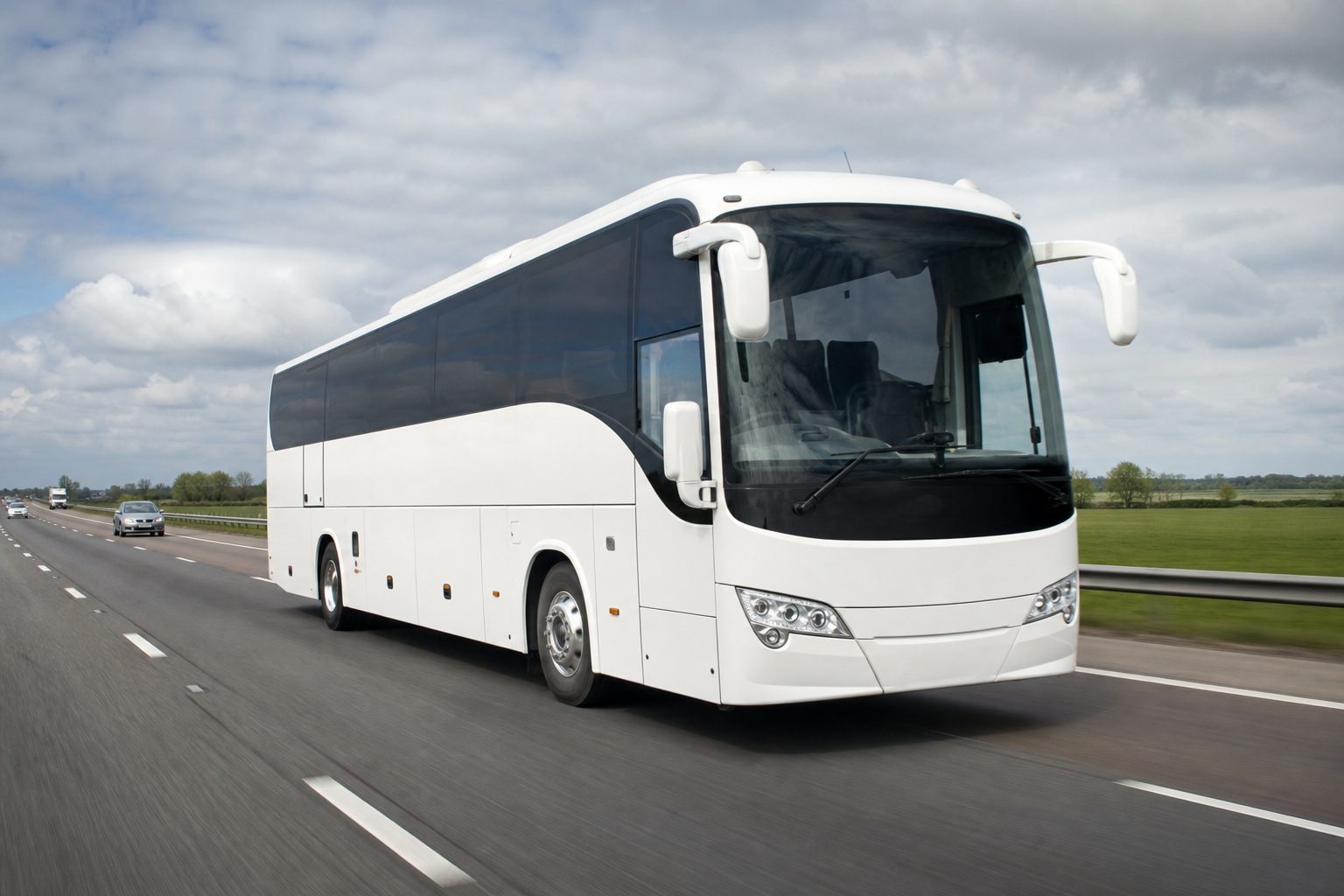
A full-size touring coach has a nearside blind zone that extends 5–8 metres alongside the vehicle — a zone that a cyclist, moped rider, or pedestrian can occupy without being visible in any of the driver’s standard mirrors. The length of the vehicle, the height of the floor line, and the position of the driver’s seat create a geometry that is worse for direct vision than almost any standard HGV body type. The Progressive Safe System specified for London HGVs addresses exactly this geometry — and although DVS and PSS do not apply to passenger vehicles, fitting the equivalent systems voluntarily is good practice for coaches.
Blind spot reduction on large passenger vehicles requires understanding where the blind zones are — and they differ significantly between coaches and double-deck buses — and which sensor and camera technology addresses each zone effectively.
The nearside zone alongside a coach is the highest-priority blind spot from a cyclist and pedestrian fatality perspective. Left-turn incidents at junctions and pull-aways from stops account for the majority of serious cyclist injuries involving coaches and buses. The zone extends from the front axle to beyond the rear of the vehicle — on a 15-metre coach, this is a substantial footprint.
CMS (Camera Monitoring System): A camera on the nearside — typically on the mirror arm — provides a live feed to the in-cab monitor activated by the left indicator. This supplements the Class V and VI mirrors for the nearside zone — the mirrors themselves remain a legal requirement. For a 15-metre coach, a single mirror-arm camera does not cover the full nearside length; a second camera at the rear of the body extends coverage to the full vehicle length. The in-cab display should present both cameras simultaneously in a split view, or switch automatically between them based on indicator engagement phase.
BSIS sensor: The UNECE Regulation 151-compliant nearside sensor covers the left-side blind zone from the front axle to beyond the rear of the vehicle and generates an audible and visual alert when an object is detected simultaneously with left indicator engagement. For a 15-metre coach, sensor field-of-view calibration must cover the full vehicle length — a sensor specified for a 12-metre rigid HGV may need repositioning or supplementary coverage on a longer vehicle.
The combination of CMS (visual awareness) and BSIS (automatic alert) is the DVS PSS specification for this zone on in-scope HGVs — passenger vehicles are not required to fit it, but the same pairing is good practice on coaches. Either component alone provides incomplete protection — the camera without the sensor requires the driver to look at the monitor at the critical moment; the sensor without the camera provides an alert without visual context.
Full-size coaches have a blind zone directly behind the rear panel that is more extensive than on a curtainsider of the same length — the coach body overhangs further, the rear window may be obscured, and the reversing arc in coach parks is often wider than the vehicle’s width. A rear camera with a wide-angle lens (minimum 130° horizontal field of view) mounted at the highest practical point on the rear panel provides the driver with coverage of the immediate reversing zone.
Double-deck buses have an additional blind zone problem: the rear upper deck overhangs the lower body, creating a zone beneath the upper deck overhang that is outside the rear camera’s view angle. On tight turns into bus bays, this zone can contain a pedestrian who is outside the rear camera frame but within the vehicle’s turning arc. A rear camera positioned to cover the lower-body zone and a second camera covering the underside of the upper deck overhang addresses this specific geometry.
The zone directly ahead of a coach’s front bumper — where a person kneeling, sitting, or crouching is below the driver’s windscreen line of sight — is a significant hazard at bus stops and coach bays. Passengers who alight and then walk in front of the coach to cross the road, or who approach the vehicle from the front to ask about the route, are in a zone the driver may not see at all from a seated cab position.
MOIS (Moving Off Information System): A front-facing camera with AI person-detection covers this zone. The alert prevents the driver from moving forward if a person is detected in the zone directly ahead. In bus stop operations, where passengers moving in front of the bus is a routine occurrence, MOIS prevents the category of incident where a driver pulls away before a pedestrian has cleared the front of the vehicle.
MOIS calibration for coaches must exclude the vehicle’s own front profile from the AI detection model. On coaches with front-mounted luggage storage, front-mounted destination displays, or tow bars, the exclusion model requires configuration for the specific vehicle’s front geometry.
The right-hand side of a long coach or bus — particularly on vehicles with a high floor line — creates a blind zone for pedestrians and cyclists who are alongside the vehicle when a right turn is made. This zone is less commonly covered than the nearside (even on in-scope HGVs, there is no DVS PSS requirement for a BSIS on the offside), but the incident record for coaches making right turns in urban environments shows that the offside is not without risk.
An offside camera providing the driver with a view of the right-side zone when the right indicator is engaged extends the same awareness that the nearside CMS provides — and is particularly valuable in countries with right-hand traffic where the offside is the dominant cyclist zone, but also relevant in UK urban environments where right-turning coaches interact with oncoming cyclists in the opposing lane.
The zones above — nearside, rear, front, offside — do not overlap cleanly. Between the front-facing MOIS coverage and the start of the nearside CMS field of view there may be a gap immediately ahead and to the left of the cab that neither system covers fully. On a 15-metre coach with a wide cab position, this gap can be significant.
A 360° surround-view system — using four fisheye cameras stitched into a composite overhead view — covers all zones simultaneously and eliminates coverage gaps by showing the driver a top-down view of the vehicle and its immediate surroundings during low-speed manoeuvres. For coach operations in tight coach parks and terminus bays, this overhead view provides situational awareness that no combination of individual cameras can match.
The nearside blind zone on a full-size 15-metre coach extends from the front axle (approximately 2–3 metres behind the cab) to 1–2 metres beyond the rear of the vehicle — a zone 15–18 metres in length. At road speeds, a cyclist travelling at 15 mph enters this zone and passes through it in under four seconds. A single mirror-arm camera does not cover this full zone; a two-camera nearside system (mirror arm plus rear body) is the correct specification for a vehicle of this length.
Yes. A double-deck bus has an upper deck overhang that creates a blind zone beneath the overhang at the rear of the vehicle. Standard rear cameras cover the lower body zone but do not address the overhang blind spot. Additionally, a double-deck bus requires interior cameras on both decks and a stairwell camera to cover the full passenger environment — the single saloon camera approach used on single-deck vehicles is insufficient for double-deck operations.
No. BSIS sensors are calibrated and positioned specifically for the nearside blind zone — the zone alongside the vehicle where cyclists and pedestrians are present during left turns. MOIS systems cover the front zone during moving-off. The two systems detect different hazards in different geometric zones and cannot substitute for each other. Both are required under DVS PSS for goods vehicles below 3 stars; coaches and other passenger vehicles are outside DVS PSS scope, so neither is a requirement — fitting both is simply good practice.
Articulated coaches (bendy buses) require sensors that do not generate false alerts from trailer articulation. FORS V7 (effective January 2025) specifically addresses this — sensors on articulated vehicles must be positioned and configured to avoid false activation from trailer swing. For articulated coaches in FORS-accredited operations, pre-V7 sensor configurations should be reviewed against the updated standard.
Left-turn cyclist incidents — where a cyclist is in the nearside zone alongside the coach when the left indicator engages and the coach begins to turn — account for the most serious injury incidents in the HSE and coroner records for coach and bus operations. This is precisely the scenario that CMS and BSIS address. The reduction in KSI rates for London HGV left-turn incidents since DVS enforcement began is partly attributable to the mandatory nearside coverage these systems provide.
Download this free checklist to apply the guidance in this article to your fleet.
Tell us what vehicles you run and what you need — we will come back with a recommendation and a price. Prefer to talk? Call 01656 721871.
Related guides: Monitoring Driver Behaviour in PSV Fleets · Compliance Requirements for Coach and PSV Operators
4 August 2026
Monday to Friday:
8.30am-5.30pm