A fleet manager with forty refuse collection vehicles on the road has no visibility of what is happening on any of them until the vehicle returns to depot — unless the fleet has live view capability. By the time a driver calls in to report a near-miss, the injured party has already been taken to A&E. By the time a missed collection complaint reaches the depot, the vehicle has completed another twelve stops. Live monitoring changes the timeline: it makes what is happening on the round visible while it is still happening, allowing managers to intervene, verify, and respond in real time rather than after the fact.
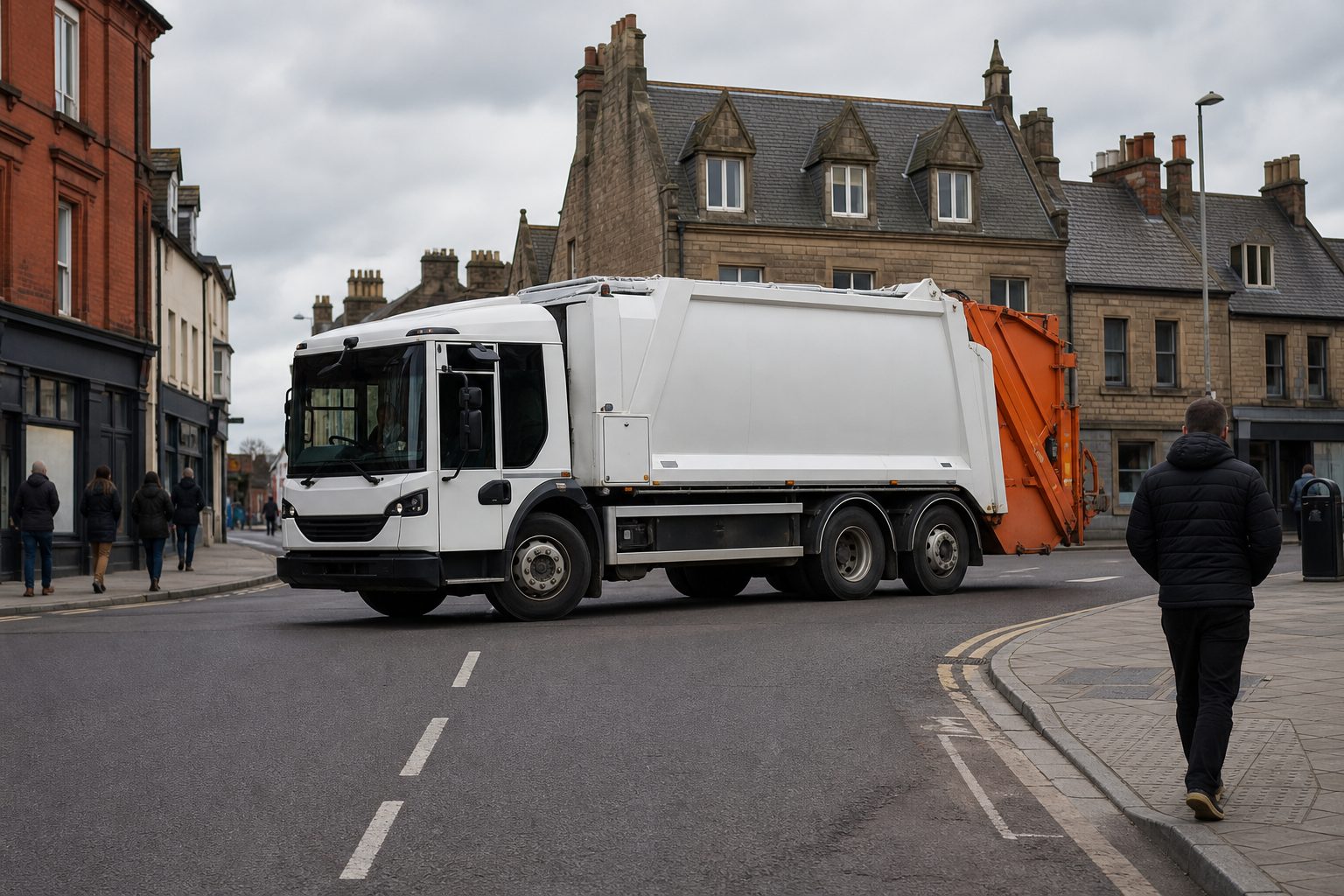
The highest-risk moment in a refuse collection round is not the road transit between stops — it is the thirty seconds when the crew member is on foot alongside the vehicle at each collection point. A rear-loading RCV doing 400 stops per shift creates 400 hazard windows where the loader is outside the cab, in proximity to the vehicle, and in an environment with pedestrians and passing traffic.
Live view gives the monitoring station a real-time view of what is happening at each of those stops. If a proximity sensor alert fires on the rear nearside camera during a bin-lift cycle, the monitoring operator sees the camera feed immediately and can intervene — calling the driver via the in-cab intercom to halt the lift cycle, or alerting the crew member directly. This intervention capability does not exist without live view: recorded footage tells you what happened after the event; live view gives you the window to prevent it.
The same capability applies to crew welfare in conditions where the loading team is working in darkness, rain, or icy conditions. A monitoring operator reviewing the live feed at 5.30am can identify a crew member who has slipped, who is not visible in the expected camera zone, or who is working too close to the compaction mechanism — and alert the driver or contact emergency services before the situation escalates.
When a g-sensor event fires on a waste vehicle — an impact, a sudden braking event, or a collision — the MDVR automatically flags and saves the relevant footage. With live view enabled, the monitoring station can access the camera feed within seconds of the alert and establish what happened while the vehicle is still at the scene.
A question that comes up consistently among waste fleet managers implementing live view is whether remote incident assessment is reliable enough to inform immediate decisions — dispatching another vehicle, contacting emergency services, or instructing the driver to wait for a police response. The answer depends on camera coverage and connectivity, but for fleets with four-camera coverage and reliable 4G signal, a monitoring operator can typically review the footage, confirm whether there has been an injury or third-party contact, and make an informed call within two to three minutes of the alert firing.
For fleets operating on rural collection routes where mobile signal is intermittent, live view is supplemented by the MDVR’s local event storage — the footage is cached and transmitted when connectivity is restored. The live view capability remains useful in these environments for in-cab communication and for the majority of urban stops where signal is consistent.
Missed collection complaints are one of the most operationally costly issues for local authority waste contractors. The standard resolution process — driver statement, supervisor callback, route check — takes time and often produces an inconclusive outcome when the accounts of what happened differ. Live view with GPS integration resolves these disputes differently: the monitoring station can review camera footage from the specific stop at the time of the alleged missed collection, see whether the vehicle stopped and the crew dismounted, and confirm or refute the complaint within minutes.
Fleets operating under local authority contracts use the term “positive service verification” for this function. Live view adds a real-time dimension to service verification that recorded footage alone does not provide: a monitoring operator can confirm, while the vehicle is still on route, that a disputed collection point was visited and serviced. Where a complaint comes in during the afternoon and the vehicle is still completing its round, the operator can instruct the driver to return to the disputed address on the same shift — avoiding the operational and reputational cost of a return visit the following day.
Standard live view alert configurations, designed around logistics or HGV delivery operations, do not translate well to waste collection. A refuse vehicle making 400 collection stops per shift generates a high volume of low-speed g-sensor events from bin-lift compaction cycles, kerb strikes, and vehicle movement on uneven residential surfaces. Applying the same alert thresholds that trigger on a motorway HGV will produce alert fatigue — monitoring operators who receive hundreds of low-significance alerts per vehicle per shift will miss the genuine incidents within the noise.
The appropriate configuration for a waste fleet applies tiered alert thresholds:
Calibrating these thresholds correctly in the first four weeks of live view deployment is the difference between a system that enhances management capability and one that is ignored because it generates too much noise. Waste fleet live view deployments that skip this calibration phase consistently report lower monitoring engagement than those that configure thresholds for the specific vehicle type and operational pattern.
Many refuse collection contracts include contractual requirements for operational transparency — the local authority client wants to be able to confirm that collection rounds are being completed to schedule, that vehicles are where the route plan says they should be, and that incidents are being managed appropriately. Live view platforms with client-facing portal access give local authority contract managers this visibility without requiring a monitoring team on the contractor’s side to relay information manually.
A portal that shows the real-time position of each vehicle, the collection stops completed versus planned, and any flagged incidents provides the contract manager with the information they need to respond to public enquiries and manage service exceptions — without requiring a phone call to the contractor’s operations desk. For waste fleet operators managing multiple local authority contracts, this transparency is a commercial differentiator: demonstrating that service delivery is visible and verifiable in real time addresses one of the most common concerns raised at contract renewal discussions.
Recorded footage tells you what happened after the event. Live view allows intervention before or during — halting a bin-lift cycle when a person is detected, dispatching support to an incident mid-shift, or confirming a missed collection complaint while the vehicle is still on route. For waste fleets, where the highest-risk events happen at individual collection stops throughout a nine-hour shift, the ability to monitor and respond in real time is operationally distinct from post-shift review.
A well-configured live view platform with tiered alerts allows one operator to oversee twelve to twenty active waste vehicles. The alert system does the filtering — the operator responds to flagged events rather than watching continuous feeds. Smaller fleets can often integrate waste vehicle oversight into a wider monitoring function alongside other vehicle types.
Live streaming requires consistent 4G connectivity. In rural areas, live view is available during periods of connectivity and supplemented by local MDVR event storage during blackout periods. Most waste collection routes include enough urban coverage for live view to function across the majority of each shift. Where rural sections interrupt connectivity, the MDVR stores footage locally and transmits on reconnection.
Yes, where the contract requires it and the live view platform supports role-based portal access. Client-facing portals typically provide read-only access to vehicle position, route progress, and flagged incident footage rather than full live streaming of all cameras. Access permissions, data retention settings, and footage use are governed by the fleet operator’s camera policy and any data-sharing provisions in the contract. The appropriate disclosure scope should be defined in the contract rather than left to ad hoc sharing.
Yes. Drivers must be informed that live view monitoring is in operation, what footage is accessed and under what circumstances, and how the footage is used and retained. This information should be included in the fleet camera policy and provided to drivers before monitoring begins. Live view does not change the legal basis for in-cab monitoring — GDPR legitimate interests applies where the processing is proportionate and drivers are informed — but it does mean that the circumstances under which remote operators can access live feeds should be clearly documented. Accessing live footage speculatively rather than in response to a flagged event requires specific justification in the policy.
A printable checklist covering system and connectivity checks, alert threshold configuration for refuse vehicles, camera coverage, use case protocols, driver notification, and monitoring station readiness.
Tell us what vehicles you run and what you need — we will come back with a recommendation and a price. Prefer to talk? Call 01656 721871.
Related guides: Best Camera Setup for Refuse Trucks · Common Waste Vehicle Incidents and How Cameras Prevent Them
4 August 2026
Monday to Friday:
8.30am-5.30pm