
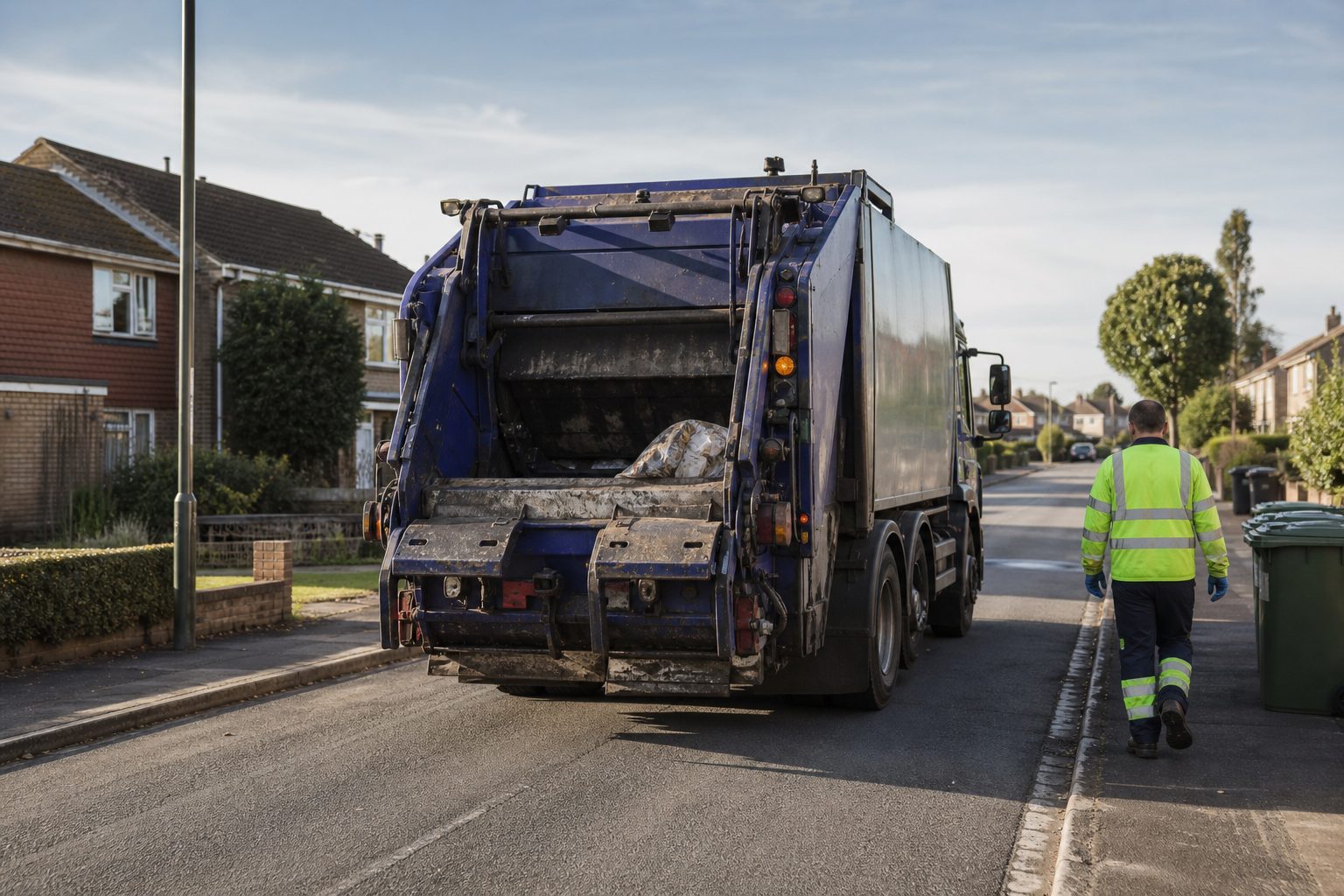
The waste and recycling sector has a combined fatal and serious injury rate more than four times the average across all UK industries. That figure is not produced by unusual or unforeseeable events — it reflects a structural operating environment where heavy vehicles and people on foot are in constant proximity, on every shift, on every collection round. The incidents that drive that statistic are not random. They cluster around a small number of identifiable scenarios, and camera systems address each of those scenarios directly.
Reversing is the most dangerous manoeuvre in waste vehicle operations. The HSE identifies it specifically as the primary reversing hazard for refuse fleets — and the frequency is the key variable that makes refuse vehicles different from other HGV types. A logistics HGV may reverse once or twice per delivery run into a defined bay. A refuse collection vehicle may reverse thirty to forty times per shift into residential streets, cul-de-sacs, and shared drives — each one a different geometry, with different pedestrian density, different sightline restrictions from parked vehicles, and different surface conditions.
A rear-facing camera triggered by reverse gear engagement provides the driver with a real-time view of the reversing zone that mirrors cannot replicate at close range and low speed. Integrated proximity sensors overlay distance alerts directly on the camera image, giving the driver an audible and visual warning as the distance to the nearest object decreases. For fleets that have fitted rear-facing cameras with sensor integration, the reversing contact rate falls significantly — the driver has information they previously lacked about the exact geometry of the space behind the vehicle.
Near-miss footage from reversing incidents is also the most effective training material available for waste fleet coaching. A clip showing a pedestrian stepping into the reversing path on the same residential street where a new driver will be operating is more instructive than any generic reversing briefing.
The second major incident category involves crew members on foot alongside the vehicle during kerbside collection. Loaders dismount, walk alongside the nearside of the vehicle to collect bins, cross behind the vehicle to access both sides of the street, and reboard — a sequence that happens hundreds of times per shift. Each dismount creates a window where the crew member is in a zone that the driver cannot see from the cab, and where the vehicle may move.
A nearside kerb-level camera, mounted at the rear nearside corner of the vehicle and angled downward, covers the ground-level zone where the loader’s feet and legs are visible during collection. This camera addresses the specific blind spot created by the vehicle’s body geometry at close range — a zone that standard wing mirrors cannot resolve. It is the most operationally specific camera position on a refuse vehicle, and the most commonly absent on camera systems fitted to a generic logistics HGV specification.
A question that comes up consistently when waste fleet operators review their incident records is whether crew contact incidents are concentrated at particular collection points — narrow residential streets with parked vehicles on both sides, or specific road types where loaders regularly cross traffic lanes to collect from both sides. The nearside camera footage makes this analysis possible: it creates a spatial record of where crew-vehicle proximity events are occurring, allowing route risk briefings to be targeted at the locations where the pattern shows.
The bin-lifting mechanism creates a hazard category that does not exist for other commercial vehicle types. During a rear-loader collection, the bin travels upward on the lift mechanism to the hopper aperture — a movement that generates a crush zone at the rear of the vehicle. A loader who is still positioning a bin when the lift cycle activates, or who is standing in the travel path, is at risk of crush injury.
A hopper camera, positioned to show the lift travel zone, is the camera that addresses this risk. On AI-integrated systems, the camera feeds detection software that identifies personnel in the hazard zone before the lift cycle activates and halts the mechanism automatically. For fleets operating fully automated side-loaders — where there is no crew member physically operating the collection arm — this detection-and-halt function is the primary pedestrian protection mechanism during the loading cycle.
The recording requirement for bin-lift incidents is operationally distinct from other camera footage. Where a crush event or near-miss occurs, the footage of the lift cycle, the sensor detection status, and the driver cab at the moment of activation is the primary investigation evidence for HSE inquiries and civil claims. Operators who cannot produce this footage — because the hopper camera was not fitted, or because the footage was not preserved in time — are unable to contest a disputed account of a lift incident on evidence.
Refuse vehicles turn left on residential collection routes more frequently than almost any other HGV type. Each left turn creates a nearside blind spot — the cyclist and pedestrian zone that DVS and FORS compliance frameworks specifically address. When a vulnerable road user is in that zone and the driver turns without adequate visibility, the consequences are severe at the scale of vehicle weight involved.
A forward-facing camera capturing the approach and the junction geometry, combined with a nearside camera showing the left-turn zone, creates a continuous record of the vehicle’s behaviour at each junction. This footage is the primary evidence in collision investigations involving a refuse vehicle turn: it shows the approach speed, the driver’s eye position from a driver-facing camera, and whether the nearside zone was clear at the point of turn. For fleets operating under DVS Progressive Safe System requirements in London, this coverage is a compliance obligation — for other fleets, it is the primary evidence base if a collision at a junction is disputed.
Third-party collision claims where footage shows the refuse vehicle turning correctly and the other party entering the nearside zone from a blind approach are among the most common insurance resolution scenarios for waste fleet operators. Footage that resolves a claim without litigation represents a measurable cost saving against the management time and legal costs of a contested claim.
Camera footage changes incident investigations in two specific ways. First, it removes the gap between what each party says happened and what the footage shows. Disputed accounts of vehicle-pedestrian incidents are often unresolvable without footage — footage makes the sequence of events objective.
Second, it creates the documentation trail that HSE investigations and Traffic Commissioner reviews require. An operator who can show that they had camera systems covering the relevant hazard zones, that the footage was reviewed after the incident, and that a corrective action was documented — whether coaching, route risk reassessment, or system adjustment — is in a significantly different position than an operator who cannot demonstrate active safety management.
Footage must be preserved immediately when an incident is reported — standard MDVR overwrite cycles of 24-72 hours mean that the relevant shift footage, sensor alert logs, and driver-facing footage cannot be recovered once overwritten.
Reversing is identified by the HSE as the primary hazard in waste vehicle operations. Crew-on-foot incidents at kerbside collection points are the most frequent source of serious crew injuries. Bin-lift mechanism incidents produce a distinct crush injury category. The combination of all three — plus road traffic collisions at junctions — accounts for the majority of the sector’s serious incident rate, which is more than four times the UK average across all industries.
Both. Cameras prevent incidents through the behaviour change that results from drivers and crews knowing the record is complete — fleets that implement footage-based coaching typically report a marked drop in event rates within the first few months. Camera systems with integrated proximity sensors and AI detection actively intervene — halting bin-lift cycles when personnel are detected, alerting drivers to objects in the reversing zone in real time. The footage function provides the post-incident evidence record; the sensor integration provides the active prevention capability.
The nearside kerb-level camera — positioned at the rear nearside corner, angled to show the ground zone alongside the hopper — addresses the crew-on-foot incident scenario that produces the most serious crew injuries in refuse operations. This position is the most operationally specific camera on a refuse vehicle and the one most frequently absent on generic HGV camera configurations. It covers the zone that mirrors cannot resolve at close range and where crew members are most exposed during collection stops.
Preserve all footage from the relevant shift: event clip, bin-lift cycle footage if a loading mechanism was involved, sensor alert logs, and driver-facing footage for the period. HSE investigations and civil claims routinely request this full set. Standard MDVR retention is a 30–60 day rolling cycle before overwrite — export and preserve the footage promptly after the incident is reported.
Yes. Near-miss recording in the waste sector is recommended by the HSE as a primary tool for identifying hazard patterns before a serious incident occurs. A near-miss is a signal that the conditions for an incident were present — the outcome was only different because of a margin that may not exist next time. Camera footage of a near-miss event, reviewed in a coaching session and used to brief other drivers on the same route, is safety management that prevents the next event from having a different outcome.
Covers reversing incident prevention, crew-on-foot safety checks, bin-lift mechanism hazards, junction collision prevention, and post-incident evidence preservation.
Tell us what vehicles you run and what you need — we will come back with a recommendation and a price. Prefer to talk? Call 01656 721871.
Related guides: Live Monitoring for Waste Collection Fleets: Live View Use Cases · Sensor Placement for Waste Collection
4 August 2026
Monday to Friday:
8.30am-5.30pm