
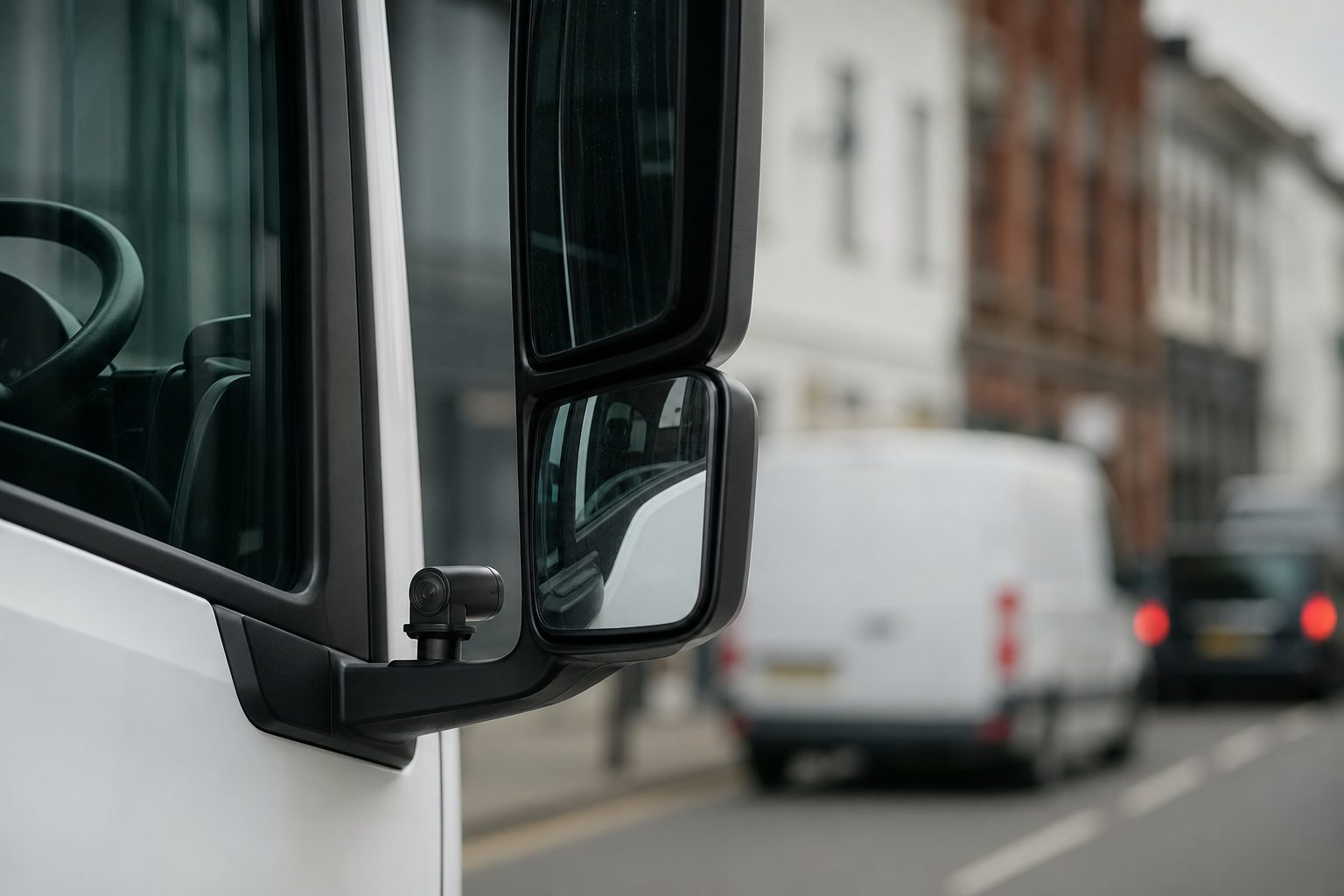
Every year, the HSE is notified of fatal incidents involving pedestrians struck by refuse collection vehicles. The risk profile is distinct from general urban freight: waste collection fleets operate with workers on foot alongside moving vehicles, reversing at high frequency in residential streets, and working in low-light conditions during early and late shifts. The compliance framework that applies to waste collection fleets covers the same statutory requirements as other commercial vehicle operations — but the operational context creates specific equipment challenges that standard HGV sensor and camera packages do not automatically resolve.
Waste collection fleets are not subject to a separate regulatory regime. The statutory obligations are the same as for any employer operating heavy vehicles:
The HSE’s guidance on waste transport makes clear that fatalities in this sector occur in specific, predictable scenarios that are not common in general freight:
Waste collection vehicles above 3.5 tonnes that are FORS-accredited or operating under contracts that require FORS Silver must meet the same camera and sensor requirements as other HGVs at that weight:
Waste collection vehicles operating in Greater London above 12 tonnes GVW must comply with the Direct Vision Standard. Most large rigid refuse collection vehicles will require the DVS Progressive Safe System — BSIS, MOIS, Camera Monitoring System, and audible left-turn warning — if the vehicle is rated zero, one, or two stars.
The most significant camera and sensor specification challenge specific to refuse vehicles is false alarm generation from the bin-lift mechanism. When a bin is being tipped, the lift arm enters the rear proximity sensor’s detection zone. If the sensor is not correctly configured for this, the driver receives a constant stop-zone alarm throughout every collection — and a driver who hears 200 false alarms per shift will have learned to ignore the alarm by the end of week one.
The solutions used in practice:
Refuse vehicle fleet managers who have fitted standard HGV sensor kits and found drivers disabling the system within weeks have almost always encountered the bin-lift false alarm problem without a solution in place. The sensor system is correct in principle but incorrectly specified for this application.
Beyond the FORS and DVS minimum camera positions, refuse collection vehicles have a case for additional camera coverage driven by the crew-on-foot risk:
HSE guidance on waste transport sets a specific hierarchy for reversing risk control: eliminate reversing where possible, and where it cannot be eliminated, use reversing aids rather than reversing assistants (banks-men). The use of a trained reversing assistant as the primary control is explicitly listed as a last resort, not a first option. Reversing aids — camera systems, proximity sensors, and reversing alarms — are the preferred technical control.
This has a practical implication for camera and sensor specification: a refuse vehicle that regularly reverses into collection alleys or communal bin stores should be treated as a higher-priority vehicle for rear camera and rear sensor fitment, regardless of whether FORS or DVS compliance triggers the requirement. The HSE’s guidance on waste transport provides the risk-based justification for fitment beyond the minimum compliance requirement.
Yes. DVS applies to all HGVs over 12 tonnes operating in Greater London regardless of operator type — local authorities, contract waste operators, and in-house fleet operations are all within scope. FORS is a voluntary scheme, so local authority fleets are only required to comply if they have chosen FORS accreditation or if a contract requires it. However, many local authority framework contracts and waste management procurement specifications reference FORS Silver as a minimum standard for vehicle equipment.
The most reliable approach is a combination of multi-radar positioning (excluding the lift zone from the detection field) and PTO-triggered sensor suppression (pausing the rear sensor alarm when the lift is active). Both require specialist installation by a technician who knows the specific vehicle’s lift geometry and electrical architecture. A standard kit installation without this configuration will generate persistent false alarms during every collection cycle.
Yes. A camera system on a waste collection vehicle that records members of the public in residential streets constitutes processing of personal data where individuals are identifiable from the footage. The operator is the data controller. A legitimate interest basis applies for safety monitoring and evidence for insurance claims. Obligations include: displaying signage notifying the public that CCTV is in operation, retaining footage only for as long as operationally necessary, having a documented retention policy, and being able to respond to subject access requests. A template data protection notice for waste collection vehicle CCTV is available from the ICO.
Risk assessment documentation covering driver, vehicle, and journey risk (required under Management of Health and Safety at Work Regs 1999 for 5+ employees). Vehicle inspection records and walkaround check logs. Maintenance service records. DVSA roadworthiness certificates. Camera and sensor walk test records. Driver training records. Operator licence documentation. Where applicable: FORS audit records, DVS permit documentation, and waste carrier licence registration.
Yes — but the sensor system must be correctly specified and calibrated for the vehicle. A FORS audit will assess whether the nearside proximity sensor is operational and generating appropriate alerts, not whether the sensor uses a specific technology. A system that is correctly configured to detect pedestrians while excluding the bin-lift zone will pass the assessment. A system that generates constant false alarms and has been disabled by the driver will not — and is also not providing any safety benefit.
A printable checklist covering statutory requirements, FORS Silver and DVS equipment, bin-lift sensor configuration, crew safety camera coverage, reversing controls, and documentation obligations for refuse collection vehicle operators.
Tell us what vehicles you run and what you need — we will come back with a recommendation and a price. Prefer to talk? Call 01656 721871.
Related guides: Camera System Requirements for UK HGV Operators · Safety Compliance for Construction Fleets
4 August 2026
Monday to Friday:
8.30am-5.30pm