
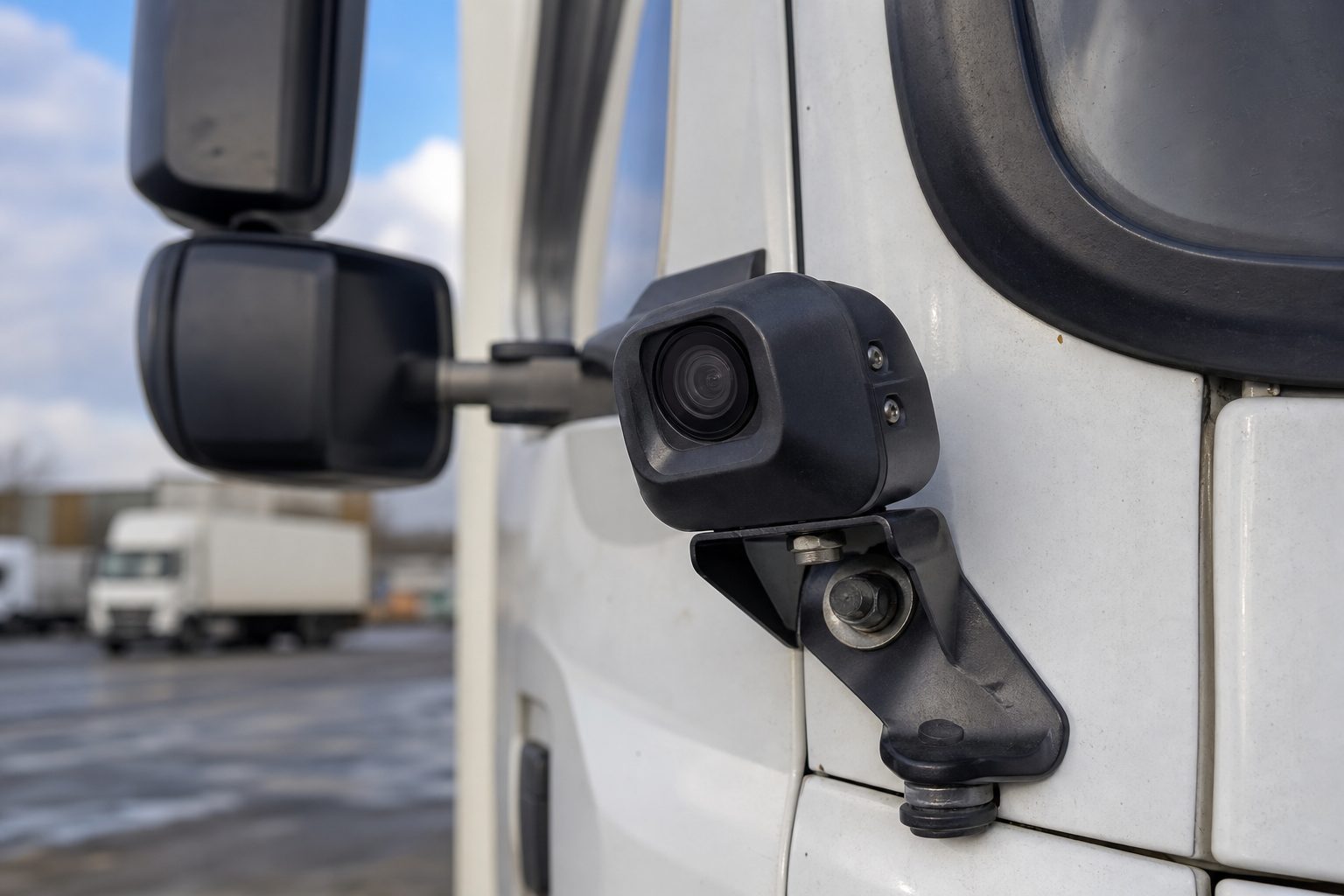
A coach or PSV carries the one thing that changes every decision about safety: other people’s passengers. The moment someone steps on board, your legal duty of care begins — and it does not end until they step off again. Camera placement determines whether your footage actually captures what you need when a claim is made, an incident is disputed, or a near-miss needs investigating.
Coaches also carry blind spots that most HGV drivers would find alarming. The combination of vehicle height, body length, and the high seating floor means that a pedestrian at a coach stop can disappear entirely from the driver’s field of view. Getting camera positions wrong does not just leave gaps in your footage — it leaves gaps in your protection. And in a PSV operation, that gap will eventually cost you.
Getting the best camera placement for coaches and PSV vehicles is something Backwatch works through with operators every week. The questions are almost always the same: where exactly should the cameras go, how many do we actually need, and what are the positions that matter most for our type of operation? This guide answers all three.
Most camera guidance written for commercial vehicles assumes a box-bodied HGV or a Transit-style van. Coaches and single-deck PSVs are a different proposition entirely.
The key differences are structural. Vehicle height on a full-size coach lifts the driver’s eye line above the nearside pedestrian zone — the area directly beside the front axle where cyclists and pedestrians are most at risk at stops and junctions. The passenger doors create a distinct liability zone: more than half of all claims involving PSVs originate from boarding or alighting incidents. The passenger saloon is a commercial space in which vandalism, assault, and injury claims all occur. And on touring coaches, the rear platform carries luggage, which means rear cameras need to cover more ground than a standard reversing view.
Minibuses, single-deck service buses, and long-distance touring coaches each have slightly different camera requirements — more on that later — but all of them share these fundamentals.
Getting coverage right means thinking about the vehicle in zones. Here is where experienced PSV operators position their cameras, and why each position earns its place.
The forward-facing camera is the starting point for any system. Mounted at windscreen height — typically behind the offside sun visor or at the centre of the upper windscreen — it captures the road ahead, approaching junctions, and any contact with other vehicles or pedestrians in the front arc.
For coaches, the field of view is critical. A narrow lens misses the nearside pedestrian zone entirely. A 120° to 140° wide-angle front camera gives coverage from pavement edge to pavement edge — essential at bus stops where pedestrians step out from between stationary vehicles. This is not a place to use a standard dashcam lens.
These are the positions most commonly absent on a first installation, and the most consequential to leave out.
The nearside (left) camera covers the zone immediately alongside the front and centre of the vehicle — the arc that most frequently involves cyclists, pedestrians stepping from the kerb, and vehicles passing at stops. Mount it near the top of the nearside bodywork, angled slightly downward, so the pavement edge comes into frame. The offside (right) camera provides cover when pulling out, overtaking, and when pedestrians cross from the right at junctions.
A question that comes up regularly when operators are reviewing their system coverage: which single camera position resolves the most claims? For PSV operators, the answer is almost always the nearside camera. A boarding incident, a near-miss at a bus stop, a disputed collision alongside — the footage that clears the driver comes from the nearside view more often than anywhere else.
A rear-facing camera covers reversing and the zone behind the vehicle when stationary at stops. On a touring coach, position it high on the rear panel, angled to cover the full vehicle width and as much ground height as possible. It will capture a passenger stepping out from behind the coach on a dark car park — which is a real and recurring scenario in touring operations.
For longer vehicles, two rear cameras are worth considering: one wide-angle for reversing, and one covering the rearmost roof profile for height-restricted access. A coach that clips a low bridge and has no rear roof camera has a problem that footage from the saloon will not solve.
The number of internal cameras depends on vehicle length. A 16-seat minibus typically needs one camera covering the full saloon from above the driver’s cab. A 49-seat touring coach requires at least two — one covering the front half and one covering the rear — to avoid dead zones at the back where incidents go unwitnessed.
Internal saloon cameras are designed for indoor lighting conditions. They operate without infrared, which creates reflections on coach windows. This is a different camera specification from your external positions, and it matters when ordering equipment.
This is the single most overlooked position on coach and PSV installations. The door camera — positioned to cover the entrance step and the area immediately outside — records the moment passengers board and alight.
Boarding and alighting incidents are the leading source of PSV compensation claims. A passenger who trips on the step, misses the grab rail, or claims the door closed prematurely will almost certainly raise a formal complaint. Without door camera footage, that becomes one person’s word against another’s. With it, the incident is typically resolved in days rather than months. Operators who have retrofitted door cameras after a costly claim rarely remove them.
If you operate double-deck coaches or double-deck service buses, the stairwell is a mandatory camera position. Falls on stairs represent a serious and recurring liability, and the stairwell is a classic blind spot for both driver and passengers. Mount the camera at the top of the stairwell, angled to cover both the steps and the foot of the stairs. Transport for London’s standard for double-deck urban buses runs to 17 cameras in total — the stairwell position is always included.
Even fleets with a camera system already installed often have coverage gaps — because the original specification was not designed around PSV-specific liabilities.
The most common errors we see:
Relying on the rear camera for side coverage. A rear camera angled sideways is a compromise, not a solution. If your nearside camera is positioned to cover the rear corner of the vehicle, the zone alongside the front axle — where most PSV incidents occur — is unprotected.
Front camera angle too narrow. A standard dashcam with a 90° lens misses the pavement on both sides. Vehicle cameras for PSV use should have a minimum 120° horizontal field of view. At coaching speeds and vehicle widths, anything less creates a gap in the nearside coverage that a claimant’s solicitor will notice.
No door camera. If your system was installed to satisfy a general fleet insurance requirement rather than designed around PSV-specific liabilities, the door camera is the position most likely to have been skipped. It is also the one most likely to be needed.
Indoor cameras without GDPR compliance. Filming passengers is lawful, but it requires visible signage at the point of entry, a documented data retention policy, and a completed privacy impact assessment. Cameras that are undeclared create legal risk rather than reducing it. Operators who have added cameras incrementally over the years sometimes find they have saloon cameras running without the supporting documentation in place.
As a working guide for UK PSV operators:
16–23 seat minibus: 4–6 cameras — forward-facing, nearside, rear, one saloon camera.
35–49 seat single-deck coach: 6–10 cameras — forward-facing, nearside, offside, rear, door, two saloon cameras.
53-seat double-decker: 12–17 cameras — as above, plus stairwell, upper saloon, and additional rear coverage.
For connected operations — where footage needs to be reviewed remotely or near real-time — all of these positions feed into an MDVR (Mobile Digital Video Recorder) with 4G connectivity. Backwatch MDVR systems support 4–16 camera channels with integrated live view, so the transport manager can review incident footage without waiting for the vehicle to return to depot.
CCTV on coaches is not currently mandated by UK law, but the practical requirements are tightening. FORS Silver accreditation requires documented camera evidence capability. Many local authority school transport contracts specify camera coverage as a condition of award. TfL’s Direct Vision Standard affects coaches operating in London, and camera evidence capability is increasingly included in PSV contract requirements.
GDPR applies to all in-vehicle filming of passengers. The requirements are not burdensome — clear signage at the entrance, a data retention policy (typically 28–31 days for PSV operations), and access controls on footage — but they need to be in place before the vehicle enters service, not added later after a complaint.
There is no blanket statutory requirement, but FORS Silver accreditation and many public sector contracts effectively mandate documented camera coverage. For coaches operating under TfL contracts in London, evidence capability is a practical condition of operation.
Most operators retain footage for 28–31 days. Legal advice for PSV operators commonly recommends a minimum of 31 days to account for delayed claim notification — many passenger injury claims are submitted three to four weeks after the incident.
Yes. Under GDPR, passengers must be informed via visible signage at the vehicle entrance. Drivers must be informed in writing, typically via employment contract or fleet camera policy. The data retention policy and a privacy impact assessment should both be documented and available if requested.
They can. Many commercial vehicle insurers offer a reduction for documented camera systems, particularly where footage is available through connected MDVR or cloud storage. The reduction varies by insurer and fleet profile.
A weatherproof camera rated to at least IP67, with infrared night vision and a minimum 120° horizontal field of view. For coaches operating in exposed or coastal conditions, IP69K weatherproofing is preferable. The camera should also handle the vibration environment of a moving coach — a specification that rules out most consumer-grade dashcams.
A door camera is positioned to capture the entrance step and doorway during boarding and alighting. It is the most direct evidence source for the most common category of PSV claim. If you can only add one additional camera position to your current system, the door is the right choice.
For school transport and regulated contract work, a driver-facing camera is increasingly expected and provides evidence value for incident investigation. For professional touring coach operations, it is a matter of operational policy and driver agreement. Any driver-facing camera must be disclosed in writing and handled according to your privacy impact assessment.
An MDVR consolidates multiple camera feeds onto a single recording unit, typically with 4–16 channels. Connected MDVRs transmit footage to a remote server via 4G, giving fleet managers access to near-real-time footage review without recovering the physical recording device from the vehicle. For PSV operators running multi-vehicle fleets, this significantly reduces the time between an incident and the first footage review.
A printable checklist for PSV operators to verify camera coverage across all key positions before a vehicle enters service.
Tell us what vehicles you run and what you need — we will come back with a recommendation and a price. Prefer to talk? Call 01656 721871.
Related guides: Fatigue Detection Techniques for Fleets · Camera Placement Guide for Waste Collection Vehicles
4 August 2026
Monday to Friday:
8.30am-5.30pm