
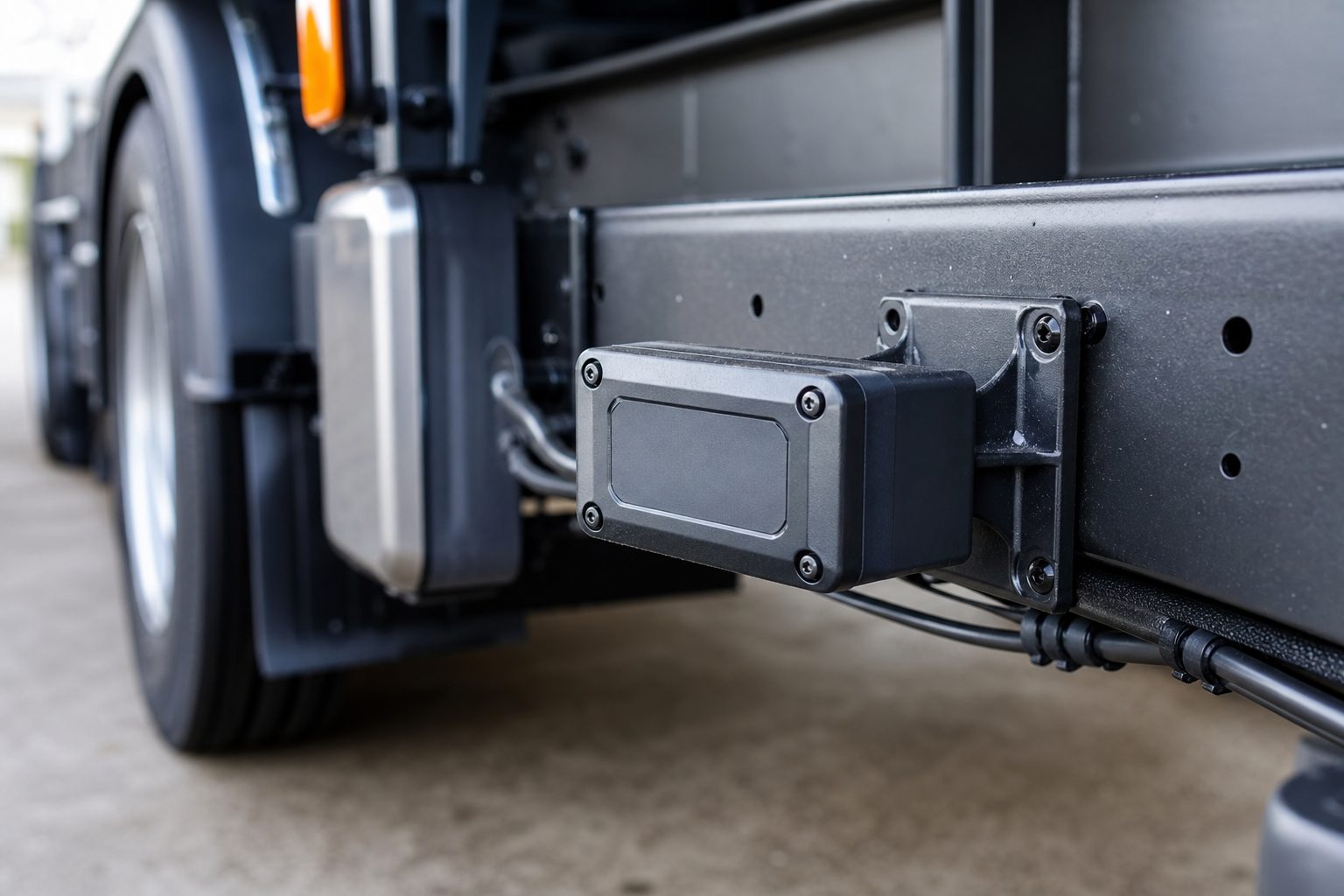
Nearly a quarter of all deaths involving workplace transport occur during reversing. It is one of the most consistent findings in workplace transport safety data, and it has driven the widespread adoption of reversing alarms across commercial vehicle fleets. Yet the legal position on these alarms is frequently misunderstood — operators assume they are mandatory when they are not, or they assume any alarm will do when the choice of alarm type has practical implications for noise complaints, driver situational awareness, and effectiveness in different environments.
This article covers what UK law and HSE guidance actually say about reversing alarms on HGVs, the two main alarm technologies and when each is appropriate, the time restrictions that apply in built-up areas, and how reversing alarms fit into a broader reversing safety setup alongside cameras and proximity sensors.
No — reversing alarms are not a legal requirement on HGVs under UK construction and use regulations. The Road Vehicles (Construction and Use) Regulations 1986 do not mandate the fitting of reversing alarms. Their installation is voluntary.
However, the situation is more nuanced than that in practice. The HSE strongly recommends reversing alarms as part of a layered approach to reversing safety. Employer duties under the Health and Safety at Work Act and the Management of Health and Safety at Work Regulations create an obligation to manage reversing risk — and a decision not to fit a reversing alarm on a vehicle that regularly reverses in pedestrian areas would need to be justified against the foreseeable risk. For most commercial fleets operating in yards, loading areas, or urban delivery environments, fitting reversing alarms is the reasonable control measure.
The regulations are clear on one point: if a reversing alarm is fitted, it must be maintained in working order. A broken alarm on a vehicle where one is clearly expected is a greater liability than having no alarm at all, because it implies the operator knew the risk and failed to maintain their own control measure.
Reversing alarms are permitted on commercial vehicles over 2 tonnes gross weight, large passenger vehicles with nine or more seats, engineering plant, and works trucks. They are not permitted on ordinary cars, where the same frequency tones are reserved for emergency signals.
A commonly overlooked restriction applies specifically to built-up area operation. Where a vehicle is fitted with an audible reversing alarm, that alarm must not be sounded in a built-up area between 11:30 pm and 7:00 am. This restriction exists because the persistent repetitive tone of a traditional reversing alarm becomes a significant noise nuisance in residential areas overnight.
Fleet operators running night deliveries, early morning waste collections, or construction site work with pre-7am starts need to be aware of this restriction. In practice, it creates a need to either disable the alarm temporarily, switch to a different control measure (banksman, camera monitoring, proximity alerts), or use a different alarm type that is better suited to noise-sensitive environments. Operators who run automated pre-7am reversing operations and simply leave tonal alarms active overnight risk noise abatement notices and enforcement action from local authorities.
Understanding the difference between tonal and broadband reversing alarms is one of the most practically useful distinctions in fleet safety equipment specification.
Tonal alarms produce a traditional “beep-beep-beep” sound — a repeating signal at a single frequency or a narrow frequency band. They are the most widely fitted type and the immediately recognisable sound associated with reversing vehicles. Their main advantage is that the tone cuts through background noise effectively, making the alarm audible at a greater distance. Their main disadvantage is the same property: they carry further than needed, penetrate walls, and are significantly more likely to generate noise complaints in residential or noise-sensitive environments. Tonal alarms also make it harder for a bystander to pinpoint the direction the sound is coming from, because single-frequency tones are inherently difficult to localise.
Broadband alarms — sometimes called white noise alarms or White Sound alarms — produce a “pshh-pshh-pshh” sound across a wide range of frequencies simultaneously. The technology was initially developed for overnight construction work at the Olympic Park site in Stratford, London, specifically to reduce the impact on local residents during prolonged nighttime operations. Broadband alarms have three practical advantages over tonal alarms. First, they are significantly easier to localise — a pedestrian or cyclist can determine which direction the sound is coming from because the broadband frequency profile is inherently more directional than a tone. Second, the sound attenuates faster with distance, so it alerts people in the immediate vicinity of the vehicle without carrying into residential areas a street away. Third, broadband alarms are substantially less likely to generate noise complaints and are better suited to operations subject to environmental noise regulations.
The trade-off is that broadband alarms are less audible at long range — which in most reversing contexts is actually appropriate, since a reversing HGV’s danger zone is close to the vehicle, not 50 metres away. They are also slightly more expensive than tonal equivalents. For most fleets operating in urban environments, residential areas, or early-morning delivery schedules, the broadband alarm is the better specification.
A third category worth noting is the self-adjusting or automatic level control alarm, which monitors ambient background noise and adjusts its output volume to remain a consistent level above background. In noisy yard environments, the alarm increases its output to remain audible. In quiet nighttime conditions, it reduces output to avoid excessive noise. Self-adjusting alarms address the fundamental limitation of fixed-output alarms: a level set to be audible on a busy construction site is unnecessarily loud — and unnecessarily intrusive — on a quiet residential street. For fleets that move between very different operating environments, self-adjusting alarms are worth the additional cost.
The HSE’s guidance on reversing safety is explicit that no single control measure is sufficient on its own. The recommended approach is layered, and reversing alarms occupy a specific and limited role within that layered approach.
The hierarchy of controls the HSE recommends starts with eliminating reversing entirely where possible — one-way traffic systems, drive-through loading layouts, and designated reversing zones. Where reversing cannot be eliminated, visual aids and detection systems reduce the driver’s dependence on audible warnings alone. A reversing camera showing the area behind the trailer directly to the driver is more reliable than an audible alarm for preventing contact with objects the driver cannot see. Proximity sensors that alert the driver when an obstacle is within a specific distance add a further layer.
The role of the reversing alarm in this setup is to alert the people outside the vehicle — pedestrians, banksmen, other drivers — that the vehicle is reversing. It is a warning to the environment, not to the driver. Reversing cameras and proximity sensors warn the driver; the alarm warns everyone else. Both functions are necessary, but they address different parties and should not be confused.
Trained banksmen or signallers remain the most reliable control for complex reversing manoeuvres in pedestrian-active environments, particularly on construction sites. Banksmen can respond to dynamic situations that sensors cannot anticipate, communicate directly with the driver, and physically stop people from entering the danger zone. For routine depot and yard reversing, sensors and cameras typically suffice. For high-complexity or high-pedestrian-risk environments, banksmen and technology should be combined.
A reversing alarm that does not sound when the vehicle engages reverse provides no warning. Alarm systems are simple devices, but they fail in predictable ways that routine checking prevents.
The most common failure is vibration loosening the wiring connection between the alarm and the reverse gear signal. Check the connection at the alarm body and at the feed wire junction at each service. The second most common failure is physical damage to the alarm housing — particularly on vehicles that back up to loading bays regularly, where the alarm is positioned on the rear face of the vehicle and takes impacts from impact with dock seals and dock bumpers. Inspect the housing for cracking or deformation at each vehicle check. The third common failure in broadband alarms is moisture ingress through cracked housing — broadband alarm electronics are more complex than tonal alarm buzzers and more susceptible to moisture damage.
The simplest maintenance protocol is also the most reliable: engage reverse on a stationary vehicle as part of the pre-trip check and confirm the alarm sounds. Thirty seconds of driver checking prevents the alarm from being silently non-functional for weeks.
Are reversing alarms a legal requirement on HGVs? No — UK construction and use regulations do not mandate reversing alarms on HGVs. However, employer health and safety duties create a practical obligation to manage reversing risk, and fitting a reversing alarm is the standard reasonable control measure for vehicles that regularly reverse near pedestrians. If you choose not to fit an alarm, the reasoning should be documented against a risk assessment.
What time can reversing alarms not be used in built-up areas? Reversing alarms must not sound in built-up areas between 11:30 pm and 7:00 am. Operators running pre-7am operations — early waste collections, construction site starts, overnight deliveries — need alternative controls for this period, or should switch to broadband alarm types that are less intrusive for residential neighbours.
What is the difference between a tonal and a broadband reversing alarm? Tonal alarms produce a “beep-beep” sound at a fixed frequency. Broadband alarms produce a “pshh-pshh” sound across a wide frequency range. Broadband alarms are easier to locate directionally, attenuate faster with distance (reducing complaints), and are better suited to noise-sensitive environments. Tonal alarms carry further and are more intrusive in residential areas.
Do I need a reversing alarm if I have a reversing camera? Camera systems and reversing alarms serve different functions. Cameras warn the driver about what is behind the vehicle; alarms warn pedestrians and others that the vehicle is reversing. A well-specified reversing system should have both, because each addresses a different hazard pathway.
Can I use a reversing alarm overnight during an early morning delivery? Not in built-up areas between 11:30 pm and 7:00 am. If you operate early morning deliveries in residential areas, consider broadband alarms (less intrusive at distance), banksmen to manage the immediate area, or operational planning to avoid reversing movements in the restricted period.
What decibel level should a reversing alarm be? HSE guidance states the alarm should be “loud and distinct enough that it does not become part of the background noise” in the operating environment. There is no single mandated dB level — the appropriate output depends on ambient noise levels. Self-adjusting alarms address this by automatically calibrating output to the current environment.
What is a self-adjusting reversing alarm? A self-adjusting alarm monitors ambient background noise and adjusts its output to remain consistently audible above that noise level. In noisy environments it increases output; in quiet conditions it reduces it. This prevents the alarm from being either inaudible in noisy sites or excessively loud in quiet residential areas — particularly useful for vehicles operating across varied environments.
Who is responsible for maintaining reversing alarms on a fleet vehicle? Fleet operators are responsible for ensuring that any safety equipment fitted to their vehicles is maintained in working order. If a reversing alarm has been fitted and becomes defective, the operator has a duty to repair it. Drivers should check that the alarm sounds on engaging reverse as part of the pre-trip walk-around.
A five-section checklist covering alarm type selection, legal and time-restriction compliance, camera and sensor integration, installation verification, and routine maintenance — for fleet managers specifying or auditing HGV reversing alarm setups.
Tell us what vehicles you run and what you need — we will come back with a recommendation and a price. Prefer to talk? Call 01656 721871.
Related guides: How Cyclist Safety Systems Protect VRUs (Vulnerable Road Users) · The Best Sensor Placements for Different Vehicle Types
4 August 2026
Monday to Friday:
8.30am-5.30pm