
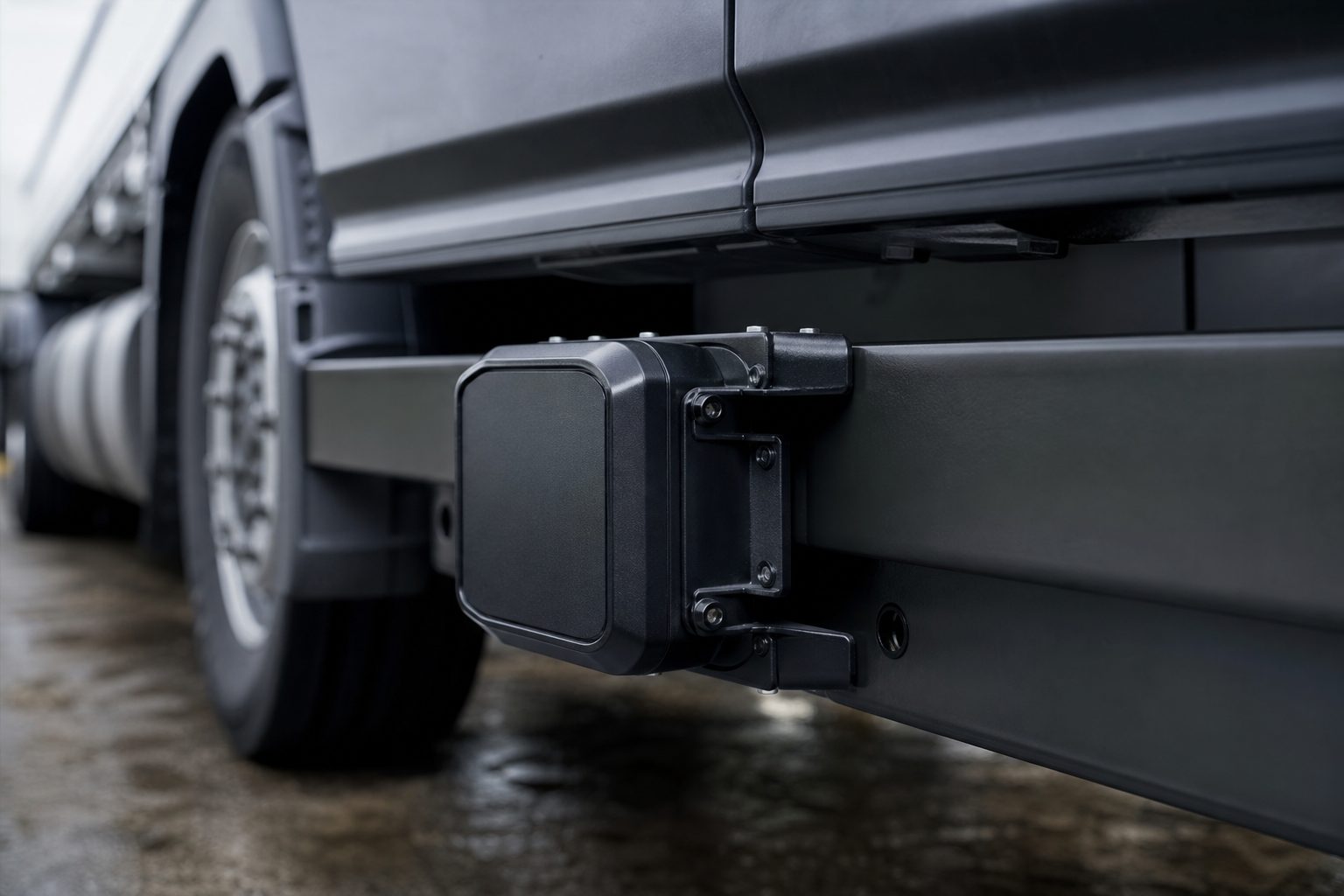
A forklift travelling at 8 mph takes less than 0.4 seconds to cover the two metres in front of it. At that speed, a pedestrian stepping from behind a racking bay has no time to move and the operator has no time to stop. Proximity detection systems exist specifically to extend that warning window — detecting a person in the path of the vehicle before the operator can see them, and alerting both sides of the hazard before the gap closes. This guide covers the four main technology types, how each works in a warehouse environment, and which UK regulations apply to forklift proximity detection.
Road vehicles are dangerous to pedestrians primarily at road crossings and construction sites. Forklifts are dangerous to pedestrians in the spaces where those pedestrians work every day — loading bays, warehouse aisles, production floors, and distribution centres. The hazard is constant and close-quarters. Unlike a road vehicle interaction, there is often no dedicated separation: pedestrians and forklifts share the same aisle, the same turning radius, and the same blind corners.
Standard proximity sensors fitted to road vehicles — rear ultrasonic sensors, nearside cameras — are designed for low-speed reversing scenarios where the driver has some awareness of what is around them. Forklift proximity detection systems operate on a different premise: the pedestrian may be completely out of the operator’s sightline, may be obscured by load or racking, and the forklift may be travelling forward, not reversing. Detection must work in all directions and must alert both the operator and the pedestrian.
Forklifts and other powered industrial trucks operating on UK sites are covered by three overlapping pieces of legislation:
None of these regulations mandate a specific technology. The framework is performance-based: reduce the risk to as low as reasonably practicable using the most suitable controls available. What constitutes “suitable” is where the technology choice matters.
Tag-based systems require pedestrians to carry or wear a tag — typically embedded in a wristband or clipped to a high-vis vest. The forklift carries an antenna that creates a detection zone. When a tag enters that zone, the system alerts the operator (in-cab audible and visual alarm) and the tag itself (vibration and buzzer) simultaneously. Detection range is typically up to 10 metres for RFID, with UWB (Ultra-Wideband) systems offering more precise positioning at a higher equipment cost.
The key advantage of tag-based systems is detection through racking, walls, and blind corners — the antenna detects the tag signal regardless of whether there is a direct line of sight. A pedestrian around a corner from the forklift is detected before the operator can see them.
The limitation is compliance dependency. The system only detects tagged pedestrians. A visitor without a tag, a contractor who forgot theirs, or a worker who removed the tag because it was uncomfortable is invisible to the system. This is the most common operational failure point — and the one that comes up most frequently when fleet safety managers review near-miss records after an incident. Tag-based systems require rigorous site entry procedures to remain effective.
Camera-based proximity detection uses computer vision to identify people in the forklift’s field of view. Modern systems use AI-powered human form recognition (HFR) to distinguish pedestrians from racking, pallets, and other equipment, and alert the operator when a person enters the detection zone. Some systems integrate with the forklift’s braking system to automatically reduce speed when a pedestrian is detected.
The advantage of camera systems is that they detect any person, regardless of whether they are wearing a tag. No compliance dependency. A visitor, a delivery driver, or a worker in an adjacent area is detected on their shape, not on a tag signal.
The limitation is environment sensitivity. Dusty, high-reflectivity, or low-light environments degrade image quality and increase false alarm rates. Warehouses with high dust loads, steam cleaning operations, or areas with reflective flooring need careful calibration and may require supplementary lighting. Camera systems also have a line-of-sight limitation — unlike tag-based systems, they cannot detect a person hidden by racking until the person is already partially visible from the camera angle.
Ultrasonic proximity sensors on forklifts operate on the same principle as road vehicle sensors — emitting a sound pulse and measuring the return time. They are the most established technology category and are well suited to slow-speed reversing scenarios in loading bays and dock areas.
Ultrasonic sensors on forklifts are effective for rear coverage during reversing but have limited applicability as a standalone pedestrian detection solution. They detect mass and distance — they do not distinguish between a pedestrian and a pallet stack. In a busy warehouse, ultrasonic sensors generate a high false alert rate from normal operations, which leads operators to ignore or disable the system. The nuisance alarm problem is the single most damaging failure mode for proximity systems: a system that drivers treat as background noise provides no safety benefit.
Ultrasonic sensors remain useful as a supplementary layer — particularly for rear-of-vehicle coverage during reversing — combined with a primary pedestrian detection system that addresses forward and side blind spots more intelligently.
Radar sensors offer extended detection range and work reliably in adverse conditions — dust, steam, heavy rain — where camera and ultrasonic performance degrades. They detect movement rather than shape, which makes them effective at identifying people moving into detection zones but less reliable for detecting stationary pedestrians in the path of a moving forklift.
Radar systems are used primarily in outdoor forklift applications — yard operations, container handling, and logistics centres where vehicles operate over longer distances and in weather conditions that would compromise other detection technologies. For indoor warehouse use, the combination of camera or tag-based detection with radar as a backup layer covers the main limitations of each.
Beyond pedestrian detection, forklift proximity systems can operate in three modes:
Most warehouses begin with V2P because the pedestrian collision risk is the primary concern. V2I is the correct tool for fixed hazard points — a mezzanine lift shaft, a dock door, or a blind intersection that cannot be redesigned. V2V becomes relevant as forklift fleet size increases and vehicle-to-vehicle proximity becomes a secondary incident driver.
A question that safety managers consistently raise when evaluating proximity detection systems is: what happens with the data? Modern systems — particularly those with telematics integration — log every detection event: which vehicle, which zone, at what time, at which GPS or site coordinate. This creates a near-miss record that does not depend on anyone reporting the event.
This data has three practical uses. First, identifying repeat hazard locations — if the same intersection generates detection events twice per day, the site layout is the problem, not individual operator behaviour. Second, evidence for regulatory compliance — if an incident does occur, the system log shows the history of near-misses that preceded it and what actions were taken. Third, measuring the effectiveness of safety interventions — if a site change or training programme was intended to reduce pedestrian-vehicle proximity events, the detection log tells you whether it worked.
The technology choice should follow the operational environment:
PUWER does not mandate a specific technology. It requires that work equipment be suitable for its purpose and that known risks are controlled. For forklifts operating in areas where pedestrians are present, HSE guidance and workplace transport regulations expect that proximity risks are assessed and controls implemented. In 2024, proximity detection systems are sufficiently established that not fitting them in high-risk pedestrian environments is increasingly difficult to justify under a “reasonably practicable” assessment.
Tag-based V2P systems typically detect within 10 metres. V2V systems can detect at up to 50 metres. Camera systems depend on lens and lighting — practical pedestrian detection in a warehouse setting is typically 5–15 metres. V2I systems at doorways and intersections are generally configured for 10–50 metres depending on approach speed.
Tag-based systems provide no protection for untagged individuals. This is the system’s primary vulnerability. Camera-based or tagless detection systems (such as retroreflective workwear detection) address this gap. Many sites use tag-based V2P as the primary system and supplement with V2I at fixed hazard points as a backup that does not depend on tag wearing.
Yes — antenna units, in-cab controller modules, and sensors mount externally and connect to the forklift’s electrical system. Retrofitting does not typically require modification to the forklift chassis or drive system. Camera-based systems require a monitor in the operator cab; tag-based systems require only the in-cab controller and roof antenna. Compatibility with specific forklift models should be confirmed with the system supplier before installation.
No — they serve different functions. Road vehicle proximity sensors detect obstacles during manoeuvring at low speed and alert the driver. Forklift proximity detection systems are designed primarily for pedestrian-vehicle collision avoidance in multi-directional pedestrian environments, and they alert both the operator and the pedestrian. The detection ranges, zone configurations, and alert mechanisms are different categories of equipment.
A six-section checklist covering site risk assessment, system type selection, detection zone specification, alert mechanisms, regulatory documentation, and commissioning — for safety managers specifying proximity detection on forklifts.
Tell us what vehicles you run and what you need — we will come back with a recommendation and a price. Prefer to talk? Call 01656 721871.
Related guides: Parking Sensors for Vans and LGVs · Safety Sensors for Quarry and Mining Vehicles
4 August 2026
Monday to Friday:
8.30am-5.30pm