
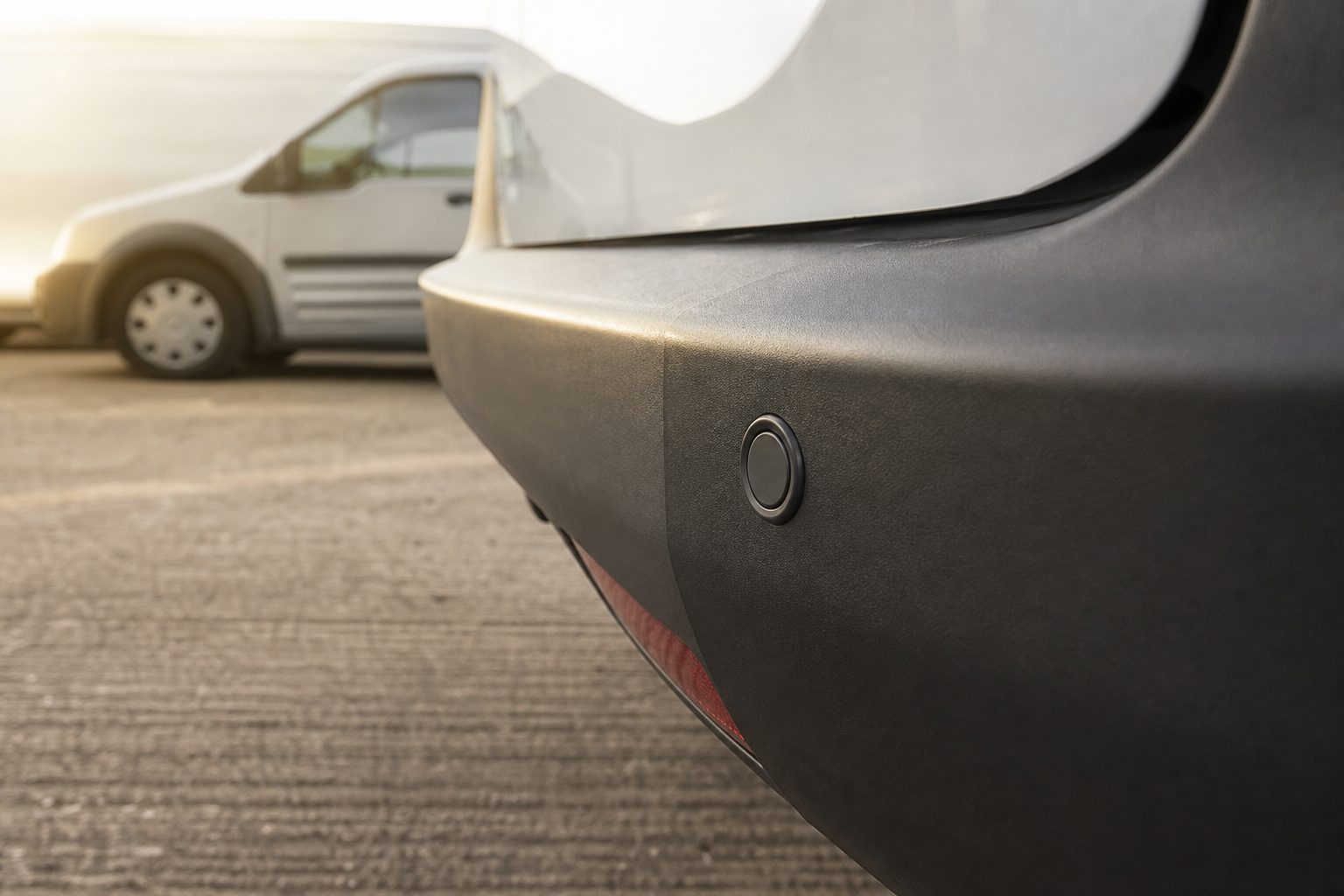
The assumption most fleet managers make about vans is that they are easier to manage than HGVs. Smaller vehicle, shorter blind spot, lower risk. In practice, the rear blind spot on a high-roof panel van is larger relative to driver sightlines than most people expect — and high-roof Sprinters, Crafters, and Transits commonly leave the factory without rear parking sensors at all. The incidents that result are not dramatic. They are minor collisions that add up: a dent in the loading bay, a bollard at a residential delivery address, a pedestrian who stepped back at exactly the wrong moment. This guide covers what aftermarket parking sensors for vans and LGVs actually do, what the fleet-grade options look like, and where FORS requirements apply to lighter vehicles.
Most modern vans offer parking sensors as an optional extra, not a standard feature. For fleets purchasing large volumes, that option is often stripped out to manage acquisition cost. The result is that a significant proportion of working fleet LCVs — Sprinters, Crafters, Transits, Vivaro, Master — are operating without rear sensors despite being large enough that the driver has essentially no direct rearward visibility.
A high-roof panel van sits at around 2.5 metres tall. The rear doors take up the full width of the vehicle. When reversing, the driver is relying entirely on door mirrors — which angle outward rather than directly rearward — or on a reversing camera if one has been fitted. The area immediately behind the vehicle, within the first 1.5 metres, is invisible from the driver’s seat without additional equipment.
Factory sensors, when fitted, are often calibrated for car-park proximity — detecting obstacles at under one metre, triggering a continuous tone, and leaving the driver to work out where the hazard is. Fleet-grade proximity sensor systems are a different category: dual-zone detection from two to three metres, audible alert escalation, and output to a cab display that shows the driver which zone has triggered and at what distance.
Fleet-grade parking sensors for vans are not the same product as consumer aftermarket sensors sold for private cars. The differences matter for commercial use:
The standard rear configuration for a van is four sensors mounted in a horizontal line across the rear face. This covers the full vehicle width, which for a standard Sprinter or Transit is approximately 2.0 metres between the rear door edges.
Sensor height matters more on vans than on HGVs. HGV rear sensors are often set at 1.0–1.2 metres to detect adult pedestrians. On a van, the priority includes children — particularly at residential delivery addresses where children may be present in driveways. Setting rear van sensors at 0.7–0.9 metres achieves reliable detection of adults and children while avoiding false triggering from the ground surface at normal mounting heights.
For long-wheelbase high-roof variants — the vehicles where the rear blind spot is most severe — a four-sensor rear configuration is the minimum. Some operators fit six sensors on longer vehicles, extending coverage into the rear corners where door-width sensors leave gaps at an angle.
Underhung sensor configurations are available for vans where the bumper profile does not allow conventional flush mounting. These mount beneath the bumper line on a dedicated bracket, keeping the sensor face clear of the bumper face and avoiding the false-triggering problem that occurs when sensors are too close to the rear edge of the vehicle’s own bodywork.
Rear sensors address the reversing scenario. Side sensors address the scenario that fleet safety managers worry about more: a cyclist or pedestrian moving alongside the van in a narrow street, or stepping off the kerb at a junction. The van driver cannot see this from the cab. The door mirror shows a strip of pavement; it does not show the pedestrian directly alongside the front corner of the vehicle.
Side proximity sensors for LCVs are typically mounted on the nearside, covering the area from the cab door to the rear of the load area. This zone is the highest-risk area for vehicle-pedestrian contact during urban driving, particularly at left turns and when pulling into or out of loading bays.
A question that comes up consistently from fleet managers running mixed fleets is whether side sensors are necessary on vans if the same vehicles do not carry FORS Silver requirements. The compliance threshold matters — but the operational risk does not disappear because a vehicle is below a weight threshold. Urban delivery vans are the vehicles most frequently operating at pedestrian-level proximity in high-footfall areas. That is the profile that creates risk, regardless of what the FORS standard says about the weight category.
FORS (Fleet Operator Recognition Scheme) covers vehicles over 3.5 tonnes gross vehicle weight. LCVs — including the heavier panel vans, crew vans, and chassis cab derivatives — fall within FORS scope if the operator holds FORS accreditation and the vehicle exceeds 3.5 tonnes.
The equipment requirements for lighter vehicles within FORS are lower than for HGVs. FORS Silver’s nearside proximity sensor mandate applies primarily to HGVs and larger goods vehicles. Lighter vehicles — those at or under 3.5 tonnes — may be assessed under different criteria within the FORS Standard. The specific requirements vary by vehicle weight category and are updated with each version of the FORS Standard.
However, two points are consistently true regardless of which weight band applies:
Operators should check the current FORS Standard for the vehicle weight categories relevant to their fleet. The standard is updated periodically, and the equipment requirements for lighter vehicle categories have moved upward with successive versions.
Wired sensor systems are the preferred option for most fleet installations. The sensor signal is more reliable, the installation is permanent, and the system integrates cleanly with an MDVR or cab display. For fleet vehicles that will carry the same equipment for several years, wired is the right choice.
Wireless sensors have a practical use case for vans that swap bodies or tail-lifts regularly, or where the rear body configuration changes between contracts. In these cases, routing a cable from cab to rear is not viable without significant installation work each time. Wireless units — where the sensor transmits to a cab-mounted receiver — allow the sensor cluster to be moved between bodies without re-cabling. The trade-off is battery dependency on the sensor unit and the possibility of interference in high-RF environments such as urban areas with dense 4G/5G coverage.
For most delivery fleets with fixed bodywork, wireless sensors add complexity without adding benefit. The question to ask when specifying is whether the vehicle body is fixed or interchangeable — that answer drives the wiring approach.
Many fleet LCVs already carry a reversing camera, fitted either at purchase or as a prior safety upgrade. The question for these vehicles is whether the existing camera is sufficient or whether a sensor system needs to be added alongside it.
The camera provides context — it shows the driver what is behind the vehicle. The sensor provides measurement — it detects the distance to the nearest object and alerts the driver even when they are not watching the display. These are complementary functions, not alternatives. A driver reversing into a tight loading bay while watching the route plan on a tablet is not watching the reversing camera. The sensor alarm is what catches their attention.
In a well-configured van installation, the sensor system triggers automatically when reverse gear is engaged, and if an MDVR is fitted, the cab display switches to the reversing camera view at the same moment. The driver hears the alert and sees the image simultaneously. That integration requires the sensor controller and the MDVR to be wired together — it is a configuration step during installation, not a hardware upgrade.
There is no blanket statutory requirement for parking sensors on delivery vans below 12 tonnes. DVS applies to HGVs over 12 tonnes in Greater London; FORS applies if your operator holds accreditation. However, the Health and Safety at Work Act and the duty of care for employee and pedestrian safety mean that operating without adequate reversing aids on a van with significant rear blind spots creates an employer liability risk — particularly if an incident occurs on the vehicle’s blind side.
Fleet-grade van sensor systems typically use dual-zone detection: a caution zone from 1.5–3 metres (intermittent alert) and a stop zone from 0–1.5 metres (continuous alarm). The specific thresholds are adjustable through the controller software during installation calibration.
Yes — commercial-grade rubber sensors are designed for metal bumpers and frames specifically. Plastic consumer sensors vibrate against metal surfaces and generate nuisance alarms. Rubber sensors absorb chassis vibration without false-triggering and are the correct choice for any van with a metal rear structure.
Four sensors across the rear face is the standard configuration for a Transit, Sprinter, Crafter, or similar-size panel van. This provides full-width coverage from corner to corner. Long-wheelbase variants may benefit from six sensors to cover the rear corners at an angle, but four is sufficient for the straight-back reversing scenario.
Front sensors are valuable for vans that regularly pull forward into loading bays with limited forward visibility, or that manoeuvre in tight yards where the front overhang is not visible from the driver’s seat. For general urban delivery use, rear and side sensors are the higher priority — but operators running in enclosed distribution centres or tight industrial estates consistently find front sensor fitment worthwhile.
A six-section checklist covering vehicle assessment, rear and side sensor specification, display integration, and walk-test sign-off — for fleet managers specifying parking sensors on vans and light goods vehicles.
Tell us what vehicles you run and what you need — we will come back with a recommendation and a price. Prefer to talk? Call 01656 721871.
Related guides: UK Regulations for Safety Sensors · Proximity Detection Systems for Forklifts
4 August 2026
Monday to Friday:
8.30am-5.30pm