
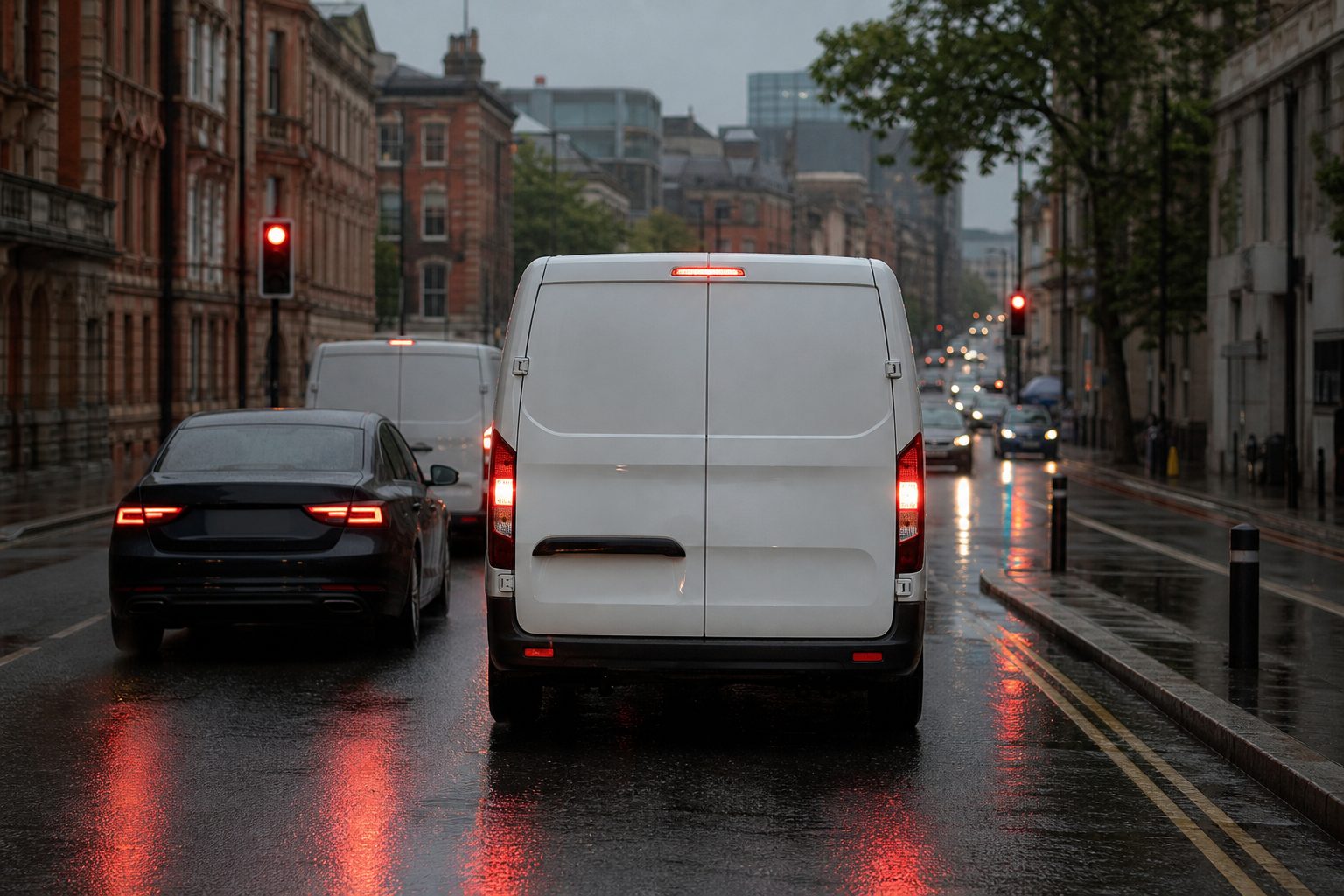
A delivery van making 60 stops in a day executes 120 parking manoeuvres — 60 approach stops and 60 pull-aways. In urban and suburban environments, each one occurs in a different context: different road width, different visibility, different proximity to kerbs, bollards, parked vehicles, and pedestrians. No driver has consistent spatial awareness across 120 varied manoeuvres in a working day. Parking sensors change the alert frequency — instead of the driver estimating clearances from a seated position in a vehicle they cannot see the corners of, the sensor tells them when they are within a set distance of an obstacle.
Two sensor technologies are available for delivery vehicle parking applications, and they are not interchangeable.
Ultrasonic sensors operate by emitting a sound pulse and measuring the time for the reflection to return. They work well in the 0–2 metre range — the close-quarters zone relevant to the final phase of a parking manoeuvre. They are inexpensive, reliable in clean environments, and suitable for both bumper-mounted rear sensors and side-mounted proximity alerts. Their limitation is that they perform poorly in rain and heavy spray (the acoustic signal is degraded), and they do not provide programmable detection zones — a sensor set to trigger at 1 metre triggers at 1 metre regardless of whether the object is a bollard, a kerb, or a pedestrian.
Radar sensors operate by emitting a radio frequency signal and measuring the Doppler shift of the reflected return. They are not affected by rain, spray, or dust. They provide programmable detection zones with multiple alert thresholds — a 2-metre outer warning zone and a 0.75-metre close alert zone can be set independently. They are more expensive than ultrasonic sensors and are the appropriate choice for vehicles operating in wet or dusty environments, or where programmable zone differentiation is required.
For urban delivery vans in standard conditions, ultrasonic sensors in the rear bumper zone are the most cost-effective configuration — the rear bumper is the highest-risk zone for low-speed contacts. Nearside and offside proximity sensors are not really suited to panel vans on urban delivery work: at normal urban operating clearances they alert continually, and ignored alerts provide no safety value.
Urban delivery stops frequently involve pulling forward to a position where the front bumper is within centimetres of a bollard, a wall, or a parked vehicle. Front bumper sensors — either ultrasonic or forward-facing radar — provide the driver with an audible alert as the vehicle approaches the obstacle during the forward stop. This is particularly relevant for delivery vehicles with limited forward visibility due to body configuration, high bonnet lines, or front-mounted equipment.
Front zone sensors are not mandated by FORS or DVS frameworks — they address a different hazard category from the nearside blind spot that BSIS sensors cover. They are specified for delivery fleets primarily on property damage reduction grounds: the most common minor contact claim in urban delivery is a front or rear bumper contact with a fixed obstruction during a slow parking manoeuvre.
Nearside and offside proximity sensors are not really a suitable fit for panel vans on urban delivery work. In constant close-quarters traffic — parked cars, pedestrians on the pavement, cyclists filtering alongside — side sensors generate continual alerts at normal urban operating clearances, and drivers quickly learn to ignore them. For van fleets, the practical priorities are rear and front bumper coverage for parking manoeuvres, with camera coverage providing awareness of the zones alongside the vehicle.
Delivery vehicles in urban environments operate in close proximity to stationary objects throughout their working day. A sensor calibrated for maximum sensitivity will alert continuously in a busy urban environment — every passing car, every pedestrian on the pavement, every adjacent parked vehicle will trigger an alert. Drivers who experience continuous alerts learn to ignore them. Ignored sensors provide no safety value.
Calibration for urban delivery requires zone differentiation: a close-range alert zone (typically 0–1 metre) that triggers an urgent audible signal during the final approach of a parking manoeuvre, and an outer awareness zone (1–2.5 metres) that provides a gentler warning when objects are present at normal urban operating clearances. The inner zone is the actionable alert — the driver needs to stop or steer. The outer zone is situational awareness — the driver should be aware of the proximity but does not need to immediately react.
No specific parking sensor requirement applies to vans under 3.5t under DVS, FORS, or any other UK regulatory framework. The case for sensors in van fleets rests on property damage cost reduction and insurance premium management rather than compliance. HGVs over 3.5 tonnes operating under FORS Silver are required to have a reversing alarm, but this is an audible warning for third parties, not a proximity sensor providing driver feedback.
Ultrasonic sensors degrade in heavy rain — the acoustic signal is absorbed by water droplets in the air. For rear sensors on vans operating in wet conditions, this means reduced detection reliability precisely when the driver needs it most during a reversing manoeuvre on a wet road. Radar sensors do not have this limitation. For fleets operating year-round in UK conditions, rear radar sensors are the more reliable technology, at a higher unit cost than ultrasonic alternatives.
Yes, if poorly calibrated. A rear sensor set to maximum sensitivity will trigger every time a vehicle or pedestrian passes behind a parked delivery van. Drivers on busy urban routes experience hundreds of false alerts per shift and stop responding to them within days of installation. Correct calibration — zone differentiation between awareness and alert, with the alert zone set to the distance at which action is actually required — cuts false alerts without suppressing genuine hazard detection. Calibration is not a one-time setup; it should be reviewed when the vehicle’s operating environment changes significantly.
Rear sensors on vehicles configured for towing detect the trailer as an object within their detection zone on every reverse manoeuvre, generating a continuous alert. Towing mode — either a manual switch or an automatic detection via the towbar electrical connection — disables rear sensors when a trailer is attached. Failure to configure towing mode results in continuous rear sensor alerts when towing, which drivers quickly learn to disable entirely, defeating the system for non-towing reversing operations.
A rear bumper sensor installation takes approximately two to three hours by a qualified automotive electrician. A system covering both front and rear zones takes around a full day. Sensors should be installed at a specialist commercial vehicle fitting centre with experience in delivery fleet configurations — consumer vehicle sensor kits installed by general auto electricians frequently require recalibration within weeks due to incorrect sensitivity settings for commercial operating environments.
Download this free checklist to apply the guidance in this article to your fleet.
Tell us what vehicles you run and what you need — we will come back with a recommendation and a price. Prefer to talk? Call 01656 721871.
Related guides: Using Cameras to Improve Delivery Efficiency · High-Risk Situations for Couriers and How to Avoid Them
4 August 2026
Monday to Friday:
8.30am-5.30pm