
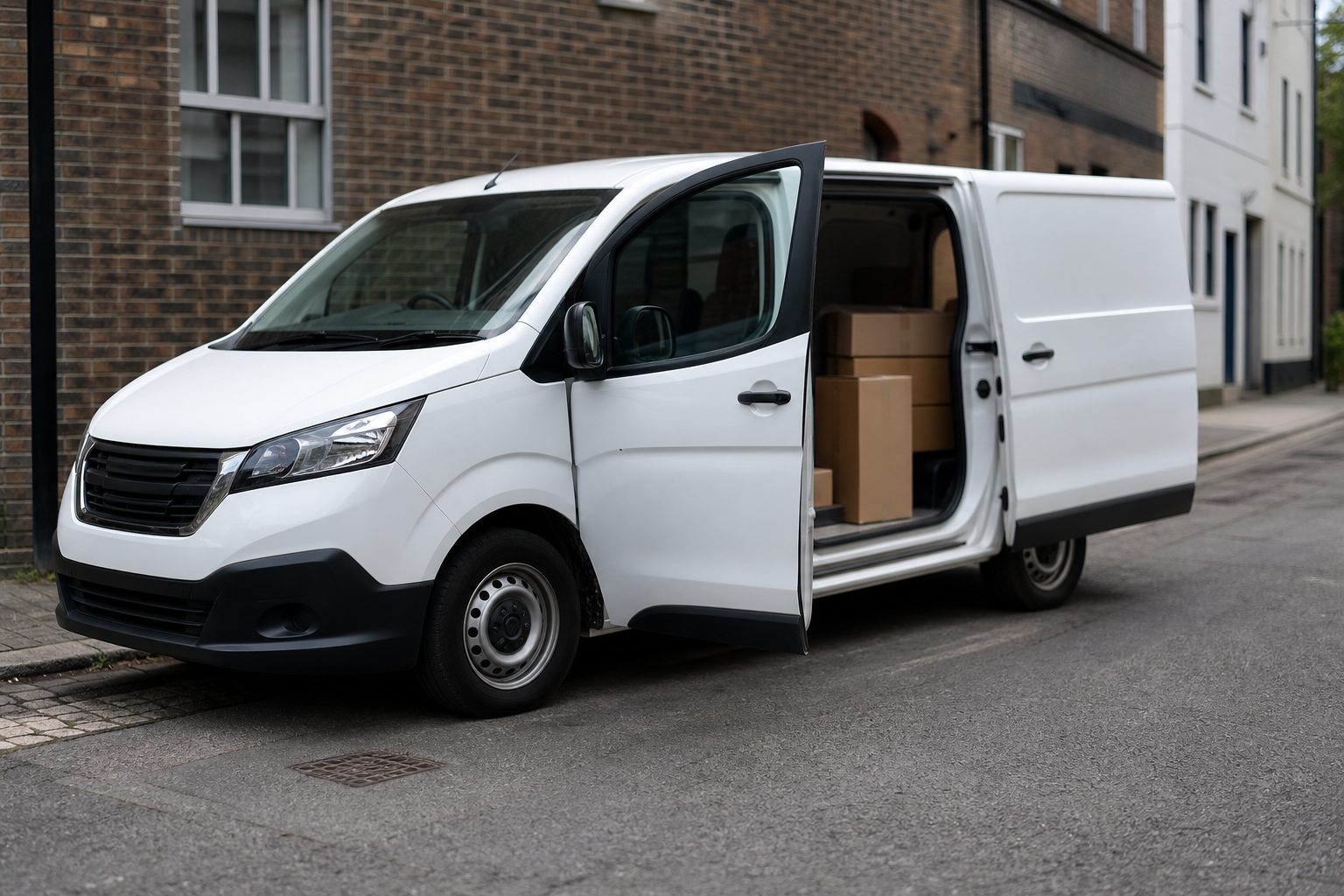
Delivery driving is statistically one of the more hazardous occupations in the UK road transport sector. Not because of motorway speeds or long-haul fatigue — but because of repetition. A courier completing 60 stops per day in urban and suburban environments encounters the same high-risk scenarios dozens of times: pulling away from a stop in a cyclist-dense area, reversing on unfamiliar premises, interacting with pedestrians at the vehicle’s kerb side. Each scenario is manageable individually. The risk accumulates across dozens of repetitions, in changing environments, under time pressure.
This guide identifies the eight situations that appear most frequently in delivery driver incident records and explains what camera and sensor systems do in each scenario — not as a substitute for driver training, but as the technical layer that addresses what training alone cannot prevent.
Moped-mounted “crash for cash” fraud targeting delivery vans is documented at scale in the UK: between 2021 and 2024, over 4,000 people were targeted in staged incidents, generating an estimated £70 million in fraudulent claims (ABI, 2024). The pattern is consistent — a moped rider pulls alongside or in front of a delivery van and then brakes or swerves deliberately, claiming to have been struck.
How cameras address it: Multi-angle footage — front, nearside, rear — with GPS speed data embedded shows exactly what the delivery vehicle and the third party were doing at the moment of the alleged contact. Staged incidents show characteristic patterns: the third party accelerating or steering into the vehicle’s path rather than being struck while stationary or moving away. This footage is decisive. Claims that survive pre-footage are withdrawn immediately on disclosure. The deterrent effect of externally visible cameras — a front dashcam is visible to a potential fraudulent claimant — also reduces targeting frequency.
UK cyclists are killed and seriously injured in left-turn collisions with larger vehicles at a rate that has resisted improvement despite progressive safety campaigns. The 2022 Highway Code revision (Rule H1) placed the highest duty of care on HGV and van drivers turning left across cyclists — but duty of care does not remove the physical blind zone that a nearside mirror cannot cover when a cyclist is alongside or slightly behind the vehicle.
How cameras address it: A nearside camera activated by the left indicator provides the driver with a live feed of the left-side zone at the exact moment the indicator engages. A BSIS sensor provides an audible alert when an object is detected in the nearside zone simultaneously with an indicator event. The combination gives the driver information their mirror cannot provide — what is in the zone that is not visible from the cab — at the precise moment it is needed. Since TfL introduced DVS enforcement in London, KSI rates in HGV left-turn incidents have fallen substantially.
Multi-drop delivery sends drivers to different addresses on every route — commercial premises with unfamiliar yard layouts, residential addresses with narrow access, shared surfaces without clear reversing space. A driver who reverses confidently at their regular depot addresses may misjudge clearances at an unfamiliar address where the obstacles are not where they expect them to be.
How cameras address it: A rear camera provides the driver with a live view of the reversing zone at any address. A proximity sensor with audible alert provides a distance indication — the driver hears the alert frequency increase as they approach an obstacle, regardless of whether they are watching the camera monitor. The combination is most effective: the camera shows what the sensor has detected, the sensor provides the alert that does not depend on the driver’s attention to the monitor.
Driver fatigue contributes to approximately 20% of all road collisions in the UK (THINK! / DfT). For delivery drivers completing long multi-drop rounds — particularly those covering 10–12 hours with a single mid-shift break — the late-round period is the highest-risk window. Near-miss incidents peak between 17:00 and 19:59, directly overlapping with the end-of-round return-to-depot period.
How cameras address it: Driver-facing cameras with AI drowsiness and distraction detection identify the fatigue signatures — extended eye closure, head position changes, phone interaction — that precede microsleep events. These alerts are actionable in real time: an in-cab alert that triggers when the driver shows a drowsiness signature allows the driver to pull over and take a break before the cognitive impairment becomes an incident. Fleet managers monitoring driver-facing event data can identify drivers consistently showing late-round fatigue patterns and restructure their rounds accordingly.
“Dooring” — a driver or passenger opening a vehicle door into the path of a passing cyclist — is a significant injury mechanism in urban areas. Highway Code Rule 239 requires drivers to check for cyclists before opening their door; liability in a dooring incident typically falls on the vehicle operator rather than the cyclist. For delivery vans making multiple roadside stops in cycle-lane-adjacent positions, the frequency of door-opening events makes dooring risk a regular occurrence rather than an exceptional hazard.
How cameras address it: A driver-side camera or a nearside camera with wide-angle coverage of the kerb zone can provide footage of the approach of a cyclist before a door-opening event. This does not prevent dooring if the driver fails to check, but it provides the factual record of what was visible (or not visible) at the time of the door opening — relevant to liability allocation in a subsequent claim. A BSIS-type sensor alert that activates when a cyclist is detected passing on the nearside is technically capable of providing a pre-opening warning if the detection zone covers the door-side area.
Contact with gates, walls, parked vehicles, and property features during parking manoeuvres is the most frequent minor incident category in delivery fleet insurance records. Residential delivery addresses with tight driveways, commercial premises with narrow access roads, and shared surfaces with restricted widths create repeated contact opportunities across a busy round.
How cameras address it: Rear and nearside cameras provide visual coverage of the vehicle’s footprint during manoeuvres. Proximity sensors in the rear and side zones provide audible distance alerts. For property damage claims, footage showing the vehicle’s approach, speed, and contact (or non-contact) at the alleged location resolves the factual dispute efficiently. False property damage claims — where damage predating the delivery is attributed to the delivery vehicle — are immediately disprovable with footage showing the property’s condition when the driver arrived.
Delivery drivers frequently encounter road rage, aggressive residents, and confrontational claimants. A driver who has allegedly blocked a driveway, made a noise at an inconvenient time, or damaged property may face an aggressive confrontation at the vehicle. Driver-facing cameras that record audio as well as video provide the factual record of what was said and by whom — relevant in both criminal and civil proceedings arising from the confrontation.
How cameras address it: Driver-facing cameras document the confrontation from the driver’s perspective. Audio recording is subject to UK GDPR compliance requirements (parties must be aware that recording is taking place, or the recording must fall within a lawful exemption). The practical approach for fleet operators is to include audio recording within the camera policy notification provided to drivers, and to rely on the footage without audio for claims resolution where audio recording compliance is uncertain.
Early morning and late evening delivery windows — increasingly common with next-day and same-day delivery expectations — require drivers to operate in conditions of reduced natural light in residential areas with lower pedestrian predictability. A pedestrian stepping between parked cars, a cyclist without adequate lighting, or a child running into the road presents differently in pre-dawn conditions than at midday.
How cameras address it: Cameras with low-light capability — infrared or wide dynamic range sensors — maintain useful image quality in conditions where a standard dashcam produces grainy footage. The footage value for a low-light incident is greatest when the camera can actually show what was in the vehicle’s path, not just a dark frame with indistinct shapes. Specifying cameras by low-light performance as well as resolution and field of view is important for fleets operating early-morning or late-evening delivery windows.
Yes. Moped-mounted crash-for-cash fraud targeting delivery vans has been documented at significant scale — over 4,000 incidents between 2021 and 2024, generating an estimated £70 million in fraudulent claims (ABI data). Branded delivery vans are targeted because the operator is identifiable, the insurance profile is known, and the operating environment (urban, slow-speed) makes a plausible staged incident easy to construct. Cameras with external-facing coverage are the primary deterrent and the primary defence.
Primarily document. A camera provides footage of what was visible on the cyclist’s approach but does not alert the driver before they open the door. A proximity sensor in the door-side zone could provide a pre-opening alert, but this is not a standard installation in UK delivery vehicles. The camera’s primary value in dooring incidents is providing the factual record of whether a cyclist was approaching and whether the driver’s visibility of the cyclist was reasonable — which is the core question in a dooring liability claim.
The underlying technology — AI analysis of eye closure duration, head position, and gaze direction — produces actionable alerts in controlled tests and in fleet deployments. False positive rates vary by camera quality, mounting angle, and lighting conditions. In delivery vans where the driver-facing camera angle is fixed by the windscreen mount and lighting varies significantly from dawn to dusk, false positive rates are higher than in controlled conditions. The practical position is that fatigue detection cameras provide a useful early-warning signal that supplements (rather than replaces) route management and rest period controls.
Stay calm; do not admit fault or make payments. Note the other party’s details and the details of any “witnesses” they produce. Photograph the scene and the other vehicle. Report the incident to the fleet manager immediately so footage can be retrieved and preserved before the rolling retention window. Report the suspected fraud to the Insurance Fraud Bureau via its Cheatline (0800 422 0421). The fleet manager should also notify the insurer that a staged incident is suspected — this changes the claims handling approach and flags the claim for fraud investigation rather than routine settlement.
Entry-level dashcam systems (front and rear camera, SD card storage) start from approximately £100–£200 per vehicle for hardware only. Connected MDVR systems with 4G live view, multi-channel recording, and cloud-based footage retrieval typically cost £200–£500 per vehicle for hardware, plus a monthly connectivity fee of £10–£25 per vehicle. Professional installation adds £100–£300 depending on vehicle type and camera count. Against typical van insurance premiums of £700–£950 per vehicle per year, and the premium reductions fleets typically report with camera systems, the payback period is often measured in months rather than years.
Download this free checklist to apply the guidance in this article to your fleet.
Tell us what vehicles you run and what you need — we will come back with a recommendation and a price. Prefer to talk? Call 01656 721871.
Related guides: Parking Sensors for Urban Delivery Vehicles · Evidence Packs for Delivery-Related Incidents
4 August 2026
Monday to Friday:
8.30am-5.30pm