
Construction vehicles operate in two distinct environments: public roads, where DVS and standard HGV regulations apply, and construction sites, where CLOCS requirements govern entry and where the hazards — banksmen, plant operators, pedestrians in PPE moving around the vehicle — are different from road-based risks. A camera specification that meets road compliance requirements but ignores site-specific exposures gives the fleet manager half a solution.
A tipper delivering materials to a city centre site, a concrete mixer working on a residential development, a flatbed carrying plant to a remote site — each vehicle has different camera requirements depending on its operating environment, the contracts it runs under, and the schemes its operator is registered with. This guide covers what an MDVR system for a construction vehicle needs to do, and the compliance requirements that shape the specification.
Construction fleet vehicles share some camera needs but have significant differences based on their specific operation:
Tipper lorries and aggregate trucks: High-volume urban deliveries, frequent reversing onto site, tight access points. Key camera positions: forward-facing, nearside, offside, rear wide-angle for reversing, and a rear view covering the loading area and any banksman position. G-sensor sensitivity is important as tipping operations create vehicle movement that can generate false events.
Concrete mixer trucks: Similar profile to tippers with the added consideration of drum rotation and the rear chute area. A camera covering the rear discharge area is operationally valuable for both safety monitoring and confirming delivery completion for disputes.
Flatbed and low-loader trucks: Long vehicles with extended rear overhang. Rear cameras must cover the full load and any overhang beyond the tailgate. Side cameras are particularly important when load dimensions create additional nearside blind spots beyond the cab.
Crane and specialist plant carriers: Less frequent road movements but high-value cargo and complex loading/unloading operations. Camera coverage of the deck and load area during transit provides evidence for any cargo damage claims.
CLOCS — Construction Logistics and Community Safety — sets out a standard for construction vehicle safety that is increasingly used as a site entry requirement by major contractors and developers. A question that comes up regularly from fleet managers whose vehicles run on CLOCS-governed sites is what camera specification is required and whether their existing MDVR setup qualifies.
CLOCS requirements include camera coverage of the nearside blind spot accessible to the driver via an in-cab monitor, meeting the Moving Off Information System (MOIS) standard, and visible confirmation to pedestrians and site workers that the vehicle is moving off safely. A well-specified MDVR system — nearside camera, in-cab monitor, rear camera — satisfies the camera element of CLOCS compliance. The MOIS standard specifically addresses the movement from stationary, where the driver must have confirmation of the nearside clear before pulling away.
For FORS (Fleet Operator Recognition Scheme) accreditation, camera requirements increase at Silver level. FORS Silver requires nearside camera with in-cab monitor and a system that meets CLOCS standards. FORS Gold uses the same camera specification as Silver — the additional requirement at Gold is that members publish a case study, not further camera hardware. Fleet managers seeking FORS accreditation should confirm that their MDVR system’s footage can be produced for audit purposes and that the platform allows retrieval of specific event footage for incident review.
Construction HGVs over 12 tonnes operating in Greater London must comply with the Direct Vision Standard (DVS) — the same requirement that applies to refuse and distribution HGVs. Vehicles without the minimum star rating must be fitted with the Progressive Safe System (PSS), which requires nearside camera coverage displayed to the driver on an in-cab monitor, blind-spot detection, and proximity alerts for vulnerable road users.
Construction vehicles entering TfL-managed roads in London without a valid HGV Safety Permit — which requires either a minimum DVS star rating or confirmed PSS installation — face fines of up to £550 per entry. For a fleet making multiple site deliveries per day in London, the cumulative cost of non-compliance is significant.
The operational case for fitting PSS-standard equipment to the whole construction fleet, rather than only London-route vehicles, is the same as for refuse fleets: managing two equipment specifications creates compliance administration overhead, and the safety benefit of nearside camera coverage and proximity detection applies equally on site access roads outside London as it does in the capital.
Construction vehicles operate in conditions that are more demanding on camera equipment than standard road freight. Cameras on tippers and mixers encounter aggregate dust, concrete splash, and regular high-pressure wash-down. Vehicles operating on unpaved site access roads are subject to constant vibration and impact from road surface irregularities. Cameras at the rear of tippers — particularly those near the tipper body hinge — are exposed to mechanical movement and contamination during tip operations.
IP67-rated cameras are the minimum standard for external positions on a construction vehicle. For cameras near the tipper body or in direct contamination zones, IP69K — rated for high-pressure, high-temperature wash-down — provides a more appropriate protection level. Cable management is critical: exposed cables on construction vehicles are regularly damaged by aggregate, plant, and site equipment. Protective conduit throughout the cable run from camera to MDVR is standard practice for vehicle-type applications where cable damage is a recurring maintenance issue.
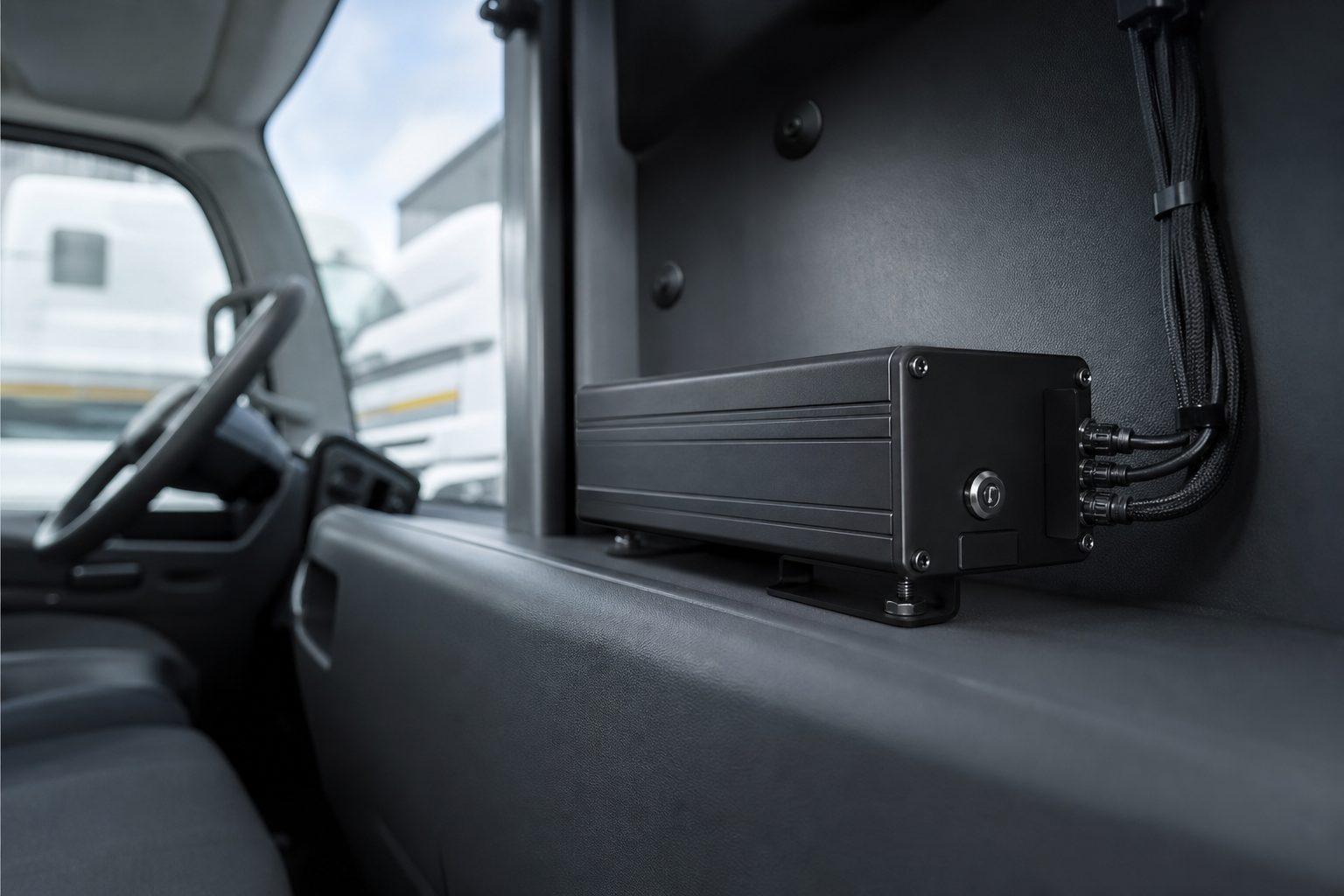
The MDVR unit should be mounted in the cab away from direct contamination. Vibration damping mounts are worth specifying on vehicles that operate primarily on unpaved surfaces where standard cab vibration profiles are exceeded.
A connected MDVR on a construction vehicle provides remote access to footage without requiring the vehicle to return to depot — directly relevant for construction fleets where vehicles may be based at site for extended periods or operating across multiple sites under a rolling contract.
G-sensor event upload means that a collision or near-miss on site is visible to the fleet manager within minutes, not at end of shift. For incidents involving site workers, third parties, or other plant, the ability to pull footage immediately — before memories fade and before the site environment changes — is operationally significant. Fleet managers who have managed construction site incidents say the same thing we hear consistently: the footage that exists immediately after the event is the footage that matters. Waiting until the vehicle returns at the end of the day is too late if the claim has already been submitted.
GPS and route data from a connected MDVR provides the road movement record for each vehicle — useful for confirming delivery completion, verifying route compliance on restricted-access roads, and demonstrating that a vehicle was not on a particular road at the time of a third-party claim.
CLOCS requires nearside camera coverage with in-cab monitor display and compliance with the Moving Off Information System (MOIS) standard. A well-specified MDVR system with nearside camera and monitor meets this requirement. CLOCS compliance is increasingly a site entry requirement for major contractors and developers, and camera specification should be confirmed against the specific CLOCS version in use on the relevant contracts.
Yes. DVS and PSS apply to all HGVs over 12 tonnes operating in Greater London, including construction vehicles. Vehicles without the minimum DVS star rating must be fitted with PSS — nearside camera, in-cab monitor, blind-spot detection, and proximity alerts. Fines of up to £550 per entry apply for non-compliant vehicles.
A minimum specification for a tipper lorry includes forward-facing, nearside, offside, and rear wide-angle cameras, with an in-cab monitor. For vehicles on CLOCS sites or DVS routes, the nearside camera and monitor are mandatory. A camera covering the rear tipper area and any banksman position adds operationally significant coverage for site incidents.
Yes. MDVR footage is directly relevant to any site safety investigation following a vehicle-related incident. The footage provides the factual record of vehicle position, movement, driver action, and the surrounding environment at the time of the event. For HSE investigations and civil claims involving construction site incidents, MDVR footage from all relevant camera positions is typically requested as primary evidence.
External cameras on construction vehicles should be IP67 rated as a minimum. Cameras in direct contamination zones — near the tipper body, rear of the vehicle, or areas subject to high-pressure wash-down — should be IP69K rated. Cable runs should be in protective conduit throughout. The MDVR unit should be mounted in the cab with vibration damping on vehicles that operate primarily on unpaved surfaces.
A printable compliance checklist for MDVR systems on construction vehicles, covering camera positions, CLOCS requirements, FORS accreditation, DVS/PSS London compliance, camera durability specification, and connected platform setup.
Tell us what vehicles you run and what you need — we will come back with a recommendation and a price. Prefer to talk? Call 01656 721871.
Related guides: MDVR Systems for Waste Collection Vehicles · How to Choose the Right MDVR for Your Fleet Size
4 August 2026
Monday to Friday:
8.30am-5.30pm