
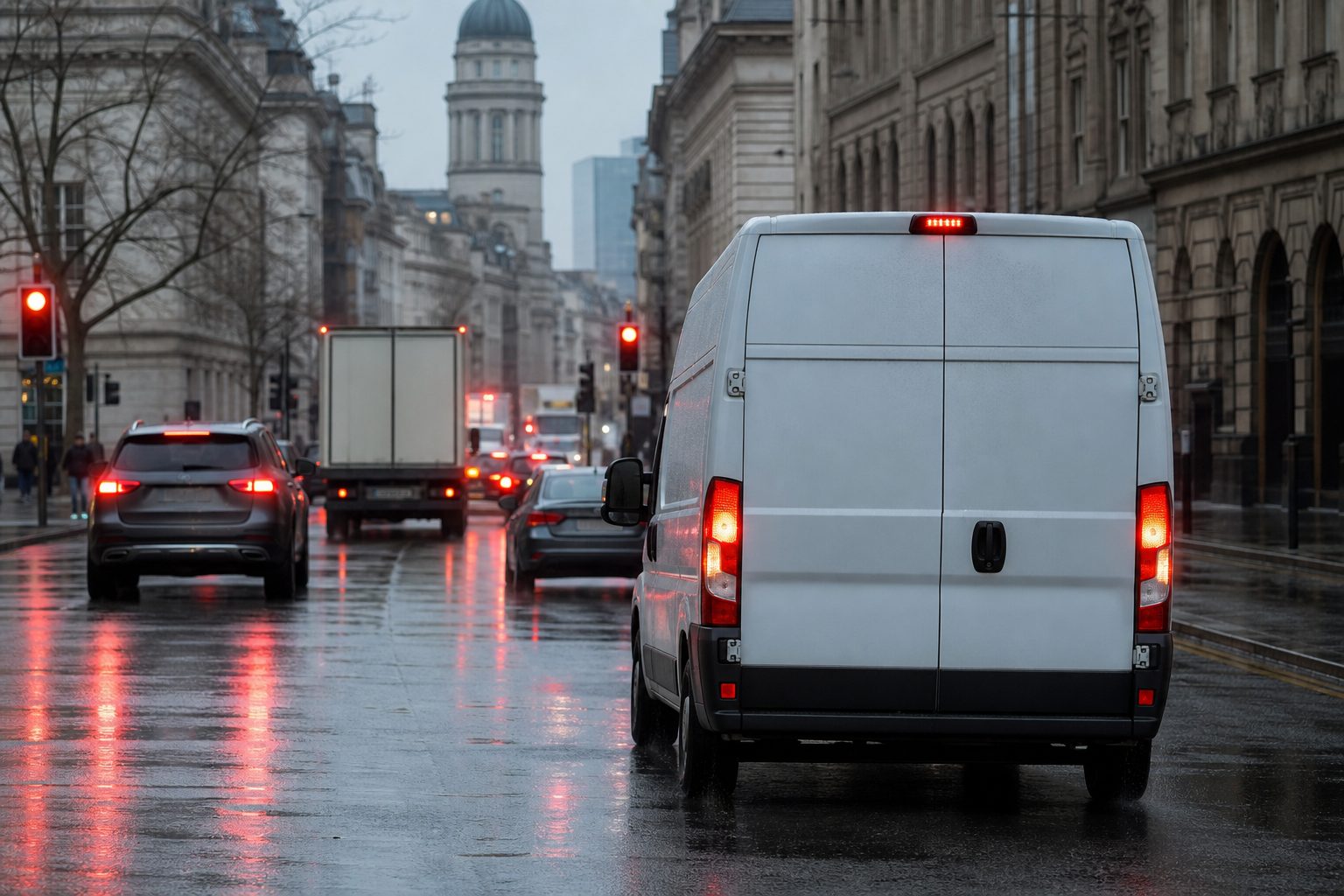
Delivery fleet insurance is expensive for structural reasons. The vehicles operate in environments with high pedestrian and cyclist density, stop and reverse dozens of times per shift in confined spaces, and carry identifiable branding that makes them easy targets for fraudulent claims. A delivery fleet manager who treats insurance as a fixed cost to be renewed annually is ignoring the variable that most directly controls it: the fleet’s claims experience over the preceding three to five years.
Camera systems are the single most effective intervention for reducing delivery fleet insurance risk — not because insurers require them, but because they change the economics of both genuine and fraudulent claims against the fleet.
Three structural factors make delivery fleets disproportionate targets for insurance claims.
First, predictability. A delivery fleet operating branded vans on regular residential routes is easy to identify and locate. A fraudulent claimant who wants to stage an incident with an identifiable vehicle in a predictable location finds a delivery van a low-difficulty target compared to an anonymous car or an HGV on a trunk road.
Second, the operating environment. Multi-drop delivery generates more reversing manoeuvres, more stop-start urban driving, and more interaction with pedestrians and cyclists than almost any other vehicle category. The frequency of genuine near-miss events is high — and near-misses are the environment in which fraudulent claims are constructed. A delivery driver who reverses awkwardly in a tight street creates an ambiguous situation that a bystander or another driver can exploit.
Third, the operator profile. Delivery fleet operators — particularly those with national or regional coverage — are perceived as having insurance that will settle rather than litigate a modest claim. The economic calculation for a fraudulent claimant is straightforward: a £3,000–£8,000 claim against a national delivery operator will settle quickly with minimal evidence required.
A camera system with multi-angle coverage and rapid footage retrieval removes the information asymmetry that makes fraudulent claims viable. The claimant who constructs a narrative around a gap in the evidence record — “the driver reversed into me and drove away” — finds that narrative confronted immediately by footage showing the driver’s reverse manoeuvre, the claimant’s position at the relevant time, and GPS data showing the vehicle’s speed and movement.
The deterrent effect is also significant. Cameras that are visible on the exterior of the vehicle — a front dashcam, an external nearside camera — signal to potential fraudulent claimants that the vehicle is covered. The staged accident rate against clearly camera-equipped vehicles is measurably lower than against vehicles without visible camera hardware.
For genuine claims — where the driver was at fault — cameras provide the factual record that enables rapid settlement without protracted dispute. A claim that is settled quickly on accurate evidence costs less in legal fees and management time than a claim that is contested, litigated, and eventually settled at a higher figure after two years. The cameras’ contribution to faster genuine claim resolution is a second mechanism through which they reduce the fleet’s overall claims cost.
Insurance premium reduction from camera systems follows a consistent pathway that takes three to five years to fully realise.
Year one: cameras are installed, footage retrieval procedures are established, and the first fraudulent claims begin to be successfully defended or withdrawn on disclosure. The claims frequency may not yet have fallen significantly, but the claims cost per incident begins to decline.
Year two and three: a driver coaching programme using camera event data reduces genuine incident frequency — harsh events, near-misses, and minor contacts decrease as drivers receive regular feedback. The claims experience record begins to show lower frequency as well as lower cost per claim.
Year three to five renewal: the fleet’s three-year or five-year claims experience record shows meaningfully lower claim frequency and faster resolution. Insurers pricing on this record offer materially better terms. Camera systems with documented coaching programmes can help deliver meaningful premium reductions for delivery fleet operators with a three-year claims record that demonstrates the effect.
The most common failure in delivery fleet camera systems is not the hardware — it is the evidence retrieval process. A camera system that records excellent footage and overwrites it before anyone retrieves it after a claim is filed has no insurance value. A camera system that requires the vehicle to return to depot for footage download — a process that may take days — loses the timing advantage that makes footage most valuable.
The operationally effective specification for a delivery fleet camera system includes: GPS-embedded recordings retrievable by address (click the delivery address, retrieve the footage); remote access via portal without requiring vehicle return to depot; and automatic preservation of event-triggered clips that flag harsh events and potential incidents in real time. A claim received on a Monday for an incident the previous Friday should produce footage within minutes, not days.
Camera systems reduce premiums most effectively when they are documented for insurers in a form that demonstrates operational implementation, not just hardware installation. The documentation that supports a premium negotiation:
An insurer who can see a fleet’s camera installation records, retrieval procedure, coaching programme, and claims defence record is pricing on evidence, not assumptions. The premium reduction for a fleet with documented systems is consistently better than for a fleet with the same hardware but no operational documentation.
The first-year effect is typically modest — insurers price on claims experience, not future projections, and a newly installed camera system has no claims record to demonstrate. The meaningful premium reduction comes at the first renewal after a full year of operation, and increases at subsequent renewals as the claims experience record extends. The full effect of documented camera systems with coaching programmes typically appears at the three-year renewal mark.
Yes. Multi-drop delivery vans are disproportionately targeted relative to their route miles. The combination of predictable routes, identifiable branding, urban operating environments, and the perception of well-capitalised operators makes them attractive targets. The most common fraudulent claim types are staged pedestrian incidents at delivery stops, false dooring claims, and fabricated property damage allegations during reversing manoeuvres.
Yes, in two ways. First, footage establishes the accurate factual record, which prevents claimant exaggeration — a genuine minor contact that causes superficial damage is settled on the evidence for its actual cost rather than the inflated figure a claimant might claim without footage to contradict them. Second, accurate footage enables faster settlement, which reduces legal costs on both sides. A rapidly settled genuine claim costs less in total than a contested one that runs for two years before reaching the same outcome.
Footage of public roads and third parties (pedestrians, other drivers, claimants) falls under UK GDPR as personal data when individuals are identifiable. The lawful basis for collection is typically legitimate interests for safety and incident investigation. Footage should be retained only as long as necessary — typically 30–60 days for standard route footage with no incident, and until formal resolution for incident-related footage. Subject access requests from individuals appearing in footage must be handled within the statutory timeframe. The fleet’s data protection policy should document the retention period, access controls, and deletion procedure for camera footage.
Camera event data — harsh braking rates, speeding incidents, distraction detections — can be used as evidence in disciplinary proceedings provided the use is covered in the driver’s employment contract and has been communicated to the driver in advance. Footage of specific incidents can also be used as evidence. Employment law requires that disciplinary proceedings be fair and that the driver has the opportunity to respond to the evidence. Using footage as the opening and only evidence, without the driver’s ability to provide context, may not satisfy the fairness requirement. Legal advice on the specific disciplinary process is recommended before using camera evidence in formal proceedings.
Download this free checklist to apply the guidance in this article to your fleet.
Tell us what vehicles you run and what you need — we will come back with a recommendation and a price. Prefer to talk? Call 01656 721871.
Related guides: Improving Driver Safety in Last-Mile Delivery · Live View for Multi-Drop Delivery Vehicles
4 August 2026
Monday to Friday:
8.30am-5.30pm