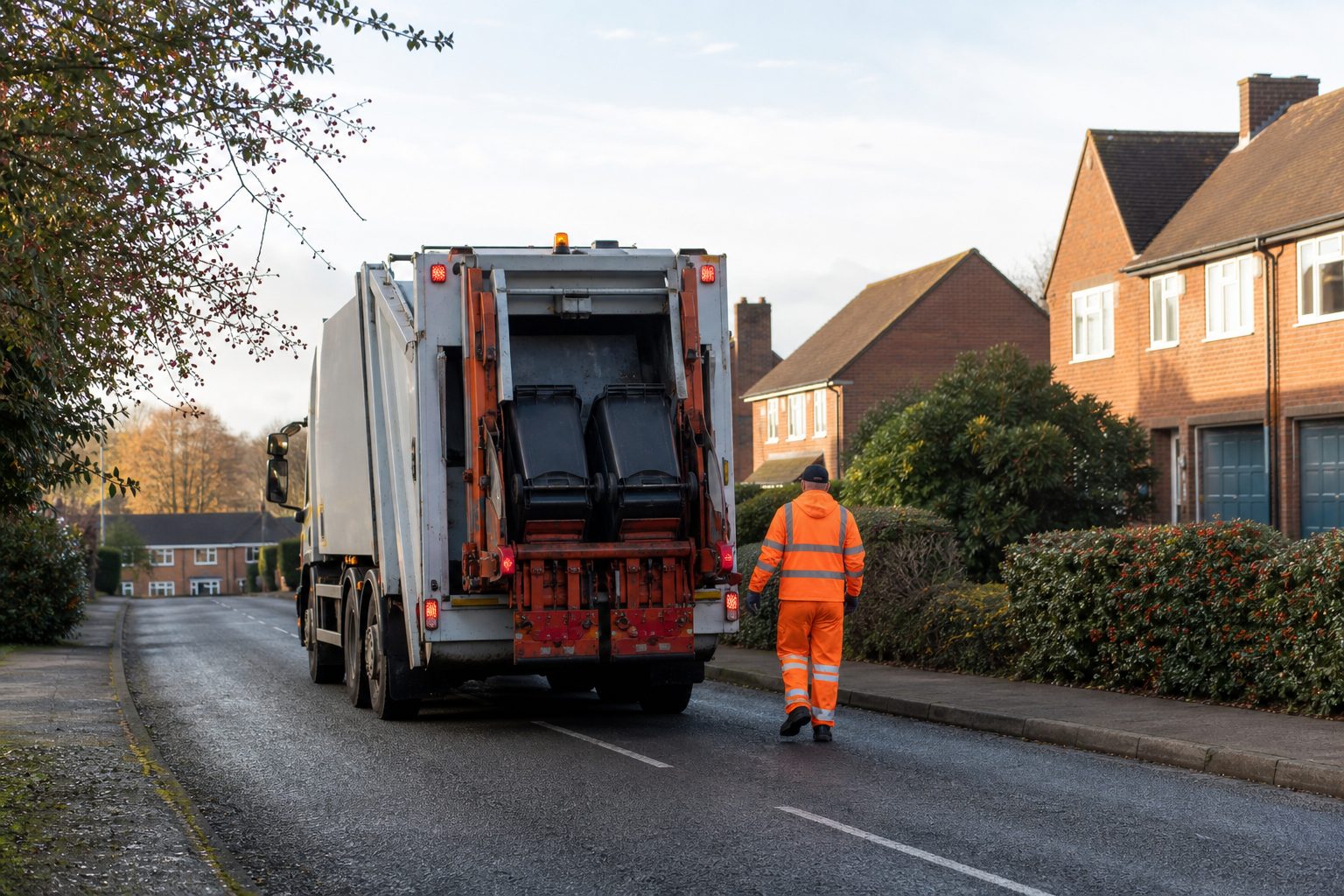
Waste fleet operators carry an above-average claims exposure relative to most commercial vehicle operations. The combination of residential operating environments, high reversing frequency, crew on foot alongside the vehicle, and daily contact with parked vehicles and pedestrians creates a claims volume that logistics and construction fleets rarely encounter. The proportion of those claims that are disputed — where the version of events offered by the third party does not match what the driver reports — is consistently high in waste operations precisely because the operating environment makes it difficult for drivers to articulate exactly what happened at each of the dozens of stops in a shift. Footage changes this. It replaces driver recollection with an objective record, at scale.
The most common disputed claim type in waste operations is parked vehicle damage. A refuse collection vehicle navigating a narrow residential street with vehicles parked on both sides is in close proximity to third-party property on every stop. When a scratch or dent is discovered on a parked vehicle in a street the RCV has visited, the claim may arrive days later with no specific incident to investigate. Without footage, the operator has no way to establish whether the damage pre-existed the collection visit, occurred during the collection, or was caused by another vehicle entirely.
Forward-facing and nearside cameras that continuously record the vehicle’s passage through the collection street provide the evidence that resolves these claims. A clip showing the vehicle’s clearance from each parked vehicle on the street, timestamped and GPS-referenced, is the record that establishes whether any contact occurred during the collection round. Fleet operators who have implemented footage review as a standard response to parked vehicle claims report that the majority of disputed claims resolve quickly once footage is available — either confirming the claim is unfounded, or confirming contact occurred and accelerating settlement rather than extended liability negotiation.
Skip and roll-off skip operators face a distinct claim type: driveway approach and gate-clearance damage during skip delivery. A delivery vehicle operating in residential driveways regularly encounters claims that the vehicle damaged a gate post, kerb edge, or driveway surface during placement. These claims are difficult to contest without footage because the delivery crew cannot assess property condition before every delivery.
A rear-facing wide-angle camera covering the skip placement zone, combined with a forward-facing camera recording the approach, creates a complete record of each delivery. A clip that shows the approach, the placement manoeuvre, and the vehicle departing without contact settles a false delivery damage claim with minimal dispute. Where footage shows contact did occur, it also accelerates settlement by removing the contested liability stage — a result that reduces legal costs even when the operator is at fault.
Not all claims in waste fleet operations are inbound — fleets with good camera coverage generate outbound subrogation recoveries when footage shows that a third party caused or contributed to an incident. A forward-facing camera that captures a vehicle pulling out from a junction into the path of a refuse truck, or a cyclist running a red light and making contact with the vehicle’s nearside, provides the evidence base for the operator’s insurer to pursue cost recovery from the third party’s insurer.
Subrogation recoveries are financially significant for waste fleet operators because the incidents most likely to generate them — reversing contacts, junction collisions, and incidents at kerbside collection points — are also the incidents most likely to involve significant vehicle damage and third-party injury costs. A fleet whose insurer can recover the cost of a collision where footage shows clear third-party fault will see that claim excluded from its loss ratio calculation over time, improving renewal terms rather than penalising the fleet for incidents it did not cause.
The National Dash Cam Safety Portal provides the route for submitting footage of third-party road traffic offences to police. A refuse vehicle overtaken dangerously or cut up by a third party can generate a submission using forward-facing footage and the third party’s registration number — most road traffic offences carry a six-month prosecution window, so the footage must be submitted promptly after the incident.
In incidents involving the refuse vehicle and crew members — a loader struck by the vehicle, a crew member injured near the hopper mechanism — the footage from the nearside camera, the hopper camera, and the driver-facing camera is the primary evidence for establishing who did what and when. This footage is the difference between a claim that attributes fault to the employer for inadequate systems and a claim that establishes the specific sequence of events.
Where footage shows a loader who stepped behind the vehicle against the established collection protocol, while the hopper camera shows no proximity sensor alert was active at the point of movement, the operator’s exposure to negligence claims is reduced. Where footage shows a proximity sensor alert was active but the lift cycle proceeded regardless, the operator’s exposure is significantly increased. The footage does not change what happened — it establishes the record that determines the outcome of any subsequent claim or HSE investigation.
A footage retention policy designed around claims management rather than just operational review looks different from a standard 24-72 hour overwrite cycle. The following retention framework addresses the specific timeline of waste fleet claims:
MDVR systems with 4G remote access allow footage preservation to happen from the operations desk without requiring the vehicle to return to depot. A fleet manager who receives a damage claim at 3pm can pull and preserve the morning’s route footage before the MDVR overwrites — a critical capability for fleets using short overwrite cycles as a default storage management approach.
Claims that would typically take weeks or months to contest through insurer negotiation often resolve within days when footage is available. A clip that clearly shows no contact occurred, or that the third party was the proximate cause of the incident, removes the factual dispute from the process. The remaining question is procedural, not evidential — and procedural settlements proceed faster than factual ones. Fleets with documented footage availability report significantly lower average claim duration than those relying on driver statements.
Yes, through two routes. Reduced claim frequency — driven by footage-based coaching that cuts harsh event rates and high-risk behaviours — improves the fleet’s loss ratio over time. Reduced claim cost — through faster false claim resolution and subrogation recovery — reduces the cost to the insurer of the claims that do arise. Both factors influence renewal premium. Some insurers offer direct discounts for documented camera systems with active coaching programmes; others reflect the improvement in loss ratio at renewal without a formal discount structure.
Parked vehicle damage in residential streets (most common); driveway and property damage during skip delivery; pedestrian and crew-on-foot incidents at collection points; junction collisions involving third-party contact; and post-incident personal injury claims where the sequence of events is disputed. Each of these claim types has a specific camera position that provides the primary evidence: nearside for parked vehicle contact, rear for skip delivery, nearside kerb-level for crew incidents, forward for junction collisions.
Until the proceedings are fully concluded, including any appeal. Civil claims in the waste sector may take 12-24 months from incident to conclusion. Employment tribunal claims following footage-based dismissals must be lodged within three months of dismissal, but the proceedings can extend significantly beyond that. The standard footage retention policy should specify that incident footage is preserved indefinitely once a claim is notified — standard overwrite cycles do not apply to footage that has entered the claims or legal process.
Yes. If another vehicle from the same fleet was on the same street at a relevant time, its footage is potentially relevant evidence for a claim on that route. Some fleets retain footage from multiple vehicles covering a persistent claim location as a standard practice. The footage does not need to show the specific vehicle involved in the claim — it shows the street condition, the presence of pre-existing damage on the claimed vehicle, or the traffic environment at the relevant time. Any footage used in legal proceedings should be original and unedited.
Covers camera coverage for claims evidence, footage retention policy, claims response procedure, subrogation and third-party claims, and crew incident evidence.
Tell us what vehicles you run and what you need — we will come back with a recommendation and a price. Prefer to talk? Call 01656 721871.
Related guides: Compliance Requirements for Local Authorities · Why Waste Vehicles Have Higher Camera Requirements
4 August 2026
Monday to Friday:
8.30am-5.30pm