
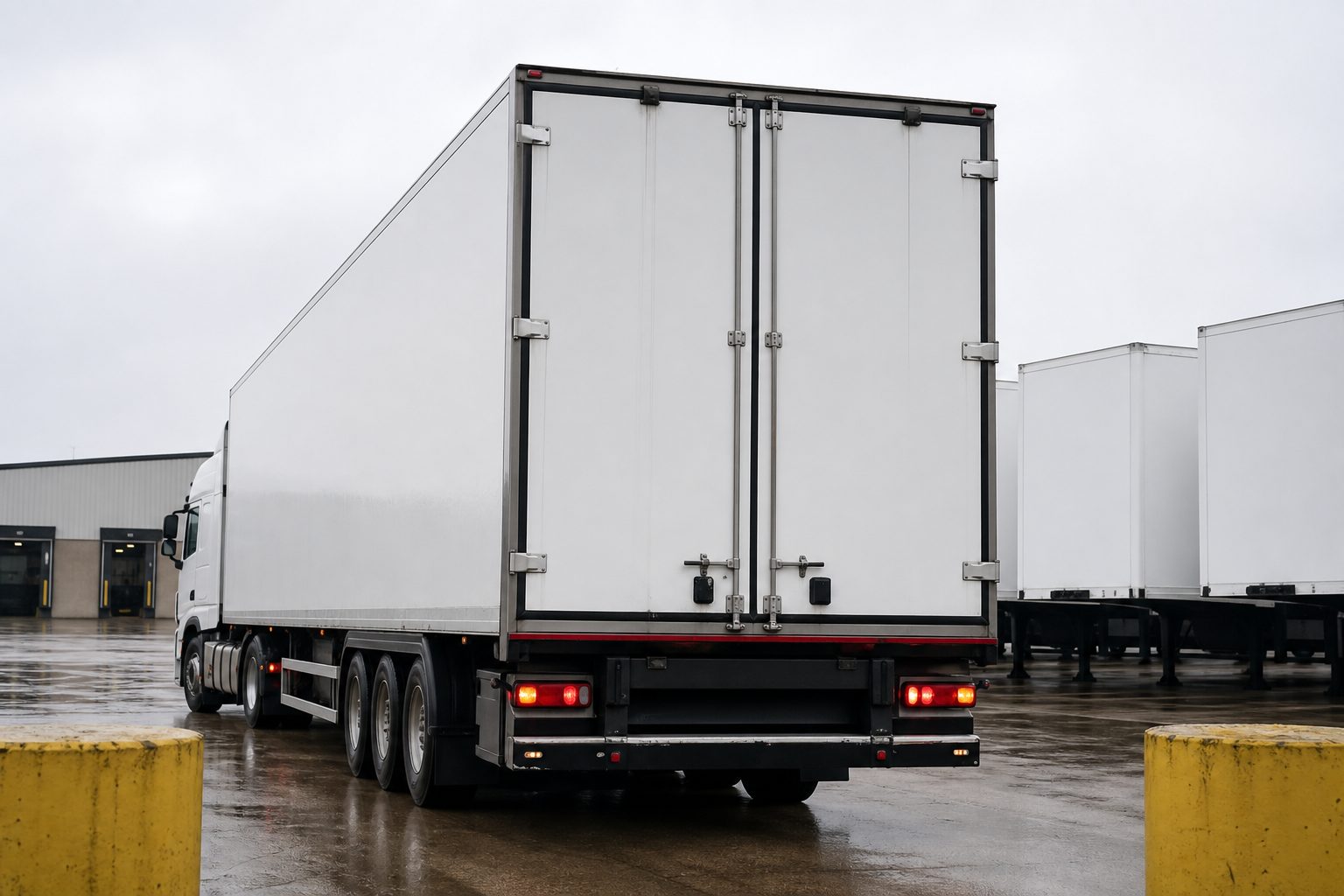
Your vehicle has blind spots your mirrors can’t solve. For rigid HGVs, articulated lorries, buses, and construction plant, those blind spots are not an inconvenience — they are the conditions under which serious collisions happen. Proximity sensors work, but only when they are placed correctly for the shape and operating behaviour of the vehicle they are fitted to. A configuration that protects a 7.5-tonne rigid will leave critical gaps on a 44-tonne artic. This guide covers the specific placement requirements for each major vehicle category.
Before looking at vehicle-specific placement, it helps to understand how modern proximity systems are structured. Most fleet-grade systems use a dual-zone architecture:
Better systems scan 10 to 20 times per second and return a warning in under 0.2 seconds — fast enough to be useful at low manoeuvring speeds. Ultrasonic sensors are the most common technology in this category: cost-effective, reliable in most weather conditions, and well-suited to the slow-speed close-quarters work where blind spots cause the most harm.
Radar sensors extend detection range and work better at speed in poor visibility, but they are bulkier and come at a higher cost. LiDAR offers the most precise spatial resolution and is increasingly common in advanced driver assistance systems (ADAS), though it remains less common in retrofit fleet configurations than ultrasonic or radar.
Rigid trucks are the vehicle type with the clearest compliance driver for sensor fitment. Under FORS v7 (effective January 2025), rigid vehicles over 7.5 tonnes require a rear camera as a minimum. Many operators fit sensors alongside the camera to cover the zones that cameras alone cannot address in real time.
The three placement zones that matter for a rigid HGV are:
For operators running in Greater London, DVS (Direct Vision Standard) compliance for vehicles over 12t requires a safe system package that includes sensors covering the nearside and rear zones — so this configuration serves dual regulatory purposes.
An articulated combination introduces a challenge that rigids do not have: the angle between the tractor unit and the trailer changes constantly during manoeuvring. Sensors fitted only to the tractor unit cannot monitor the full length of the trailer, and the trailer swings outward through a wider arc than the cab during a turn.
Sensor systems are fitted to the tractor unit only — proximity sensors are not fitted to trailers — with camera coverage taking over along the trailer:
One thing fleet managers raise consistently when speccing artics: the system needs to handle the trailer coupling and uncoupling process without generating nuisance alarms every time the trailer is dropped. Look for systems that allow zone suppression by input signal — so that the reversing camera trigger suppresses the rear sensor alarm briefly during coupling, rather than the driver being trained to ignore the beep.
Buses present a different risk profile from HGVs. Their primary hazard is not reversing — it is pedestrians at stops, particularly children, who can move unpredictably in the space between the bus and the kerb. Low-floor city buses also sit closer to the ground, which changes the optimal sensor height.
For urban bus operators, consider how the sensor system integrates with the existing driver display. Operators who fit sensors alongside a camera system and route both to a split-screen display in the cab see higher driver engagement — drivers who can see both the image and the sensor alert zone are less likely to dismiss the alarm as a false positive.
Plant equipment — excavators, dumpers, telehandlers, concrete mixers, skip loaders — is where the gap between what sensors are designed for and how they are actually used creates the most problems. Plant equipment often operates in constrained sites alongside workers on foot, frequently reverses with limited visibility, and the operating environment involves more physical obstacles (hoarding, signage, aggregate stockpiles) that can generate false alerts if sensors are not correctly calibrated.
Site-based plant equipment is exempt from FORS requirements (FORS applies to road vehicles), but the Construction (Design and Management) Regulations 2015 and HSE guidance on vehicle/pedestrian separation create a clear duty of care framework for site operators. Proximity sensor fitment is increasingly referenced in RAMS documents for plant on pedestrianised sites.
Vans — Transit, Sprinter, Crafter — are often treated as a lower priority because they are smaller. But LCVs operate in tighter urban environments, make more frequent deliveries at residential addresses, and are driven by a wider range of people than a specialist HGV driver. The rear blind spot on a high-roof panel van is larger relative to driver sightlines than many operators assume.
LCV proximity sensors are the entry point for many operators new to fleet safety equipment. Starting with rear fitment on the full LCV fleet, then expanding to nearside coverage on any vehicles that operate regularly in urban areas, is a practical sequencing approach.
A question fleet safety managers raise consistently is: what goes wrong with sensor installations? Three errors come up most often.
First, sensors placed too low on the rear face, particularly on vehicles with a step or towbar. At 0.4–0.5m height, a sensor can detect the tow coupling on the vehicle ahead as a constant obstacle — generating nuisance alarms that train drivers to ignore the system. Set rear sensors at 0.8–1.2m as a starting point and adjust with vehicle-specific calibration.
Second, gaps in side coverage. A single sensor on the nearside of a long rigid body covers a fraction of the total exposure. The coverage arc of an individual ultrasonic sensor is typically 1.5–2.5m at its widest point. Running the numbers: continuous nearside coverage needs several overlapping sensors — and on artics, where sensors are not fitted to the trailer, nearside camera coverage takes on that role.
Third, fitting sensors without integrating the warning into the driver’s existing cab display. A beeper under the chassis that the driver cannot locate or associate with a specific zone is not a safety system — it is a noise generator. Driver uptake is significantly higher when the cab display shows which zone has triggered and at what distance.
A well-specified rigid will typically carry four sensors on the nearside, four across the rear, and one or two at the front nearside corner. That is nine to ten units for a complete configuration. Smaller rigids (7.5t) may use a reduced nearside count of three sensors if the vehicle body is shorter.
FORS v7 (January 2025) mandates a rear camera for rigid vehicles over 7.5 tonnes. Sensors are not specifically mandated at Bronze level, but many operators add them because camera alone does not provide audio warning during reversing. At Silver and Gold levels, the expectation is a more comprehensive safe system.
Yes — ultrasonic sensors are not vehicle-specific and can be removed and refitted. The wiring harness and controller module may need adaptation for a different vehicle body profile, but the sensor units themselves are reusable.
Most configurations are set to activate rear sensors on engagement of reverse gear. Side sensors can be set to activate at all times below a speed threshold (typically 15–20mph) or only on a turn signal input. This is a calibration choice, not a hardware limitation.
The yellow (caution) zone typically extends to 2–3 metres; the red (stop) zone covers 0–1.5 metres. Some systems allow zone thresholds to be adjusted through the controller software to match specific operational requirements.
DVS (Direct Vision Standard) applies to HGVs over 12t operating in Greater London. The safe system requirement under DVS includes sensors covering the nearside and rear zones, alongside a camera and an audible left-turn warning. So yes — for London-operating fleets, sensors are part of the compliance package.
Tick-box placement guide covering rigid HGVs, artics, buses, plant equipment and LCVs — with zone height, sensor count, and FORS v7 compliance notes for each vehicle type.
Tell us what vehicles you run and what you need — we will come back with a recommendation and a price. Prefer to talk? Call 01656 721871.
Related guides: Reversing Alarms for HGVs: What You Need to Know · Common Sensor Faults and How to Fix Them
4 August 2026
Monday to Friday:
8.30am-5.30pm