
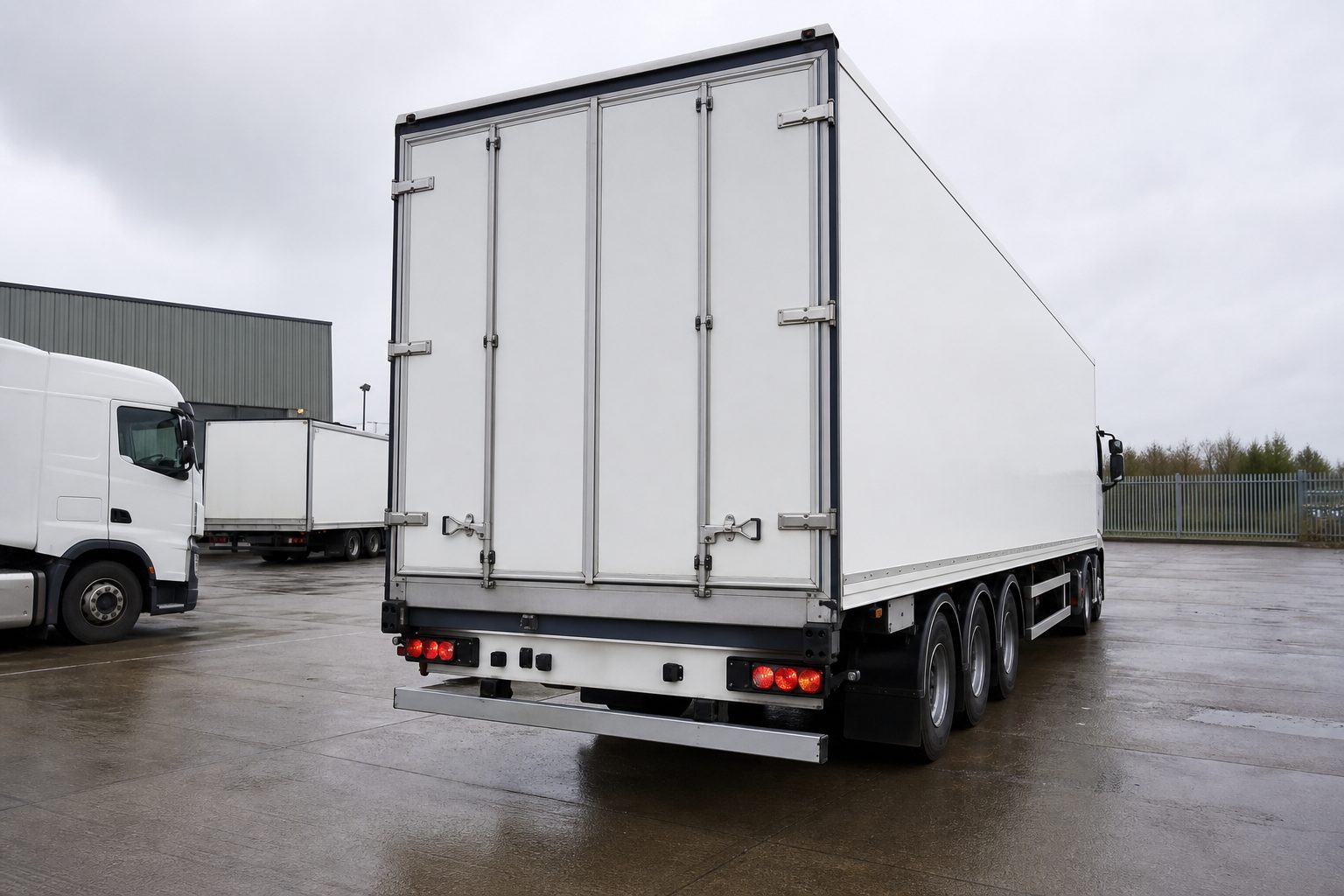
HGVs account for roughly 70% of cyclist fatalities on UK roads despite making up only 4% of traffic. The consistent factor in these incidents is not speed, driver inattention, or road conditions. It is the physical geometry of large vehicles — the zones around an HGV where the driver has no direct line of sight and where a vulnerable road user can be present without the driver ever knowing.
Blind-spot detection systems exist specifically to cover those zones. They do not replace driver awareness or good positioning; they provide a warning when something is in a location the driver cannot see. This article explains where the blind spots are, how detection systems work across the three main technology types, what BSIS and MOIS mean in the context of DVS 2024 compliance, and how to evaluate which system is right for a specific vehicle and operational profile.
Understanding what a blind-spot detection system needs to cover requires understanding the geometry of the problem. An HGV has four distinct zones where the driver’s direct vision is absent or severely limited:
Front — the area immediately in front of the cab extends roughly 2 metres ahead of the vehicle. A cyclist stopped at traffic lights can be entirely invisible to the driver if they are inside this zone. This is why Moving Off Information Systems (MOIS) target specifically the moment of pulling away from stationary — the highest-risk moment for front-zone incidents.
Nearside (left side) — the most consistently dangerous zone for urban driving. The left side of the vehicle, from the front wheel arch to the rear of the trailer, is largely invisible from the cab. This zone extends across multiple lanes on a wide vehicle and is where the majority of cyclist fatalities involving HGVs occur during left-turn manoeuvres.
Rear — the area behind the trailer extends up to 3 metres depending on trailer type. Reversing incidents account for a substantial proportion of HGV-related fatalities in yard and loading environments.
Offside (right side) — the right side of the vehicle has a blind zone running the length of the trailer. This zone is particularly dangerous when the vehicle is pulling away at a junction or changing lanes, when motorcyclists and cyclists may be alongside.
Detection systems need to be specified against these zones. A system that covers the nearside and rear but not the front does not satisfy MOIS requirements. A system that detects stationary objects but cannot distinguish a moving pedestrian from a kerb does not satisfy BSIS requirements. The specification of the system determines what it can actually protect against.
All blind-spot detection systems share the same fundamental logic: a sensor detects an object or person in the monitored zone, and the system issues an alert to the driver. The difference between technology types is in how that detection is performed, what conditions it operates reliably in, and what the system can distinguish.
There are currently three technology approaches used in commercial vehicle blind-spot detection. Each has a different performance profile, and most current compliant systems use two of the three in combination.
Radar systems use microwave radio waves to detect the presence, distance, and movement of objects in the monitored zone. Two radar sensors mounted on the nearside of the vehicle can monitor the full length of an HGV and trailer, covering the same area that would have required six to eight ultrasonic sensors in older system designs.
Radar’s primary advantage for BSIS compliance is its ability to distinguish moving objects from stationary ones. A BSIS-compliant system must notify the driver only when there is a risk of imminent collision — not every time a stationary kerb or parked vehicle is within the detection zone. Radar’s Doppler measurement capability (which detects relative motion) allows the system to differentiate a moving cyclist from a static lamppost, significantly reducing false alert rates.
Radar operates independently of lighting conditions and performs reliably in rain, fog, and dust. It is the technology used by the majority of vehicle manufacturers to meet European UN Regulation R151 (BSIS) and R159 (MOIS) requirements, and it is the most common solution for DVS 2024 compliant retrofits on existing fleet vehicles.
The limitation of radar is range versus resolution trade-off at very close distances. At extreme close range (under 0.5 metres), some systems have reduced accuracy, which is why rear-proximity sensor integration alongside radar is common in comprehensive setups.
AI camera systems use machine learning models trained on large datasets of pedestrian, cyclist, and vehicle images to detect and classify vulnerable road users within the camera’s field of view. The camera continuously analyses each frame and triggers an alert when a person or cyclist is detected in the defined danger zone, with optional audio-visual warning and an in-cab monitor feed showing the driver what has been detected.
The key advantage of camera-based BSIS is that it provides the driver with visual confirmation of what triggered the alert. A radar alert tells the driver that something is there; a camera alert can show them what and where. For driver training and incident review, the camera record also provides the footage needed to understand what happened and when.
Camera systems are affected by lighting and weather conditions in a way that radar is not. A heavily fogged lens or a camera facing direct sunlight can reduce detection reliability. Camera systems designed for DVS 2024 compliance are engineered to mitigate these factors, but environmental performance remains a consideration when specifying a system for vehicles operating in challenging conditions.
AI camera systems that meet the BSIS specification can detect and classify vulnerable road users specifically, reducing false alerts caused by other vehicles or static objects. Systems without AI classification — standard CCTV cameras with no object recognition — do not satisfy the BSIS requirement of distinguishing between collision-risk and non-collision-risk detections.
Ultrasonic proximity sensors are mainly used for reversing assistance on smaller vehicles. For blind spot detection they have largely been superseded by radar, which offers greater detection distances, an adjustable beam pattern, height, and detection range, and less likelihood of sensor damage.
However, ultrasonic systems cannot meet the DVS 2024 BSIS specification as standalone VRU detection. The updated DVS standard requires systems that can distinguish moving pedestrians and cyclists from stationary objects and issue alerts only in collision-risk situations. Ultrasonic sensors detect presence and distance but cannot classify what they have detected or whether it is moving. Operators with HGVs currently running ultrasonic-only nearside detection systems need radar or AI camera upgrades to meet the 2024 DVS Safe System specification for vehicles operating in Greater London.
DVS (Direct Vision Standard) 2024 is the current TfL requirement for HGVs over 12 tonnes operating in Greater London. All in-scope vehicles need either a three-star rating (based on how much direct vision the cab provides) or a compliant Progressive Safe System. Most HGVs on UK roads do not achieve three stars naturally, so the Progressive Safe System route — fitting BSIS and MOIS — is the practical compliance path for the majority of fleet operators.
BSIS (Blind Spot Information System) monitors the nearside of the vehicle at speeds between 0 and 30 km/h. It must be capable of detecting vulnerable road users within the nearside zone and alerting the driver only when there is a genuine risk of collision — not for every stationary object in the area. The detection zone specified by TfL covers a 2-metre height band, 2.2 metres to the nearside, and extends 9 metres to the rear of the cab.
MOIS (Moving Off Information System) covers the front of the vehicle at the moment of pulling away from stationary. It monitors the area up to 2 metres ahead of the vehicle and alerts the driver to pedestrians, cyclists, or other road users in the path of the vehicle before it moves. MOIS must be active between 0 and 30 km/h.
Both systems must issue warnings in-cab via audible and visual alerts. Both must be active regardless of indicator status — so the system cannot only activate when the driver signals left. The permit application to TfL requires documentation of the specific systems fitted and confirmation that they meet the technical specifications.
Fleet managers evaluating blind-spot detection systems for their vehicles should consider four factors beyond initial installation cost:
What is the difference between BSIS and MOIS? BSIS (Blind Spot Information System) monitors the nearside of the vehicle while it is moving at low speed, alerting the driver to pedestrians and cyclists in the danger zone alongside and behind the cab. MOIS (Moving Off Information System) covers the area directly in front of the vehicle when it is pulling away from stationary. Both are required under DVS 2024 for HGVs over 12 tonnes operating in Greater London.
Do blind-spot detection systems work at motorway speeds? BSIS and MOIS systems under DVS 2024 are specified to operate at speeds up to 30 km/h. At motorway speeds, blind-spot monitoring is handled by different systems — typically lane-change assist radar. Commercial vehicle blind-spot detection for DVS compliance is focused on urban, low-speed operation where pedestrian and cyclist risk is highest.
Are radar systems better than camera systems for BSIS compliance? Both can meet the BSIS specification. Radar is more reliable in adverse weather and requires less maintenance. AI camera systems provide visual confirmation of what triggered the alert and produce a footage record useful for driver training and incident review. Most comprehensive setups combine radar detection with camera output to give the driver both the alert and the visual context.
How many sensors does a BSIS system need to cover an HGV? Radar-based BSIS systems typically use two sensors per side to cover the full length of the vehicle and trailer. Camera-based systems use one or two cameras per side depending on the vehicle length. Older ultrasonic systems required six to eight sensors per side to achieve comparable coverage — the reduction in sensor count is one of the practical benefits of radar and camera alternatives.
Will fitting a BSIS system automatically give my HGV a DVS permit? Fitting a compliant BSIS and MOIS system qualifies your vehicle for the Progressive Safe System route under DVS 2024. You still need to submit a permit application to TfL with documentation of the specific systems fitted. The permit must be renewed annually and any change to the safety system configuration reported. Contact your fleet safety supplier for the documentation requirements.
What happens if an HGV without DVS compliance enters Greater London? Non-compliant vehicles operating in the DVS zone can be issued fixed penalty notices of up to £550 per vehicle per day and stopped by TfL enforcement officers. The permit must be in place before the vehicle operates in the zone — it cannot be applied for retrospectively after an enforcement notice.
Can blind-spot detection systems be retrofitted to older HGVs? Yes — retrofit kits are the primary market for BSIS and MOIS systems, since the DVS requirements apply to vehicles already in service, not just new registrations. Retrofit installation typically takes a day per vehicle and involves mounting sensors, wiring through the cab, and installing the in-cab alert unit and monitor if not already fitted.
How does a blind-spot detection system alert the driver? Alerts are delivered via an in-cab buzzer or speaker (audible alert) and a warning light or indicator on the cab monitor (visual alert). Systems integrated with the camera setup can also switch the monitor to the relevant camera view when a detection is made, giving the driver immediate visual confirmation of what has triggered the alert.
A five-section checklist covering vehicle assessment, DVS 2024 BSIS/MOIS compliance verification, technology evaluation, installation checks, and ongoing maintenance — for fleet managers and engineers specifying or auditing blind-spot detection systems.
Tell us what vehicles you run and what you need — we will come back with a recommendation and a price. Prefer to talk? Call 01656 721871.
Related guides: What Are Ultrasonic Sensors and How Do They Work? · How Cyclist Safety Systems Protect VRUs (Vulnerable Road Users)
4 August 2026
Monday to Friday:
8.30am-5.30pm