
Most drivers know that something beeps when they reverse too close to a wall. Fewer know what is actually making that calculation, or why the same technology that helps you park a van is also used on an HGV navigating a loading dock with a cyclist in the nearside blind spot. Ultrasonic sensors are one of the most widely fitted proximity detection technologies in commercial vehicles — simple in principle, reliable in practice, and commonly misunderstood when fleet operators start comparing them with radar and camera alternatives.
This article explains how ultrasonic sensors work, where they are positioned on commercial vehicles, what they can and cannot detect, how they compare with other proximity technologies, and what the shift in DVS regulations from 2024 onwards means for operators who currently rely on them for vulnerable road user detection.
Ultrasonic sensors operate on the same principle as sonar — and, if you want a more familiar reference, the same principle bats use to navigate in complete darkness. The sensor emits a burst of high-frequency sound waves, typically in the range of 20 to 40 kHz, which is above the threshold of human hearing. When those sound waves encounter a solid object, they bounce back to the sensor. The sensor measures the time between the emission and the return — this is called the time of flight — and from that calculates the distance to the object.
The maths is straightforward: sound travels at approximately 343 metres per second at room temperature. If the sensor emits a pulse and receives the echo after 5 milliseconds, the round-trip distance is 1.715 metres, so the object is 0.86 metres away. The sensor translates this into a distance reading that triggers an audible warning, a visual alert on a cab monitor, or both.
The key property that makes ultrasonic sensors useful in commercial vehicle applications is that they detect objects regardless of colour, transparency, or lighting conditions. A pedestrian in a high-visibility jacket and a black post at the edge of a loading bay are equally detectable. This is the defining advantage over camera systems alone, which are dependent on contrast and light to identify obstacles.
On commercial vehicles, ultrasonic sensors are typically mounted in clusters at specific vulnerable points:
The number of sensors fitted varies by application. Older nearside detection systems used eight or more sensors to provide full-length coverage of the vehicle’s left side. Newer radar-based alternatives achieve similar coverage with two sensors at greater accuracy, which is part of why the DVS regulations have evolved away from ultrasonic as the default standard for VRU detection (more on this below).
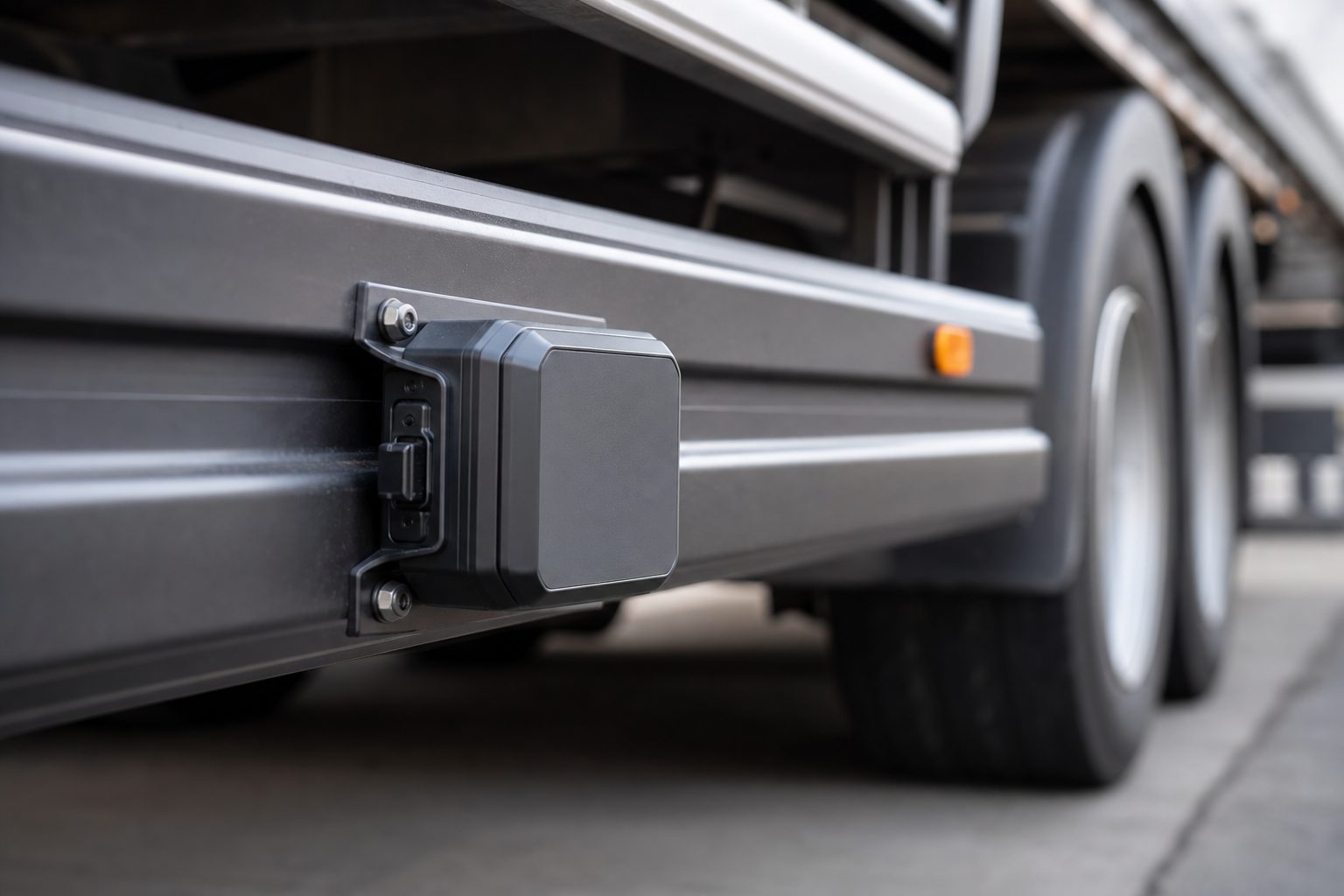
On the vehicle itself, the sensors are typically flush-mounted in purpose-built brackets or recessed into the bodywork to reduce exposure to physical damage. The sensor faces must remain clean and clear — dirt, ice, or mud build-up on the sensor face can block or distort the signal, which is a routine maintenance consideration for fleets operating in harsh environments.
Fleet managers who have encountered false alerts or missed detections are often working with expectations that exceed what ultrasonic technology is designed to deliver. Understanding the practical limits prevents both over-reliance and unnecessary dismissal.
Reliable detection scenarios:
Less reliable scenarios:
The short-range, low-speed profile makes ultrasonic sensors highly suited to yard manoeuvring, loading dock approach, and urban low-speed driving — precisely the scenarios where pedestrian and cyclist risk on commercial vehicles is highest. It also explains why they are less well-suited to motorway driving scenarios, where radar or camera systems with longer detection ranges are more appropriate.
Most modern commercial vehicle safety setups combine technologies rather than relying on a single sensor type. Understanding how ultrasonic sensors fit alongside radar and cameras helps fleet managers specify systems appropriately and understand what each component is doing.
Ultrasonic vs. radar: Radar uses microwave radio waves rather than sound waves. This gives radar a substantially longer detection range — effective from a few metres up to 200 metres or more depending on the system — and it remains accurate at higher vehicle speeds. Radar is the preferred technology for forward collision warning, adaptive cruise control, and lane-change assistance. For close-proximity nearside detection, radar systems require fewer sensors than ultrasonic equivalents (two sensors can replace eight ultrasonic units in DVS-compliant configurations) and offer greater accuracy. The trade-off is cost — radar systems are generally more expensive to install than ultrasonic.
Ultrasonic vs. cameras: Camera systems provide visual information that ultrasonic sensors do not. A camera can show the driver an image of what is in the blind spot; an ultrasonic sensor can only tell them that something is there at a certain distance. In practice, the most effective nearside detection setups combine both: ultrasonic or radar for automatic alert triggering, and a camera feed so the driver can visually confirm what the sensor has detected before manoeuvring. Camera systems can be affected by lighting, lens fogging, and contrast limitations; ultrasonic detection is immune to those factors.
Cost and simplicity: Ultrasonic sensors remain the most cost-effective proximity detection option for many applications. They are simple to install, require no image processing, and have low power consumption. For applications where close-range low-speed detection is the primary requirement, they remain entirely appropriate.
This is the most important regulatory context for UK fleet operators currently running ultrasonic-based VRU detection systems.
Under the Direct Vision Standard (DVS) 2020, ultrasonic proximity sensors were an accepted component of compliant Safe System setups for HGVs operating in Greater London. The 2024 update to the DVS requirements changed this significantly. Ultrasonic VRU warning systems are no longer acceptable as standalone DVS Safe System compliance under the 2024 specification. The updated standard requires Moving Off Information Systems (MOIS) and Blind Spot Information Systems (BSIS), which must meet performance specifications that ultrasonic-only systems cannot fulfil.
This does not mean ultrasonic sensors are obsolete on commercial vehicles. It means they no longer satisfy the DVS Safe System requirement for VRU detection on their own. Operators with HGVs over 12 tonnes operating in Greater London need to confirm that their current sensor setup meets the 2024 BSIS and MOIS specifications — not the 2020 ultrasonic standard. Operators running ultrasonic systems elsewhere, outside London, are not affected by this specific regulatory change.
For vehicles where DVS 2024 compliance is required, radar or AI camera-based systems that meet the BSIS and MOIS performance criteria are the replacement technologies. Existing ultrasonic sensor installations on these vehicles may remain useful for other proximity applications but will need to be supplemented or replaced for DVS compliance purposes.
Fleet managers who have had a sensor “stop working” almost always trace the fault to one of three causes. The sensor face is dirty — mud, ice, or a build-up of road film on the sensor surface prevents the signal from transmitting or receiving cleanly. The wiring connection has corroded or vibrated loose — ultrasonic sensors on working vehicles are exposed to constant vibration, and connector integrity should be checked at each service. Or the sensor has been physically damaged — a minor collision, a loading bay impact, or pressure-washing at close range can damage the sensor housing even when the surrounding bodywork looks undamaged.
A sensor that triggers constantly with no obstruction present (a “stuck” alert) is almost always a calibration issue or a mounting problem — the sensor is detecting part of the vehicle itself. Repositioning or recalibrating resolves this in most cases without replacing the unit.
What frequency do ultrasonic sensors operate at? Commercial vehicle ultrasonic sensors typically operate at 20–40 kHz, above the threshold of human hearing. The specific frequency varies by manufacturer and application. Higher frequencies provide shorter wavelengths, which improves precision at very close range; lower frequencies penetrate further in air.
Can ultrasonic sensors detect cyclists in wet weather? Yes — ultrasonic detection is acoustic, not optical, so rain and low light do not affect performance in the way they affect camera systems. Mud or ice build-up on the sensor face can cause interference, but the detection principle itself is unaffected by weather.
Are ultrasonic sensors DVS 2024 compliant? Ultrasonic VRU warning systems do not meet the DVS 2024 Safe System specification as a standalone solution. The 2024 update requires BSIS (Blind Spot Information Systems) and MOIS (Moving Off Information Systems), which specify performance standards that ultrasonic-only systems cannot meet. Speak to your vehicle safety supplier to confirm whether your current setup meets the updated specification.
What is the detection range of a typical commercial vehicle ultrasonic sensor? Most commercial vehicle ultrasonic sensors are designed for detection up to approximately 2–4 metres. Some systems extend to 6 metres for rear proximity warning. Beyond this range, the reflected signal becomes too weak for reliable detection — which is why ultrasonic is a short-range, low-speed technology.
How many ultrasonic sensors does an HGV need for full nearside coverage? Older ultrasonic-based nearside detection systems typically used six to eight sensors to cover the full length of the vehicle’s left side. Newer radar alternatives can achieve equivalent coverage with two sensors. The exact number depends on the vehicle length, the sensor field of view, and the detection system specification.
Can I combine ultrasonic sensors with cameras? Yes — and this is the most common setup. Ultrasonic sensors handle automatic proximity alerting; cameras provide the driver with visual confirmation of what has been detected. The combination gives the driver both a warning and the context to respond correctly, rather than relying on a single technology.
What causes ultrasonic sensors to give false alerts? The most common causes are: dirt or ice on the sensor face, physical damage to the sensor housing, nearby construction or industrial noise at similar frequencies, and incorrect mounting that causes the sensor to detect part of the vehicle itself. Most false alert issues are resolved by cleaning the sensor face, checking the mounting alignment, and confirming the installation calibration.
How do I know if an ultrasonic sensor has failed? Signs of sensor failure include: no alert when an object is placed directly in front of the sensor, a constant alert with no obstruction present, or an alert that activates at inconsistent distances. Most fleet management platforms with integrated sensor monitoring will flag a sensor communication fault directly. Physical inspection of the sensor face, wiring connections, and mounting bracket is the recommended first step.
A practical checklist covering installation checks, monthly inspection, false alert diagnosis, no-detection fault finding, and DVS 2024 compliance verification for ultrasonic proximity sensor systems.
Tell us what vehicles you run and what you need — we will come back with a recommendation and a price. Prefer to talk? Call 01656 721871.
Related guides: Reducing Blind-Spot Incidents With Sensor Systems · Blind-Spot Detection Systems Explained
4 August 2026
Monday to Friday:
8.30am-5.30pm