
Your fleet is at its most vulnerable when it’s not moving. Drivers are home. The yard gate is locked. The vehicles you’ve spent thousands equipping with cameras and safety systems are sitting in the dark — and the only thing watching them is whatever recording system you’ve set up, if you’ve set one up at all.
Most fleet operators invest heavily in on-road monitoring: dashcams, MDVRs, proximity sensors. The vehicle is well-covered while it’s working. But the depot? That’s where the assumptions start. “We’ve got a fence.” “We’ve got a security light.” “It’s a gated yard.” And then — as more than a few transport managers have discovered after the fact — a trailer disappears overnight and the CCTV footage is too grainy to read the number plate on the cab that took it.
Live view changes the equation for depot and yard security in ways that fixed recording systems cannot.
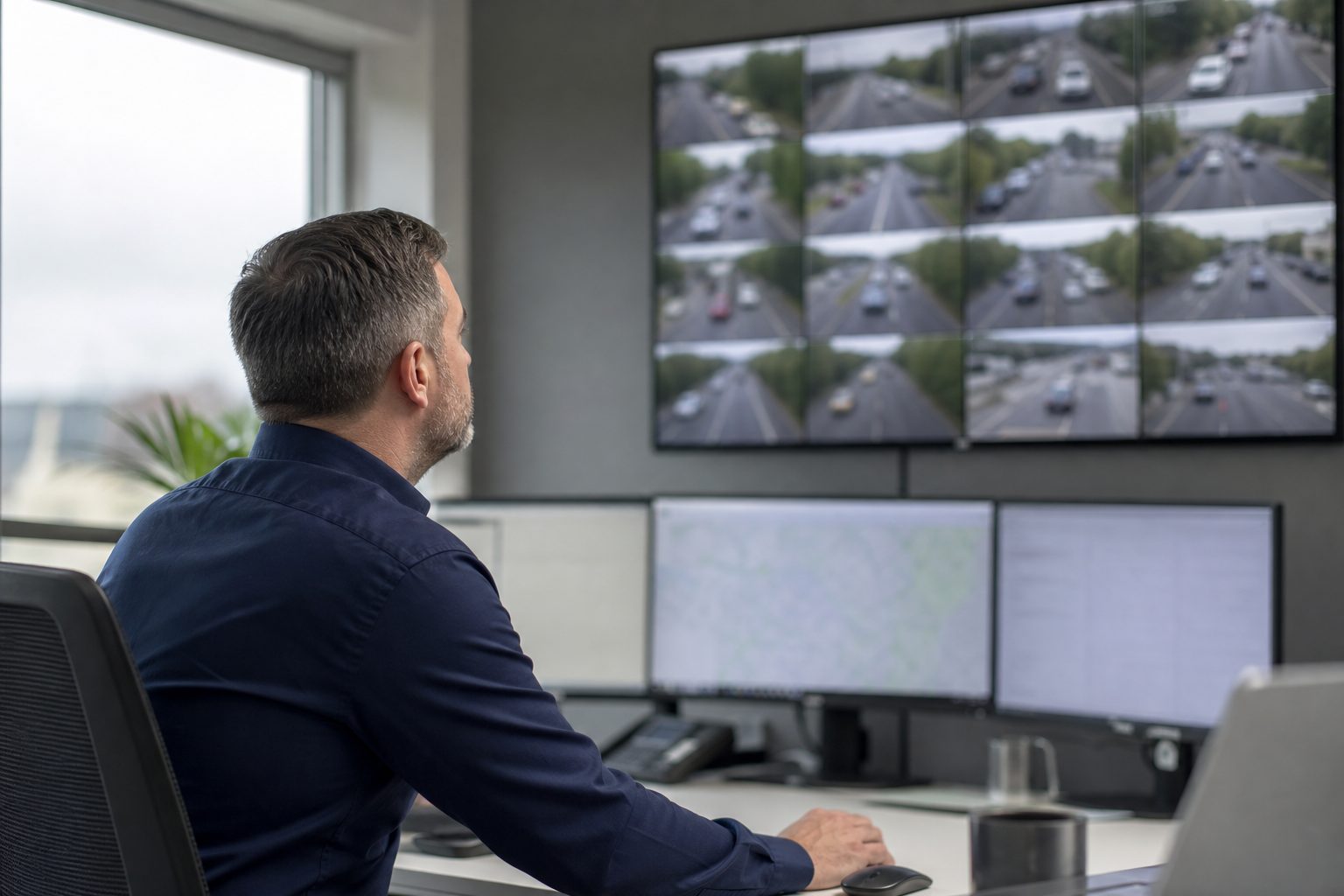
Live view, in a fleet camera context, means real-time access to your vehicle cameras from any device, anywhere. You open an app or a portal, select a vehicle or camera, and you see what that camera sees — right now, not a recording from last night.
The same technology that lets a transport manager monitor a vehicle’s position on-road also works when that vehicle is stationary in the yard. If your camera system supports live streaming, it doesn’t stop being useful at the depot gate. It runs round the clock — which is when depots are actually most exposed.
This is fundamentally different from passive CCTV recording. A recorder captures footage and stores it. Live view means someone can watch, respond, and intervene in real time. That distinction matters far more than most people realise when something is actively happening in your yard at 2am. Our live view monitoring guides cover the technical differences in more detail — the practical summary is this: one system gives you evidence after the fact, and the other gives you a chance to stop something while it’s happening.
Most depot security relies on a combination of perimeter fencing, lighting, and a fixed CCTV system with a recorder. This handles the obvious threat — a stranger walking in from the street. It handles less well the scenarios that actually cause the most losses.
Trailers, especially loaded or high-value ones, are frequently targeted by operators who understand fleet routines. They know when the yard is empty, which vehicles aren’t immobilised, and that most depot cameras are there to produce footage after an incident, not to catch one in progress.
We hear this regularly from fleet operators who’ve been through a theft. The footage was there, but it was after the fact. The trailer was already gone, the number plate was obscured, or the camera angle was wrong. A trailer stolen from a lot with chains on the gate and onsite security — it still happened, because passive physical measures don’t stop a determined actor who’s prepared for them.
Real-time live view with motion alerts lets someone respond while an incident is unfolding, not twelve hours later when the vehicle has already been moved or stripped. Police response times for commercial vehicle theft reports routinely exceed five hours. That’s five hours where your own monitoring capability either did useful work — or didn’t.
Fixed CCTV is installed at specific points around your site: the gate, the main parking area, the fuel point. It covers those fixed angles and nothing beyond them. If something happens outside those angles, you have a gap.
Vehicle-mounted live view cameras are mobile. Every vehicle in your fleet becomes a camera node. When those vehicles are parked in the yard, each one extends your coverage — capturing the surrounding area from multiple angles simultaneously. A 20-vehicle depot with live view capability effectively has 20 camera positions, repositioning every time drivers park differently.
There are other practical differences worth knowing:
In practice, fleet operators use live view at depots for several distinct scenarios:
After-hours access. Any vehicle movement outside normal operating hours triggers an alert. You check the live feed immediately and decide whether it warrants calling the police — or whether it’s the cleaners doing a late shift.
Loading and unloading verification. Disputed loads are a recurring operational problem. Live view lets you confirm, in real time or from timestamped footage, exactly what was on a vehicle when it left the yard. This is particularly valuable wherever cargo theft or load tampering is a concern.
Damage and liability. Vehicles pick up damage in yards regularly: during manoeuvring, reversing into bays, or from causes that aren’t immediately obvious. Live view footage with a timestamp resolves disputes quickly and limits unwarranted insurance claims.
Yard behaviour. Pre-departure checks skipped, handbrakes not applied, vehicles left running unattended — all visible remotely, without needing someone physically on-site to catch it happening.
Fuel siphoning detection. A persistent problem across HGV fleets. Siphoning from a parked truck takes several minutes of sustained access — detectable through motion-triggered recording or by reviewing footage from the relevant overnight window when a discrepancy is spotted.
The value scales with the risk profile of what you’re storing and operating. Fleets carrying high-value cargo — pharmaceuticals, electronics, construction materials — have the clearest case. But lower-value fleets have equally valid reasons to care about this.
Large vehicles (HGVs, plant, buses) represent significant capital per unit. A single theft or arson incident can put vehicles off the road for weeks while insurance resolves. For smaller operators running 5–20 vehicles, that level of disruption doesn’t just mean a financial loss — it can cost delivery contracts and customer relationships that took years to build.
FORS-accredited operators and fleets working under DVS compliance requirements already understand the value of camera evidence for regulatory purposes. Depot live view extends that evidence chain to the yard — where vehicles spend a substantial portion of their working lives, often with no monitoring at all.
If you’re evaluating whether your current camera setup extends usefully to depot monitoring, these are the questions worth asking before you commit to a configuration:
Can you access camera feeds remotely? Some MDVR systems record without transmitting. If footage only lives on a local SD card or hard drive inside the vehicle, you have recording — not live view.
Does the system work when the vehicle is stationary and the ignition is off? Some fleet camera systems only operate while the vehicle is powered. Depot monitoring requires cameras that can stay active in a low-power or hardwired mode after the driver walks away.
Is the cellular or Wi-Fi connection reliable in your yard? Live streaming requires adequate signal. Check coverage at your specific depot location — don’t assume it.
What does the alert threshold look like? Motion-triggered alerts are only useful if sensitivity is calibrated correctly. Too sensitive and you’ll be notified every time a bird lands on a bumper. Not sensitive enough and you’ll miss the incidents that actually matter.
How is footage stored and accessed? Cloud storage with timestamped footage and user-level access control matters for compliance — especially if footage is ever needed for an insurance claim or police investigation.
Does depot live view replace fixed CCTV? Not necessarily — the two systems are complementary. Fixed CCTV covers site-wide perimeter and entry points; vehicle-mounted live view covers the vehicles themselves and the immediate surrounding area. Most operators with serious security requirements run both.
Can live view cameras work when vehicles are parked with the engine off? Depends on the system. Some MDVRs have a parking mode that maintains low-power camera operation when the ignition is off. Confirm this before purchase if overnight depot monitoring is a requirement for you.
Does live view footage hold up as admissible evidence? Timestamped video footage from fleet camera systems is regularly used in insurance claims, police investigations, and employment disputes. The key factors are footage quality, chain of custody, and the storage format. Cloud-stored event clips are generally more reliable than footage retrieved from a local hard drive that has been powered off for several days.
What cellular signal level is needed for live streaming? Most live view platforms stream reliably on a 4G connection. Some compressed formats work on 3G, though quality and latency will vary. Check coverage at your specific depot location — don’t assume it’s adequate based on general area coverage.
How does depot live view work for multi-site fleets? A centralised platform lets you access cameras across all depots from a single login. You can view specific vehicles at specific sites without being physically present — useful for transport managers responsible for more than one yard.
Is there a GDPR consideration for depot camera monitoring? Yes. Cameras covering areas where staff work are subject to UK GDPR requirements around employee monitoring. Signage informing staff that cameras are in use, plus a documented data retention policy, are both required. Footage should be kept only as long as operationally necessary.
What’s the difference between a live view system and a standard dashcam? Consumer dashcams store footage locally on an SD card with no remote access capability. Fleet live view systems transmit over cellular, allow remote viewing, and use cloud storage — built for operational use and evidence retrieval rather than personal incident recording.
Can live view be used to check vehicle condition before drivers depart? Yes. Exterior cameras let transport managers identify visible defects before a driver leaves the yard — potentially preventing delayed starts and, in some cases, flagging issues that a driver might miss during a rushed pre-departure check.
Download this free checklist to audit your current live view setup or evaluate new systems for depot and yard monitoring.
Related guides: Setting Up Live Alerts for High-Risk Events: A Fleet Manager’s Configuration Guide · Creating Evidence Packs From Live Monitoring Footage
4 August 2026
Monday to Friday:
8.30am-5.30pm