
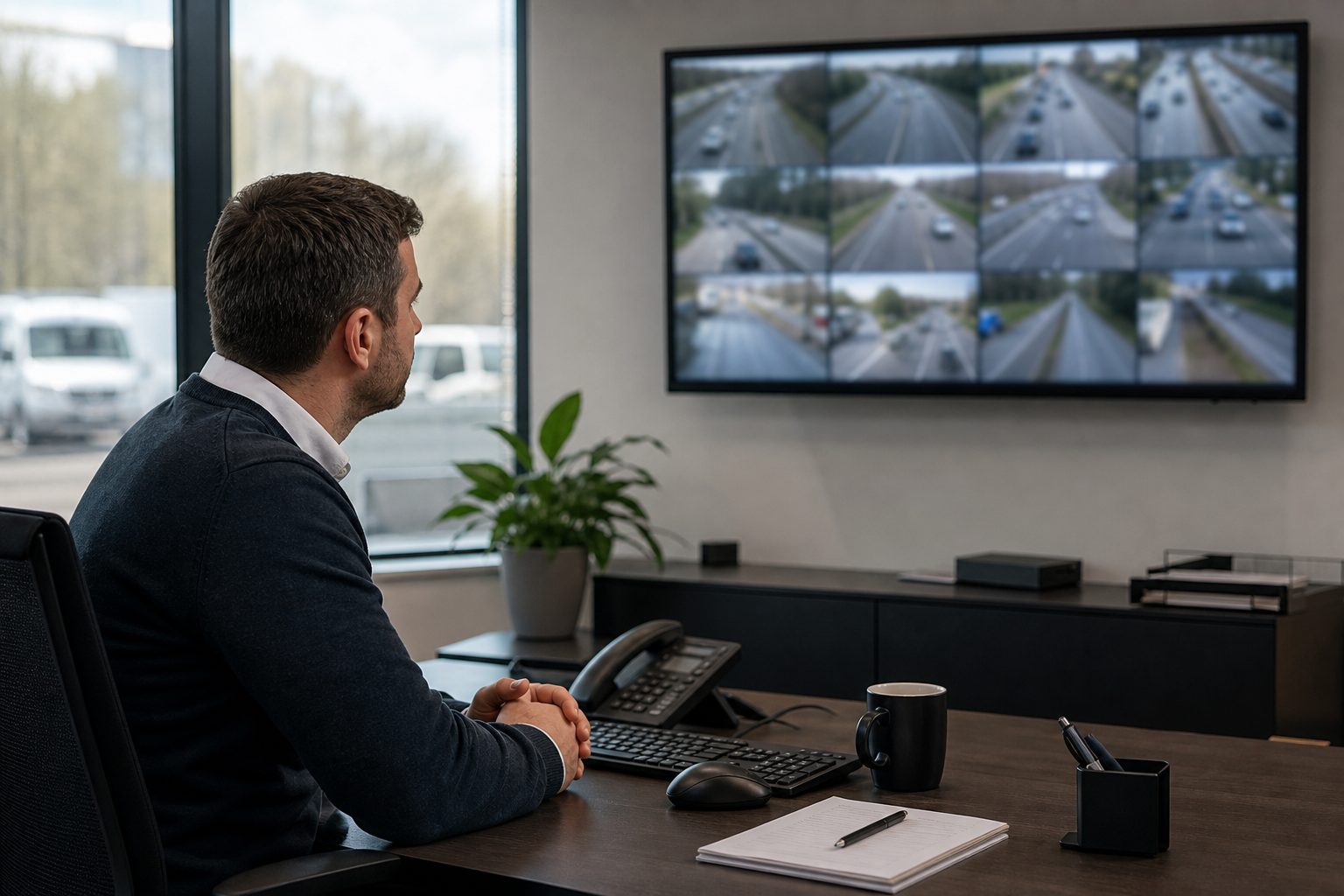
Fleet safety research consistently identifies the same mechanism at work when camera systems reduce accident rates: drivers who know their behaviour can be observed drive differently, even when nobody is actively watching. This is not unique to fleet monitoring — it reflects a well-documented pattern in workplace safety. Accountability shapes behaviour. The question for fleet managers is not whether the effect exists but how to make it durable, and how to use real-time monitoring to reinforce it at the moments when it matters most.
Live view monitoring operates on two levels. The first is the accountability effect — the background knowledge that any vehicle in the fleet can be checked at any time. The second is active intervention: a transport manager who sees something concerning via the live feed can contact the driver immediately, while the behaviour is happening or within seconds of it, rather than raising it the following morning from a recorded clip.
The accountability mechanism works because drivers cannot distinguish between the moments when they are being observed and when they are not. A driver who knows that their manager has live view capability — and that it has been used to check on vehicles during the current shift — adjusts their behaviour consistently, not just during the times they believe they are being watched.
Fleet managers who have introduced live monitoring alongside a clear driver briefing report consistent improvements in the specific behaviours most directly linked to accident risk: smoother braking, better following distance, reduced phone use. The briefing is important. The accountability effect is strongest when drivers understand what live view is used for — welfare checks, incident response, route management — rather than perceiving it as covert surveillance. Drivers who understand the purpose of the monitoring respond constructively to it. Those who feel surveilled without explanation often develop resentment that actively undermines the safety benefit.
A question that comes up regularly when fleet managers are introducing live monitoring is how much difference the briefing makes to outcomes. The research on driver monitoring systems suggests it makes a significant difference — not because drivers are trying to game the system when briefed, but because understanding the purpose of monitoring changes how they internalise the accountability. Monitoring that drivers understand as a safety tool drives behaviour change. Monitoring they experience as a management tool produces compliance rather than internalisation.
Live view enables the transport manager to see what a driver is doing. In-cab alerts change what the driver does without any manager involvement. The two mechanisms are complementary: in-cab alerts address the behaviour in the moment it occurs, live view enables the manager to check context and intervene when the alert does not resolve the situation.
Modern AI camera systems detect and alert on a comprehensive set of risk behaviours: forward collision risk, lane departure, harsh braking, sharp acceleration, speeding, driver distraction, fatigue indicators including head drop and eye closure, and mobile phone use. Each detection triggers an audible signal in the cab — a tone, a voice prompt, or both — while the driver still has time to correct their behaviour.
The effectiveness of in-cab alerts depends heavily on how they are configured. A 50-vehicle fleet with nine alert types enabled simultaneously can generate over 400 notifications per day across the fleet. On poorly configured systems, the majority of alerts go unreviewed by managers and drivers habituate to the in-cab signals within days. Alert fatigue does not just reduce the value of the system — it actively undermines safety by training drivers to tune out warnings that are supposed to prompt corrective action.
The configuration approach that produces lasting behaviour change starts with identifying the three or four behaviours most associated with incidents on your specific fleet — typically harsh braking, speeding, and distraction for most road freight operations. Calibrate thresholds for those behaviours first. Implement a five-second grace period that allows drivers to self-correct before the alert triggers. Review alert volumes in the first week and adjust if drivers are receiving more than two or three meaningful alerts per shift. A driver who receives ten alerts per shift will learn to ignore them. A driver who receives two or three alerts with clear significance will respond to each one.
Recorded footage from G-sensor events is the standard raw material for driver coaching. Live view adds the ability to conduct coaching that is contextual and immediate — a transport manager who observes a concerning behaviour via the live feed can call the driver while they are still on the route, address the specific behaviour, and discuss it while it is fresh rather than the following morning from a recorded clip reviewed out of context.
The coaching scenarios fleet managers describe most consistently are the ones that live view makes qualitatively different. A driver who is observed in a live view session following too closely in heavy motorway traffic receives feedback within minutes, while the conditions that produced the behaviour are still present. The same driver receiving feedback from a recorded clip the following morning is being asked to connect an abstract piece of footage to conditions they may not fully remember. The immediacy changes the quality of the coaching conversation.
Live view footage also provides the evidence base for coaching conversations that drivers are more likely to accept. A common pattern in driver coaching is drivers contesting their recollection of the event — they remember the journey differently, or they have a plausible explanation for the recorded behaviour. A live view session conducted in real time removes this contestability. The driver knows the manager was watching at that moment. The coaching conversation starts from a shared and current understanding of what happened rather than a dispute about footage from hours earlier.
The behaviour change figures from connected camera deployments with live monitoring capability are significant. Fleets typically report meaningful crash reductions within the first year of deployment, with corresponding reductions in at-fault claims. A study by the National Surface Transportation Safety Center for Excellence found that implementing in-vehicle monitoring led to a 60% reduction in speeding events and a 50% reduction in aggressive driving incidents. RoSPA data suggests that businesses adopting driver behaviour technology reduce accident rates by more than a third.
These figures reflect the combination of monitoring, alert feedback, and coaching — not live view in isolation. Isolating the live view contribution from the broader connected camera deployment is methodologically difficult. What is consistent across implementations is that fleets which actively use live monitoring as part of their driver management process — including the driver briefing, the in-cab alert configuration, and the real-time coaching capability — achieve better outcomes than those which install the same hardware and use it only for retrospective incident review.
For UK commercial fleets, the insurance implication is significant. Many insurers now offer premium reductions for fleets with connected camera systems. The reduction reflects the statistical evidence that monitored fleets have fewer at-fault incidents, not a policy preference. Fleets that can demonstrate active use of live monitoring and coaching — rather than passive recording — are often better positioned in renewal discussions.
Yes. The accountability effect — drivers adjusting behaviour because they know their vehicle can be observed at any time — is well-documented in fleet safety research. The effect is strongest when drivers are briefed on what live view is used for and understand it as a safety tool rather than covert surveillance. Fleets with connected monitoring consistently report reductions in harsh braking, speeding, and phone use following deployment.
In-cab alerts provide real-time feedback at the moment of a risky behaviour, while the driver still has time to correct it. Properly configured, they reduce the three or four behaviours most associated with incidents on your fleet. Poorly configured, they generate so many alerts that drivers habituate to them and stop responding. Start with a small, targeted alert set and calibrate thresholds before expanding to additional behaviour types.
For immediate behaviour change, yes. Coaching conducted while the driver is still on route, addressing behaviour observed in the last few minutes, is more actionable than feedback from a clip reviewed the following day. Recorded footage remains valuable for formal coaching sessions, performance reviews, and situations where the driver’s account of events needs to be addressed with time-stamped evidence.
Explain what live view is used for: incident response, welfare checks, route management, and real-time coaching. Be specific about when managers might check: if a G-sensor alert fires, if a vehicle stops unexpectedly, if weather conditions on a route are deteriorating. UK GDPR requires employees to be informed about monitoring systems. Practically, briefed drivers accept monitoring as a professional tool. Unbriefed drivers experience it as surveillance.
Briefing protocols, in-cab alert configuration, live view coaching steps, and ongoing monitoring review — a complete checklist for deploying live monitoring for driver behaviour improvement.
Tell us what vehicles you run and what you need — we will come back with a recommendation and a price. Prefer to talk? Call 01656 721871.
Related guides: Live View vs Recorded Footage: Pros and Cons · 10 Real Incidents Prevented by Live Monitoring
4 August 2026
Monday to Friday:
8.30am-5.30pm