
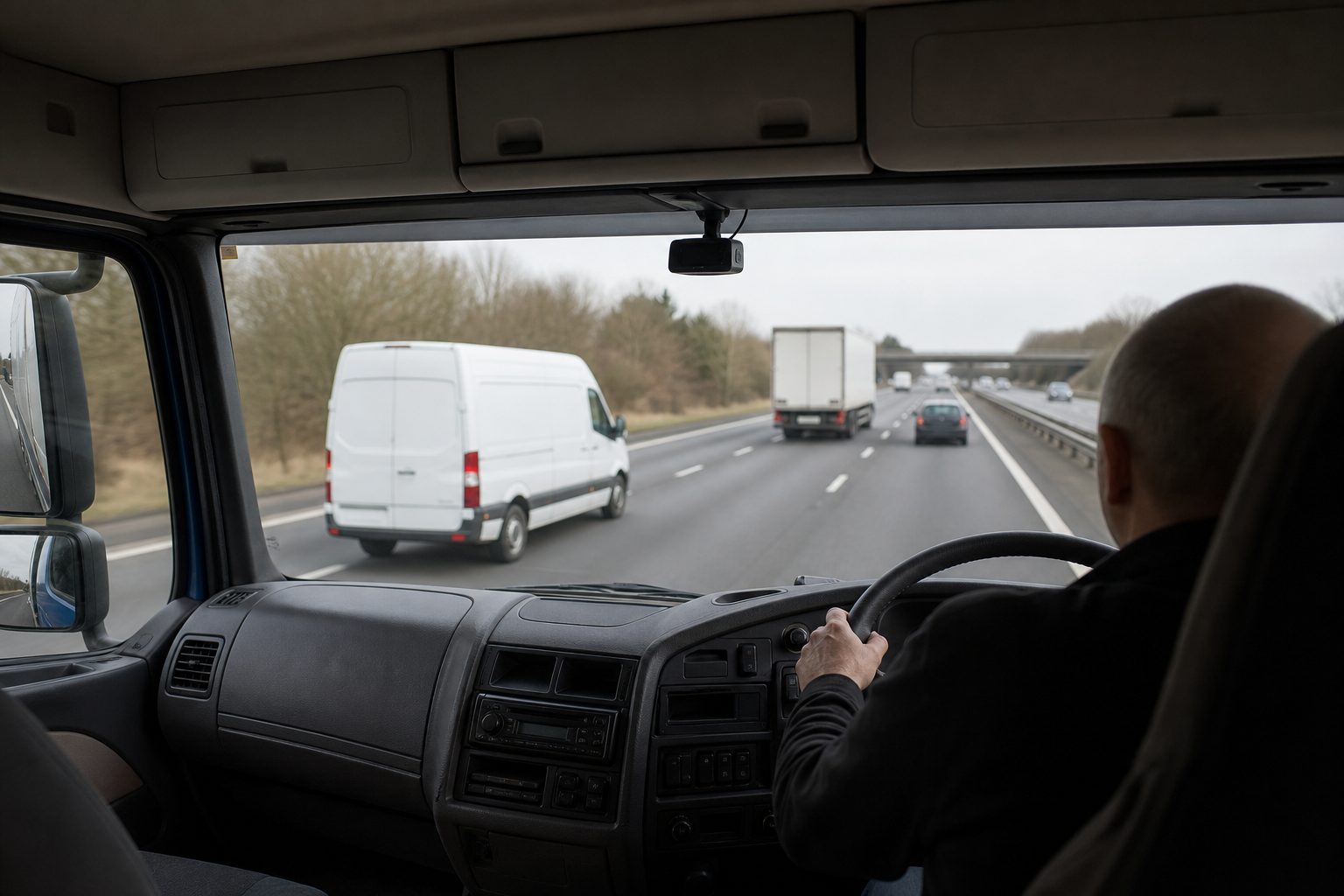
Fleet managers specifying a connected MDVR system often encounter live view and recorded footage as two separate features — one that streams what is happening now, one that stores what happened earlier. The instinct is to compare them and decide which matters more. That instinct leads to a false choice. Live view and recorded footage do different jobs, and the question is not which to prioritise but how to use both effectively.
This article covers what each capability does well, where each falls short, and the real-world scenarios that show why fleets relying on only one of them leave gaps in their evidence and operational management.
Recorded footage is the continuous, time-stamped video written to the MDVR’s local storage throughout the vehicle’s operating day. It captures everything: the normal journey, the near-miss, the incident, and everything before and after. It does this whether or not anyone is watching, and it continues regardless of network coverage, platform availability, or transport manager workload.
The primary value of recorded footage is its completeness and permanence. When an insurer needs evidence, when a solicitor requests disclosure, when an HSE investigation requires the factual record of a workplace incident — the recorded footage is the authoritative source. Its value derives from the fact that it was made at the time of the event, not retrieved after the fact, and that it captures the full sequence of events rather than a clip triggered by a particular threshold.
Recorded footage also drives the retrospective coaching function. A transport manager reviewing G-sensor events from the previous week, working through a driver debrief, or building an evidence case for a training programme is using recorded footage. The review happens on a schedule that suits the manager, not in response to a live event.
The limitations of recorded footage are equally clear. It is historical. By the time a transport manager identifies a concerning event in the recorded footage, the vehicle has moved on, the driver has continued their shift, and the opportunity to intervene in that specific situation has passed. For incidents that need an immediate response — a driver welfare concern, a collision in progress, a vehicle stopped in an unsafe location — recorded footage tells you what happened but not what is happening.
Live view is the real-time operational tool. A transport manager who opens the fleet platform and requests a live camera feed from a specific vehicle sees what the driver is seeing, as it is happening — typically with 3–8 seconds of latency from vehicle to screen. The value is in the present tense: it enables a response calibrated to current conditions.
The intervention scenarios where live view changes outcomes are specific. A driver has stopped unexpectedly and is not responding to calls — live view of the driver-facing camera confirms whether this is a breakdown, a medical situation, or a communication failure. A G-sensor alert has fired on a vehicle — the transport manager can check whether the vehicle is stationary and the driver is safe, rather than waiting for a callback. Weather or road conditions on a particular route are deteriorating — live view of one vehicle shows what other drivers on the same route are about to encounter.
Live view also enables real-time delivery and route verification without waiting for footage retrieval. A customer disputes that a vehicle attended a particular address. The transport manager can check the live GPS position and, if the vehicle is still in the area, confirm via the camera feed. A question that comes up regularly from fleet managers who have had this situation is how they managed before they had the capability — and the answer is usually that they could not respond credibly until the vehicle returned and footage was manually reviewed.
The limitations of live view are also real. It consumes data continuously — a single-channel standard definition stream uses approximately 250–400MB per hour, which is manageable for selective use but significant at scale. It requires 4G coverage at the vehicle location; in weak-signal areas the stream will buffer or drop. And it is impermanent — the transport manager watching live view is not creating a separate recording. If something significant happens during a live view session, the evidence is the recorded footage, not the live observation.
The clearest demonstration of why both capabilities matter is the incident management workflow. A G-sensor alert fires on a vehicle. The transport manager opens live view immediately — this takes seconds — and sees the current state of the vehicle. The driver is stationary on the hard shoulder, appears unhurt, is on the phone. The transport manager calls to confirm the driver is safe and requests they stay put pending recovery. They then switch to the recorded footage from 90 seconds ago and review the sequence of events: the approaching vehicle, the impact, the drift to the hard shoulder. This view goes to the insurer within minutes.
In this scenario, live view answered the welfare question. Recorded footage answered the evidence question. Neither could have done the other’s job.
A fleet running recorded footage only would have the evidence but no ability to confirm the driver’s welfare until a callback or vehicle return. A fleet relying only on live view would have the welfare confirmation but no time-stamped footage sequence for the insurer. The combination is what makes the response both immediate and complete.
Certain fleet operations weight one capability more heavily than the other, though rarely to the exclusion of the second.
Operations where live view is the primary operational tool: Long-distance haulage, where drivers are operating independently for extended periods and welfare checks are genuinely needed. Fleets with high false-claim exposure — particularly urban delivery operations where vehicles are frequently in proximity to vulnerable road users — benefit significantly from the ability to check the current state of a vehicle in real time when a claim is called in.
Operations where recorded footage is the primary evidence tool: Any fleet with HSE or insurance obligations — which is all commercial fleets — depends on recorded footage as the first line of defence. Waste collection, construction, and transport operations all encounter situations where the recorded sequence of events is the difference between a contested claim and a clear liability outcome.
Operations that need both equally: Mixed urban/rural fleets, council and local authority vehicle operations, and any fleet where individual drivers operate without consistent direct oversight benefit from the combination of real-time visibility and a complete recorded archive.
The practical specification question for fleet managers is how to configure a connected MDVR system to get value from both capabilities without creating operational overhead.
For recorded footage: storage should be sized for the retention window required. A 1TB HDD at 4-channel standard definition retains approximately 15–21 days before loop overwrite. For GDPR compliance — which requires footage to be retained for no longer than necessary, typically interpreted as 28–31 days for fleet operations — a 2TB drive provides comfortable headroom for most 4–8 channel systems. G-sensor event clips are the priority retention item and should be exported to the fleet platform promptly, before rolling overwrite removes them.
For live view: most fleet managers use it selectively — opening a feed for a few minutes when circumstances warrant, not monitoring continuously. At selective usage, the data consumed by live view is modest. The configuration decision is ensuring that the SIM plan includes sufficient data for the expected live view usage pattern, which varies significantly by fleet type and operational environment.
Both capabilities are included in a connected MDVR platform subscription. Live view is not a separate product — it is part of the remote access functionality that 4G connectivity enables. The question is not whether to add it but whether the transport manager has the processes in place to use it when it matters.
They serve different purposes, so neither is categorically better. Recorded footage is the complete, permanent evidence archive — it captures everything whether or not anyone is watching. Live view enables real-time intervention and welfare checks. Most fleet operations benefit from both: recorded footage for evidence and coaching, live view for situations where knowing what is happening now changes the quality of the response.
No. Live view and recorded footage are independent functions. The MDVR records continuously to local storage regardless of whether a live view session is active. Watching a vehicle in live view does not create a separate recording, but it also does not interrupt or affect the continuous recording already in progress.
Significantly more. A single-channel live view stream at standard definition uses approximately 250–400MB per hour. Event-triggered clip upload — a 30-second to 2-minute clip sent to the platform when a G-sensor threshold is met — uses a few megabytes per clip. At selective live view usage, the data difference is manageable. At continuous multi-channel streaming it requires a dedicated higher-data SIM plan.
Live view itself is not separately recorded — what you watch in a live view session is the same footage being written to the MDVR’s local storage. That recorded footage is available for retrospective review in the normal way. If something significant happens during a live view session, the evidence is in the MDVR’s stored footage, not the live observation.
For a small fleet with a single transport manager, recorded footage typically delivers more immediate value — it provides the evidence base for insurance claims and driver coaching that every commercial fleet needs. Live view adds real-time operational capability that compounds in value as the fleet grows and the manager’s ability to physically check on vehicles diminishes. On a connected MDVR platform, both are available simultaneously; the question is workflow and process rather than a binary choice.
Configuration checklists for both live view and recorded footage, plus an incident response workflow showing how to use both capabilities together.
Tell us what vehicles you run and what you need — we will come back with a recommendation and a price. Prefer to talk? Call 01656 721871.
Related guides: How Live View Helps Prevent Accidents · How Live View Improves Driver Behaviour
4 August 2026
Monday to Friday:
8.30am-5.30pm