
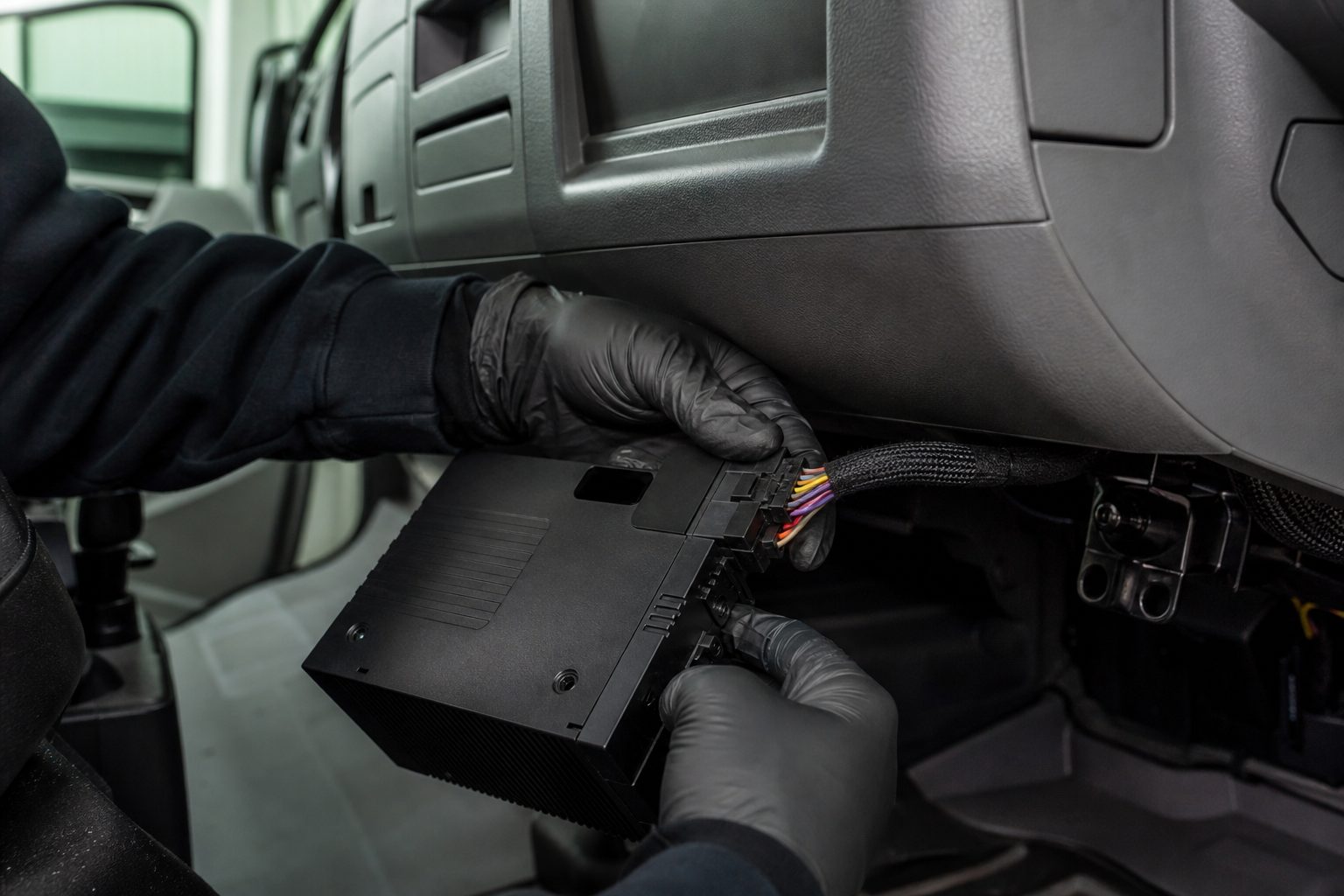
The most common MDVR specification mistake is not choosing the wrong system — it is choosing a system based on the smallest vehicle in the fleet rather than the most demanding use case. A 4-channel MDVR that works well on a small van does not scale to a tipper lorry or an articulated vehicle without a replacement. Fleet managers who specify a single MDVR model across a mixed fleet often find themselves running two or three different systems within a year as operational requirements reveal themselves.
The right MDVR for your fleet is determined by four decisions: how many cameras the vehicle needs, how much storage is required to meet your retention obligations, whether remote access is operationally necessary, and whether compliance requirements (DVS, CLOCS, FORS) impose specific capability requirements. This guide covers each decision in sequence.
MDVR channel count determines how many cameras the unit can support simultaneously. The decision is made at the vehicle level, not the fleet level — a 4-channel MDVR on a 7.5-tonne box van may be entirely appropriate while an 8-channel MDVR on a 44-tonne artic is a minimum specification.
4-channel MDVR: Suits small and medium commercial vehicles where forward-facing, nearside, offside, and rear cameras provide adequate coverage. Typical applications: vans, pick-ups, 7.5-tonne rigids, light plant. 4-channel systems are lower cost, simpler to install, and cover the majority of incident evidence needs for standard commercial vehicle operations.
8-channel MDVR: Suits larger HGVs, specialist vehicles, and any vehicle where the operating environment creates additional camera requirements. An 8-channel system on a tipper lorry can support forward, nearside, offside, rear wide-angle, rear working area, bin lift or load area, and driver-facing cameras — with a channel to spare for expansion. 8-channel should be the default specification for any vehicle over 7.5 tonnes or any vehicle with specific compliance requirements.
12-channel and above: Required for articulated vehicles (multiple cab-unit cameras plus a single trailer camera channel — the cab-to-trailer link carries one channel only), coaches and buses (multiple passenger cabin cameras plus exterior), and specialist vehicles with extended coverage requirements. High-channel MDVR systems typically require higher-capacity storage to match the increased footage volume.
A question that comes up regularly is whether to specify 8-channel for vehicles that currently only need 4 cameras. The answer is generally yes — the marginal cost of an 8-channel over a 4-channel MDVR is modest, and installing an 8-channel system now avoids the cost and disruption of replacing a 4-channel unit when a new compliance requirement or operational need arises.
MDVR storage determines how many days of footage can be retained before loop overwrite, and whether the storage medium can withstand the operational environment. Three storage configurations exist:
SD card: Low cost, easy replacement, suitable for systems where footage is regularly downloaded or where a short retention window (3–7 days) is acceptable. SD card storage has lower capacity limits than HDD — a 256GB SD card at 4-channel standard definition retains approximately 5–7 days. Not suitable for high-channel systems or vehicles where 30-day retention is required for GDPR compliance.
HDD (hard disk drive): Higher capacity (1TB–2TB typical for fleet MDVRs), suitable for extended retention requirements. A 1TB HDD at 4-channel standard definition retains approximately 15–21 days; at 8-channel, proportionally less. HDD storage requires vibration tolerance specifications appropriate for the vehicle type — a tipper lorry or off-road plant vehicle generates vibration profiles that can shorten HDD life if not specified correctly. SSD (solid state drive) is the preferred alternative on high-vibration vehicles as it has no moving parts.
Hybrid (HDD + SD): The most flexible configuration — the HDD provides primary high-capacity storage while the SD provides a secondary copy of G-sensor event footage, ensuring that critical incident clips are retained on a separate medium even if the primary HDD is damaged in a severe incident. Hybrid storage is the recommended specification for any vehicle where incident footage protection is a priority.
A connected MDVR has 4G capability, allowing footage to be accessed remotely via the fleet management platform without the vehicle returning to depot. G-sensor events are uploaded automatically. The transport manager can request specific footage from any vehicle in the field. A non-connected MDVR records to local storage only — footage is retrieved when the vehicle returns and the storage is physically extracted or connected via USB.
For most commercial fleet operations, connected is the correct choice. The operational case is straightforward: the majority of incident management scenarios require access to footage quickly, not at the end of the shift. A third-party claim submitted on the day of an incident can be addressed immediately with connected footage. The same footage accessed by physical extraction 12 hours later, after the driver has returned, refuelled, and handed the vehicle over, is retrieved too late to shape the first response to the claim.
The cost differential between connected and non-connected MDVRs has narrowed significantly. A fleet SIM plan for 4G event upload typically costs £3–8 per vehicle per month at standard event-triggered data volumes. For most fleets, this cost is recovered in a single insurance claim resolution. The argument for non-connected systems is primarily for vehicles in environments where 4G coverage is permanently unavailable — underground operations, remote sites with no cellular coverage — which describes a small minority of UK fleet use cases.
Compliance requirements can override other specification decisions. If a vehicle needs to meet DVS/PSS requirements for London operation, the nearside camera and in-cab monitor are mandatory regardless of the fleet manager’s preferences. If a vehicle is on CLOCS-governed site contracts, nearside camera and MOIS compliance are required. If the fleet is pursuing FORS Silver or Gold accreditation, the camera system must support the evidence retrieval capability that FORS audits require.
For UK commercial fleets in 2026, the practical specification implication is:
Any HGV over 12 tonnes with London routes: 8-channel MDVR minimum, nearside camera, in-cab monitor, 4G connected, hybrid storage recommended. The PSS requirement means nearside coverage is non-negotiable, and connected footage access supports the incident management process that regular London urban operation generates.
Construction vehicles on CLOCS sites: 8-channel minimum, nearside camera, in-cab monitor. Same logic as DVS — the site entry requirement determines the camera specification, not the transport manager’s preference.
Standard HGV or van fleet without London/CLOCS exposure: 4-channel may be appropriate for smaller vehicles; 8-channel recommended for vehicles over 7.5 tonnes. Connected strongly preferred for all vehicles where incident management speed matters.
Smaller fleets (under 10 vehicles) often approach MDVR specification as a per-vehicle decision, choosing each unit based on the specific vehicle. This works but creates management complexity if multiple MDVR models are in use simultaneously — different platforms, different footage retrieval processes, different maintenance spares.
Larger fleets benefit from standardising on a single MDVR model and platform across the fleet, specifying to the most demanding vehicle type in the fleet. The operational overhead of managing multiple MDVR systems — particularly when incidents require footage from multiple vehicles — is significant. A fleet of 50 vehicles running three different MDVR systems requires three different retrieval workflows, three different platform logins, and three sets of support relationships. A single platform across the fleet reduces this to one.
For mixed fleets with both vans and HGVs, a practical approach is two MDVR specifications: a 4-channel connected model for vans, and an 8-channel connected model for HGVs. Both on the same fleet management platform. This balances the cost of over-specifying vans against the operational simplicity of a single platform view.
For vehicles up to 7.5 tonnes with no specific compliance requirements, 4-channel is typically sufficient. For HGVs over 7.5 tonnes, specialist vehicles, or any vehicle with DVS, CLOCS, or FORS compliance requirements, 8-channel is the appropriate starting point. When in doubt, specify 8-channel — the marginal cost is modest and it avoids a replacement when requirements change.
A 1TB HDD provides 15–21 days retention at 4-channel standard definition. For 8-channel systems or HD recording, a 2TB HDD is more appropriate for 30-day retention. For high-vibration vehicles (tippers, off-road plant), SSD storage is recommended. Hybrid storage (HDD + SD card event backup) is the most resilient configuration for incident-critical footage.
For most commercial fleet operations, yes. Connected MDVR enables footage access without vehicle return, automatic G-sensor event upload, and real-time fleet visibility. The cost of 4G connectivity is typically £3–8 per vehicle per month. For fleets where incident management speed matters — which is most commercial fleets — connected pays for itself in the first resolved claim.
A pre-purchase specification checklist for fleet MDVR systems, covering channel count decisions, storage type selection, connectivity requirements, compliance checks (DVS/CLOCS/FORS), and fleet standardisation guidance.
Tell us what vehicles you run and what you need — we will come back with a recommendation and a price. Prefer to talk? Call 01656 721871.
Related guides: MDVR Systems for Construction Vehicles · Camera Placement for Construction Vehicles
4 August 2026
Monday to Friday:
8.30am-5.30pm