
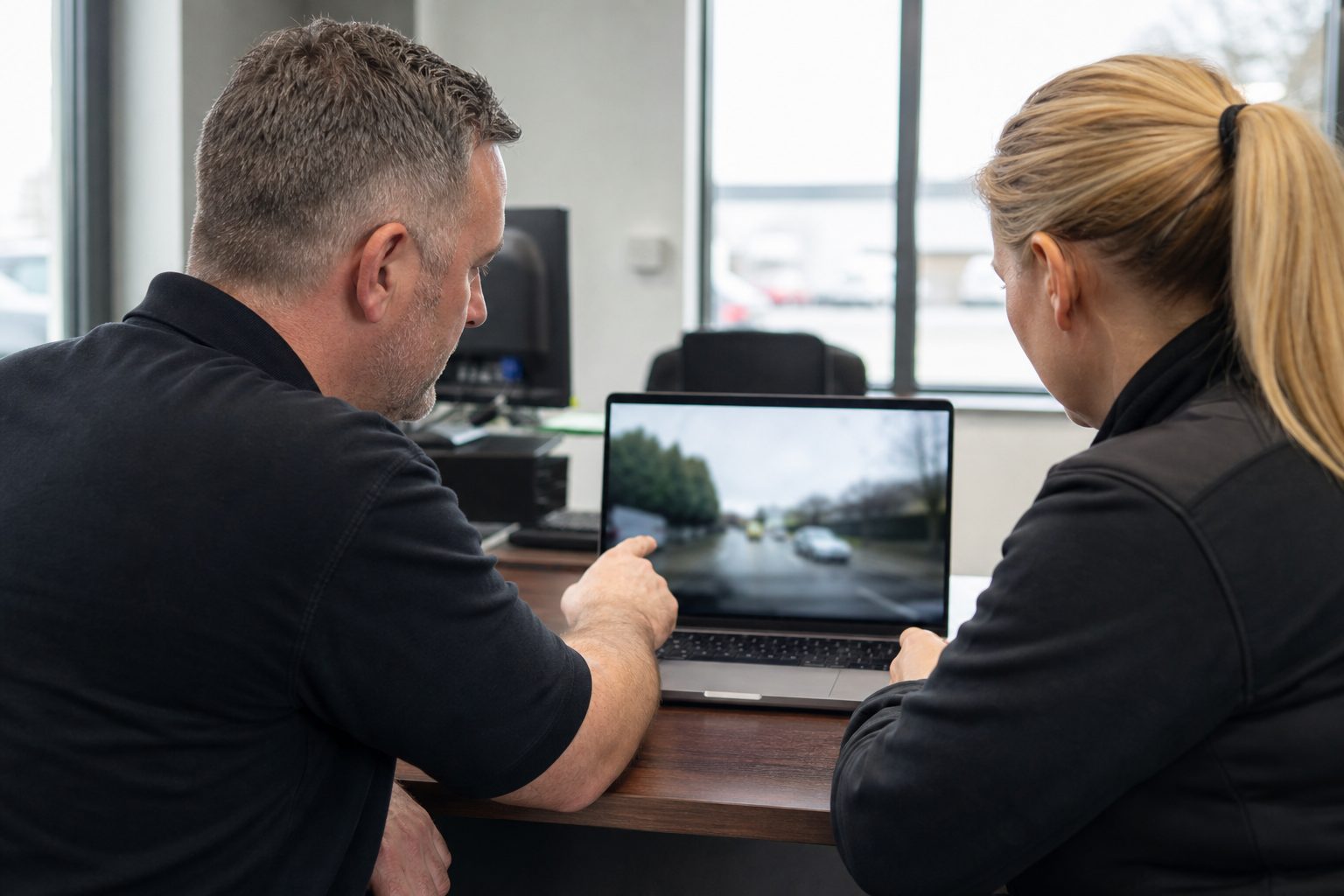
You have the footage. Every harsh braking event, every near-miss, every red-light run — sitting in a cloud inbox or on a hard drive, generating alerts that somebody has to deal with. The cameras are installed. The hard part, it turns out, is building a training programme around what they capture.
Fleet managers running driver coaching programmes with in-vehicle footage consistently outperform those who use cameras only for incident investigation. A study by the National Surface Transportation Safety Center for Excellence found that fleets combining in-cab video with structured coaching reduced safety-related accidents by 52%. The footage is not the asset — the coaching conversation it enables is.
This guide covers how to run that programme: which footage to use, how to structure a session, how to get driver buy-in without creating a surveillance culture, and how to stay on the right side of UK data protection law.
Think of vehicle footage the way professional sports teams use game film. The clip does not accuse the driver of anything — it shows what happened, in context, without argument. That shift from “your manager says you did X” to “here is what the camera captured” changes the entire conversation.
In a well-run coaching programme, the driver watches the clip first and narrates what they see. What road conditions were present? What was the vehicle doing? Was there a contributing factor the clip does not show — a pedestrian stepping out, a pothole, an emergency stop by the vehicle ahead? This approach treats the footage as a shared starting point for a professional conversation, not as prosecution evidence.
The results when coaching is structured this way are measurable. Fleets that implement footage-based coaching in a structured way consistently report meaningful drops in harsh braking and speeding within the first year. Those are not abstract safety statistics — they directly reduce tyre wear, fuel consumption, and insurance claims.
Not all footage is equal for training purposes. The most useful clips fall into three categories.
Near-miss events. G-force-triggered clips from harsh braking, sharp cornering, or emergency manoeuvres. These are the highest-value training material because they show real-world hazards that were successfully avoided — sometimes only just. Reviewing a near-miss with a driver while the scenario is still fresh produces better behaviour change than any classroom simulation.
Pattern incidents. A single speeding event might be a one-off. Three speeding events on the same road over three weeks is a habit. Footage review gains most of its power when it identifies patterns across multiple trips — something a human reviewer looking at individual clips will miss, but which analytics dashboards surface automatically.
Positive examples. The coaching conversation that only ever shows drivers what they did wrong will eventually breed resentment. A question that comes up in every fleet coaching conversation is whether cameras are only used to catch mistakes. The answer should demonstrably be no. Footage of a driver handling a genuinely difficult manoeuvre well — reversing cleanly into a tight loading bay, navigating a contraflow with appropriate clearance — is valuable recognition material.
Multi-channel systems add a further dimension. A single forward-facing dash cam shows what the vehicle was heading towards. A four- or eight-channel MDVR system — covering nearside, offside, rear, and driver-facing angles simultaneously — shows the full operating picture: how the driver positioned the vehicle on approach, whether blind spots were checked, how the load shifted during hard cornering. For fleets running large vehicles, articulated trailers, or drivers reversing into confined spaces, the single-cam view is simply insufficient for meaningful coaching.
Here is the reality that fleet managers consistently encounter when introducing camera coaching programmes: experienced drivers hear “surveillance,” not “training.”
This is not irrational. The pattern documented across fleet forums and by transport managers themselves runs consistently: cameras are introduced as a safety tool, then within 18 months they are used for disciplinary write-ups, and drivers who raise the discrepancy are told the policy has not changed. We hear this from fleet managers who have been through a failed camera rollout. The turning point is always the same — the first time footage is used in a disciplinary hearing rather than a coaching conversation.
The practical steps that consistently make the difference:
Communicate before installation, not after. Drivers who find out about cameras from a colleague rather than from management will assume the worst. Explain what the system captures, who reviews it, when footage can be accessed, and what happens when an event is flagged — before the cameras go in.
Establish event-triggered review, not continuous monitoring. Drivers can work with an AI system that captures clips when a harsh event occurs. They cannot work — and will not stay — with the knowledge that someone could be watching them live at any moment. Industry surveys consistently find that most drivers approve of in-vehicle cameras when the purpose is clearly communicated as safety. Approval drops sharply when drivers suspect live access is routine.
Make the exoneration story visible. The most powerful thing that can happen in a camera programme’s early months is footage clearing a driver of a false accusation — a third-party claim, a customer complaint, a disputed incident. When drivers see cameras protecting them, the framing shifts. Cameras have cleared us of liability a number of times, and drivers see that now — this is the sentiment that marks the transition from a resented programme to an accepted one.
Default to coaching, not discipline. The policy should state explicitly that a first flagged event triggers a coaching conversation, not a written warning. Fleet managers who document this in writing and honour it earn the trust that makes driver buy-in compound over time.
Having footage and knowing what to do with it in a one-to-one conversation are different skills. The structured coaching model that produces measurable behaviour change follows five stages.
1. Schedule promptly. The coaching conversation should happen within two to three days of the event, while the road scenario is still fresh. A clip reviewed three weeks later loses its teachable power — the driver cannot reconstruct the context, and the conversation becomes abstract.
2. Prepare the session. Watch the clip at least twice before the meeting. Check whether the driver has prior events of a similar type — a pattern of harsh braking on motorway approaches points to a different intervention than a one-off event in unusual traffic conditions. Go into the session with context, not just a clip.
3. Open with rapport. Acknowledge the driver’s time and open with something genuine. A driver who walks into a coaching session expecting a dressing-down will not absorb coaching — they will be managing their own stress response. An experienced driver with a good record should hear that acknowledged before the clip plays.
4. Let the driver narrate first. Play the clip and ask the driver what they see. What was happening on the road? What were they responding to? This is not an interrogation — it is a technique that produces better outcomes because the driver’s own analysis of their behaviour is more durable than being told what they did wrong. Ask about contributing factors. Agree on the correction together rather than delivering it as an instruction.
5. Close with a specific commitment. “I’ll be more careful” is not a coaching outcome. “I’ll increase my following distance on A-road approaches to three seconds and use the nearside camera check on every left turn at this junction” is a measurable commitment that subsequent footage can verify. Document it.
One application of vehicle footage that rarely appears in fleet safety literature but consistently comes up in practice: using footage of experienced drivers as induction material for new starters.
A new driver joining a fleet that operates in complex urban environments — loading bays, contraflows, tight streets, high pedestrian density — faces a learning curve that classroom training cannot compress. Footage of an experienced driver navigating those same scenarios, with commentary, provides the kind of contextual preparation that a diagram cannot replicate. New drivers can watch how a senior colleague approaches a reversing manoeuvre — the mirror sequence, the approach angle, the use of the nearside camera — before they encounter the scenario on the road themselves.
Multi-camera systems are particularly well-suited to this. All camera angles from a competent manoeuvre can be played together: the driver-facing view showing mirror checks, the nearside view showing clearance from parked vehicles, the rear view showing the final reversing position. It compresses the informal learning that used to happen through extended accompanied runs.
Fleet managers operating driver-facing cameras in the UK need a documented lawful basis under UK GDPR. The ICO’s position is that driver-facing cameras in commercial vehicles can be operated lawfully under legitimate interests — provided the data is used for the stated purpose, proportionately, and with appropriate retention limits.
In practice, this means:
The practical recommendation: before installing driver-facing cameras, have a privacy notice specific to the fleet camera programme reviewed by your HR adviser or employment solicitor. The cost of that review is a fraction of the cost of an employment tribunal where undocumented camera policies have featured in unfair dismissal claims.
A question that comes up in every conversation about footage-based coaching is how long before results are visible. Evidence from UK fleet deployments points to a consistent pattern:
The ROI argument rests on a calculation that fleet managers often overlook: driver turnover costs a fleet £8,000 to £12,000 per driver. A well-run coaching programme that retains experienced drivers — who accept cameras when they are used fairly — pays for the entire camera system within a handful of prevented departures.
For fleet managers starting from scratch, these are the steps that separate programmes that produce behaviour change from those that generate resentment:
Yes — but only when coaching conversations follow a structured format and footage is reviewed consistently. Fleets that install cameras without a coaching programme typically see a short-term behaviour improvement followed by reversion within three to six months. Structured coaching programmes show measurable behaviour change at six months and sustained improvement at twelve.
Forward-facing footage is sufficient for many training scenarios — speed compliance, following distance, junction behaviour. Driver-facing cameras add value where distraction events are a priority — phone use, fatigue indicators, seatbelt compliance. Multi-channel MDVR systems provide the widest training perspective, covering blind spots, reversing manoeuvres, and nearside events that a single forward-facing camera misses entirely.
The consistent evidence from fleets that have navigated this successfully points to three non-negotiables: communicate before installation (not after), establish event-triggered review rather than continuous monitoring, and make the exoneration use case visible early. When drivers see footage protecting a colleague from a false claim, the framing shifts from surveillance to protection — and that shift is durable.
Yes, under UK GDPR’s legitimate interests basis — provided drivers are informed in writing before the system is activated, footage is used for the stated purpose, and a documented retention policy exists. Audio recording in the cab carries higher compliance requirements and needs specific justification. The ICO does not typically pursue individual fleet operators, but employment tribunals have heard claims where undocumented camera policies were used in disciplinary proceedings.
Most UK fleets operate a 30-to-90-day rolling retention window for routine footage. Event footage linked to an incident, insurance claim, or coaching session is typically retained longer — up to 12 months — to support any investigation. Your retention policy should be documented and communicated to drivers as part of the fleet camera policy.
Event-driven coaching — triggered by a specific flagged incident — is the foundation. Many fleets add a periodic review, quarterly or six-monthly, where footage from the preceding period is reviewed even without a specific triggering event, to identify patterns that individual-event coaching might miss. The coaching session itself should cover one or two events maximum; covering six events in a single session generates overwhelm rather than learning.
Yes, and this is one of the most underused applications. Footage of experienced drivers navigating complex scenarios — reversing into tight bays, urban routes with high pedestrian density, specific loading areas — can be used as induction material. It compresses informal learning that previously required extended accompanied runs, and multi-channel footage provides context that a single-camera view cannot match.
AI false positives are the fastest way to destroy the credibility of a footage-based coaching programme. Drivers who receive coaching notifications for mirror checks or drinking water will stop engaging with the system — and sometimes find collective ways to make the false-positive rate economically unviable for the operator. The answer is a human review stage between AI detection and coaching escalation, so only genuine events reach the coaching conversation. When selecting camera systems, ask suppliers for documented false-positive rates on their driver-facing AI detection — it is a specification point that significantly affects programme viability.
Five steps to launching a footage-based driver coaching programme that improves behaviour and builds driver trust.
Tell us what vehicles you run and what you need — we will come back with a recommendation and a price. Prefer to talk? Call 01656 721871.
4 August 2026
Monday to Friday:
8.30am-5.30pm