
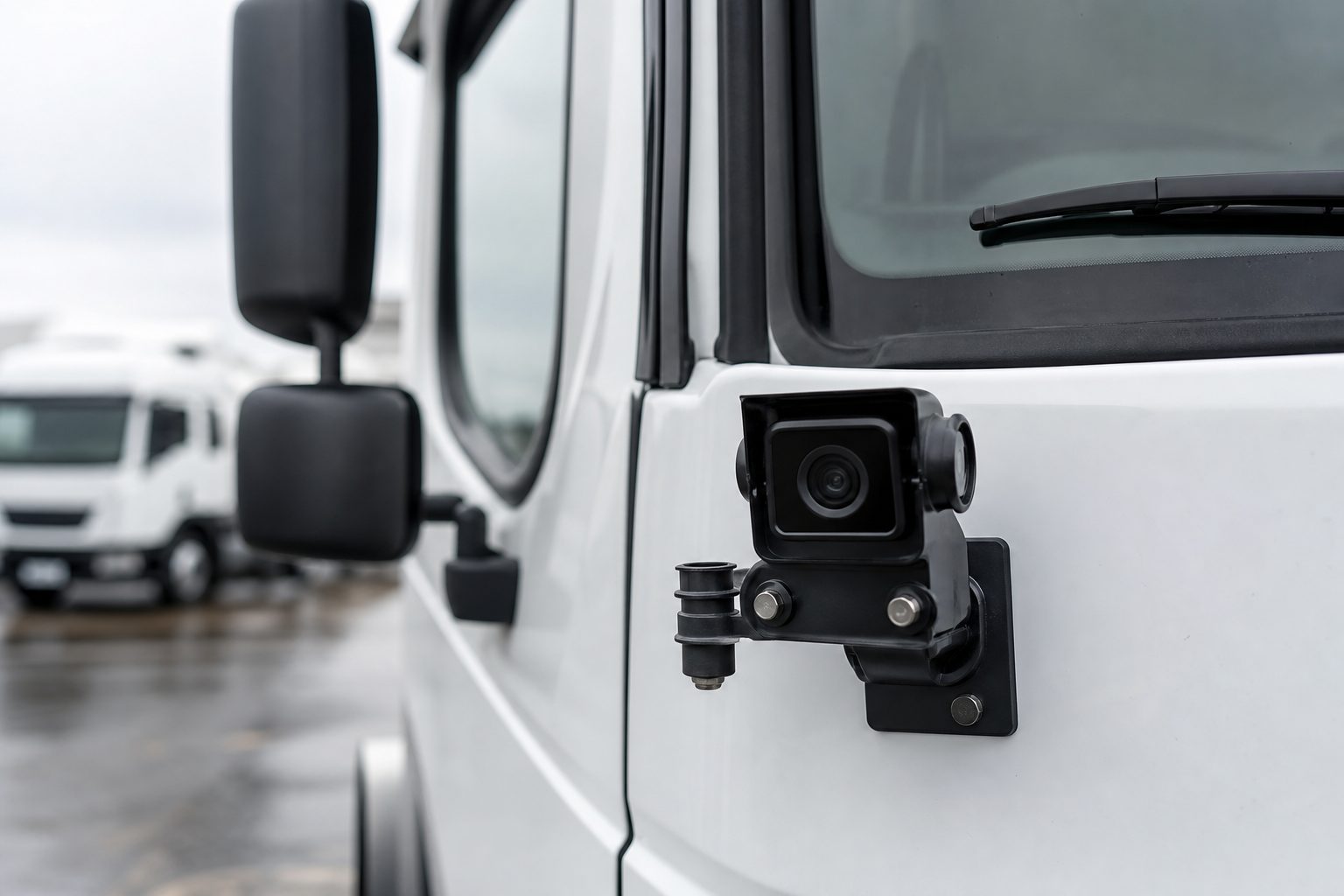
Audio recording in fleet vehicles is one of those topics where the desire to do it and the ability to do it legally are very different things. The desire makes sense: audio can capture what video misses — a verbal confrontation at a loading bay, a passenger making a threat, a driver’s state of mind at the moment of an incident. The technology is there. Many camera systems can record audio as standard. So why does the ICO’s guidance read like a yellow card?
This article gives you the honest picture. Not a summary of what’s theoretically permitted, but a practical view of what the ICO actually says, what the risks are, and whether audio recording is likely to be worth the compliance overhead for your operation — because for most UK fleets, the answer is more nuanced than the marketing for any camera system will tell you.
The Information Commissioner’s Office does not ban audio recording in vehicles. It does something more pointed: it states that “sound recording is unnecessary and, unless you have a very specific need, intrusive.” That phrase — “very specific need” — is the standard your use case has to clear.
Under UK GDPR, audio recording of identifiable individuals is personal data processing. That means you need a lawful basis, a documented purpose, and a proportionate approach. The ICO’s vehicle surveillance guidance makes clear that audio is treated as a step up in intrusiveness from video — not simply the same obligation applied to a different data type.
The practical consequence: you cannot enable audio recording by default on your fleet’s camera system and assume it is covered by the same legitimate interest basis that applies to your forward-facing video. Audio requires its own justification, its own documentation, and its own communication to drivers and (where applicable) passengers.
There is a legal and cultural reason why audio recording occupies a different category from video surveillance. The vehicle cab is a driver’s workplace. Recording what employees say in their workplace — conversations with colleagues, personal calls during breaks, comments made under stress — engages employment law in a way that a forward-facing road camera does not.
The Human Rights Act 1998 protects the right to privacy. UK employment tribunals have found that covert or inadequately disclosed audio monitoring of employees can constitute a breach of that right even where the employer had a legitimate safety concern. The line between monitoring a workplace and surveilling a private space is thin in a cab where a driver spends ten or more hours a day.
Recording members of the public introduces a second layer of complication. Third parties in or around your vehicles — passengers on a PSV, pedestrians during a roadside incident, other drivers involved in a collision — have no employment relationship with you and no prior notice of recording. Capturing their voice data requires the same lawful basis and the same transparency obligations, except you have no mechanism to obtain consent or provide a privacy notice before the recording starts.
There are operations where audio recording can meet the “very specific need” standard the ICO requires. The honest answer is that these are specific, not general.
PSV and taxi operations with assault risk: In operations where driver assault is a documented and recurring risk — late-night urban bus services, certain taxi and PHV operations — triggered audio recording (activated by a driver-operated panic button) is both proportionate and defensible. Several local authority CCTV policies for licensed taxis in England and Wales explicitly permit panic-triggered audio for this reason. Continuous ambient recording is a different matter entirely.
Cash-in-transit and high-value load operations: Where vehicles carry high-value goods and the risk of verbal instruction or coercion during a robbery is real, a specific operational case can be made. This is a narrow category.
Post-incident triggered recording: Some operators configure audio to record only when another camera trigger is activated — a harsh braking event, an impact detection alert. This is the pattern the ICO’s guidance gestures toward when it mentions “exceptional circumstances.” Proportionate, purposeful, and time-limited rather than ambient.
What does not meet the standard: enabling audio as a default because the camera has the capability, hoping to use recordings to challenge drivers in performance conversations, or recording ambient in-cab conversations as a general deterrent. The ICO has specifically noted that gathering evidence in ways that do not follow its guidance may result in that evidence being excluded in legal proceedings — which is the outcome you were trying to prevent.
If your operation has a genuine case for audio recording, the compliance framework is not optional and it is not light. These are the minimum steps before any audio-capable camera goes live:
Data Protection Impact Assessment (DPIA): Mandatory under UK GDPR for any processing likely to result in a high risk to individuals. Audio recording of employees in a vehicle qualifies. The DPIA must document what data is collected, why, how long it is retained, who can access it, and how risks have been mitigated. It must be completed before deployment, not after.
Employment contract and policy update: Workers must be told about monitoring before it begins. This means updating employment contracts or fleet camera policies to specifically reference audio recording — not just video. A blanket “vehicles may be monitored” clause does not cover audio. Drivers must know that audio is being captured, under what circumstances, and how recordings may be used.
Lawful basis documentation: Consent is rarely the right basis for employee monitoring — it is difficult to demonstrate that consent given by an employee to their employer is genuinely free. Legitimate interest is more appropriate, but you must conduct a legitimate interest assessment (LIA) and document why your operational need outweighs the driver’s privacy interest. That document needs to exist and be retrievable if the ICO asks.
Signage: Vehicles must carry clear signage that audio recording is in operation. The standard “CCTV in operation” notice does not cover audio. The signage needs to be visible at the point of entry and must specify the nature of the recording.
Retention policy: Audio recordings should be subject to the same (or shorter) retention period as video — typically 28–31 days for fleet operations. Audio recordings held beyond purpose and without justification are a data protection liability.
A question that comes up regularly when fleet managers are reviewing camera specifications is whether to enable audio as a default on new camera installations. The honest answer for most HGV and light commercial vehicle operations is: probably not, yet.
The compliance overhead — DPIA, employment contract revision, signage, retention policy, ongoing access controls — is real and non-trivial. The benefit for most road freight operations is marginal. A forward-facing camera, nearside camera, and MDVR with connected live view will capture the evidence you actually need for incident defence without engaging the additional legal exposure that audio creates.
Where audio recording earns its place is in operations with documented and specific risks that video alone does not address: PSV operations with assault histories, specialist transport with instructed-coercion risk, or triggered recording tied directly to incident detection. In those cases, the operational case is real, the ICO’s “very specific need” threshold is clearable, and the compliance work is justified.
For everyone else: disable the audio function on any camera that has it enabled by default, document that you have done so, and revisit the question when your operational risk profile gives you a genuine reason to answer it differently.
It is not prohibited, but it is heavily regulated. The ICO treats audio as more intrusive than video and requires a documented “very specific need” to justify it. You need a lawful basis, a DPIA, employee notification, updated contracts, and appropriate signage before any audio-capable system goes live.
Not automatically. Legitimate interest applies to audio only if you have conducted and documented a legitimate interest assessment demonstrating that your operational need outweighs the privacy intrusion. Because audio is treated as more intrusive than video, the balance is harder to demonstrate. Many solicitors advising fleet operators recommend against relying on legitimate interest for ambient audio without specific operational justification.
Yes. Workers must be informed before monitoring begins. Updating your fleet camera policy and employment contracts to specifically reference audio recording is the minimum standard. A general “vehicles may be monitored” clause does not satisfy this requirement for audio.
Potentially, but recordings made without proper disclosure and lawful basis may be challenged as inadmissible. The ICO has specifically noted that evidence gathered in non-compliant ways may be excluded. Getting the compliance framework right before deployment is part of protecting the evidentiary value of any recordings you make.
A Data Protection Impact Assessment is a documented analysis of a proposed data processing activity — what data is collected, the risks to individuals, and how those risks are mitigated. Under UK GDPR, a DPIA is mandatory before introducing any processing likely to create high risk to individuals. Audio recording of employees in vehicles qualifies. The DPIA must be completed before the system goes live.
For most fleet operations, yes. Disabling audio by default removes the compliance exposure without losing the video evidence capability that matters most for incident defence. Document the decision — it demonstrates you made an informed, deliberate choice rather than overlooking the issue.
A two-page compliance checklist covering the legal steps required before enabling audio recording in UK fleet vehicles — DPIA, lawful basis, driver contracts, signage, and retention.
Tell us what vehicles you run and what you need — we will come back with a recommendation and a price. Prefer to talk? Call 01656 721871.
Related guides: How to Clean and Maintain Your HGV Cameras · Cameras for Low-Light and Night Operations
4 August 2026
Monday to Friday:
8.30am-5.30pm