
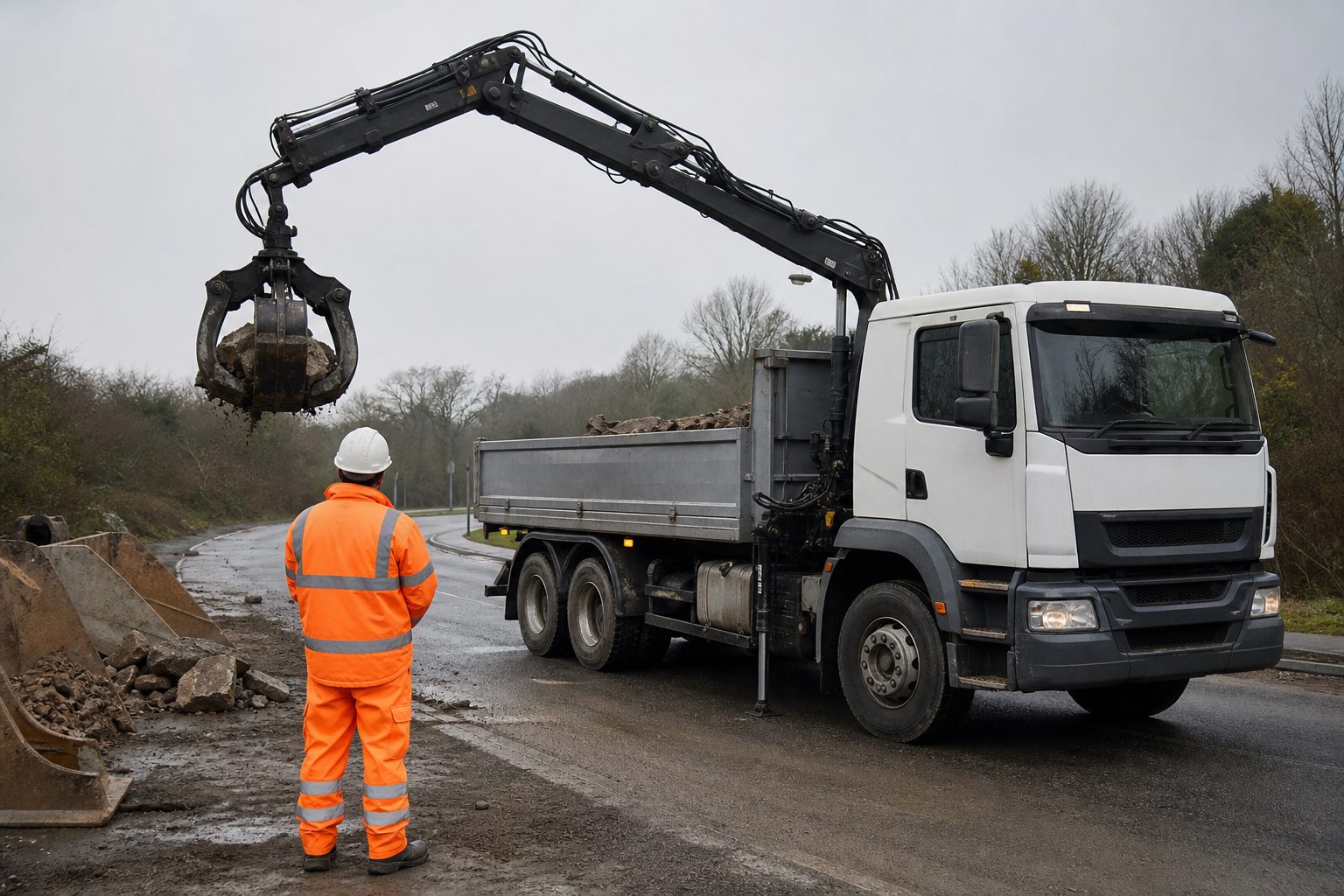
The camera specification for a construction fleet vehicle gets most of the attention in compliance discussions. The sensor specification gets less — and it is frequently where the gap between a system that passes audit and a system that works in practice is widest. A proximity sensor calibrated for road freight that generates continuous false alerts on a construction site gets turned down or ignored. A g-sensor calibrated for normal road events that fires on every tipping cycle produces a data stream that obscures genuine incidents. Sensor systems on construction vehicles require specification and calibration for the environment they actually operate in.
FORS Silver v7 (effective January 2025) and CLOCS v5 (effective March 2025) define the sensor baseline for road-going construction vehicles. The requirements for a rigid vehicle over 7.5 tonnes — the category covering most construction HGVs — centre on the nearside blind spot sensor system (BSIS) with audible alert, left-turn audible warning with night mute, and reversing alarm. MOIS front detection is not mandatory, but fitting it as a matter of course is recommended.
FORS v7 introduced two specific changes relevant to construction fleets. First, the required sensor element at Silver level is the BSIS nearside detection system — MOIS front detection remains a recommendation rather than a requirement, and FORS Silver can be satisfied through more than one compliance route, including fitting a Progressive Safe System. Second, FORS v7 explicitly defined false alert non-compliance: a sensor that triggers from roadside furniture, the vehicle’s own bodywork, or the kerb during normal driving is a non-compliant system at audit. For construction vehicles, which consistently generate false alerts from body movements and site environments if not correctly configured, this definition has direct compliance implications.
The nearside proximity sensor addresses the left-side blind zone during forward movement and at collection stops. On a standard delivery HGV, this is calibrated for open-road clearances — detection range of 2-3 metres, alerting when a parked vehicle or obstacle is within range. On a construction vehicle working in confined site environments, this calibration produces continuous alerts throughout the working day.
Banksmen, plant operators, and site workers are routinely within 2-3 metres of construction vehicles on site. Proximity sensors calibrated for road freight thresholds alert continuously when a vehicle is manoeuvring in these conditions. The driver response — to turn down or disable the sensor alert — is a predictable consequence of a sensor that cannot distinguish a genuine hazard from normal site proximity. FORS v7’s false alert compliance definition targets exactly this scenario: a sensor that triggers continuously from normal operating conditions is non-compliant.
Calibration for construction site operations requires adjusting the nearside sensor’s active detection range to reflect the working environment. A reduced sensitivity range — typically 1.5-2 metres for active alert — and adjustment of the alert threshold to exclude the vehicle’s own body geometry are the standard starting points. Walk-test verification at the calibrated distances should be documented and repeated after any modification to the vehicle body that changes the sensor geometry.
The Moving Off Information System detects cyclists and pedestrians in the front nearside zone when the vehicle moves off from a stationary position. Construction vehicles stop at site gates, weighbridges, delivery queues, and banksman halt points throughout every shift. Each stop-start event is an MOIS scenario — a potential pedestrian or cyclist in the front zone at the point of departure.
On construction sites specifically, the front zone is occupied by banksmen giving departure clearance signals. An MOIS sensor should not alert when the banksman giving the signal is in the confirmed clear position — but a miscalibrated system that detects at full sensitivity during forward movement will alert on the banksman, on site fencing, and on parked plant throughout the site. The MOIS sensor should activate only during the stationary-to-moving transition and at low speed, and should not generate alerts during road-speed forward movement.
For vehicles over 12 tonnes operating in Greater London — which includes most construction HGVs on London-area sites — MOIS is also a DVS Progressive Safe System requirement. The DVS PSS MOIS specification requires front nearside detection to 2 metres ahead of the vehicle, active regardless of indicator status. FORS Silver MOIS and DVS MOIS are aligned in detection zone requirements but DVS specifies additional technical criteria for VRU movement detection that pure proximity sensors may not satisfy.
G-sensors on construction vehicles record acceleration events — harsh braking, impacts, and sudden movements — that trigger footage preservation and driver coaching flags. Road-calibrated g-sensors are set for the event thresholds appropriate to a vehicle travelling at road speed and braking under normal and emergency conditions. On a tipper, the hydraulic body raise creates a g-force signature that a road-calibrated sensor cannot distinguish from a vehicle incident event.
The practical consequence is a false event log that is unusable for genuine incident management. A tipper that tips twelve times per shift and generates twelve false g-sensor events has a data stream in which genuine events — a harsh braking on the public road, a contact at a junction — are obscured. The driver coaching value of the data is zero; the operations desk is managing alert volume rather than genuine risk.
Construction fleet MDVR specifications should require either a sensor ECU that can exclude defined movement signatures (tipping cycle vibration and articulation), or a sensitivity threshold that is set above the tipping cycle range. The appropriate threshold differs by vehicle type and tipping cycle speed — a field calibration exercise during normal tipping operations, with the threshold set to exclude the highest-vibration tipping event while still capturing genuine impacts, is the standard approach.
The raised body itself introduces two further risks that dedicated equipment addresses. A tipper operating with the body raised should be fitted with an overhead-cable detector, which warns the driver before the raised body reaches overhead power lines. A tilt sensor is also available, which prevents the body from being raised when the vehicle is on an excessive lean — for example on soft ground — helping to prevent tip-overs during the tipping cycle.
Rear proximity sensors address the hazard zone directly behind the vehicle during reversing. For construction vehicles, the primary consideration is sensor placement relative to the vehicle body geometry — not just a generic HGV rear face. On a tipper, the rear of the chassis is different from the rear of the tipping body: a sensor mounted on the tipping body may be at a higher position when the body is raised, changing the detection geometry. On a concrete mixer, the drum body extends rearward — a sensor mounted on the chassis rear face may not detect objects alongside the drum during a tight reversing manoeuvre.
The standard rear sensor configuration — caution zone from 1.5 to 3 metres triggering an intermittent alert, stop zone from 0 to 1.5 metres triggering a continuous alarm — applies to construction vehicles but requires position adjustment for body geometry. Integration with the rear camera so that a detection event in the stop zone triggers the rear camera to full-screen on the in-cab display is the functional standard that makes the sensor alert useful rather than just audible.
The left-turn audible warning is a mandatory FORS Silver requirement — a voice warning that activates when the left indicator is engaged, alerting pedestrians and cyclists on the nearside that the vehicle is turning. The night mute function (23:30–07:00) prevents the warning from activating in residential areas during quiet hours. For construction vehicles, this is a road-operating requirement; the left-turn warning applies on the approach to sites, not during in-site manoeuvres where banksmen are directing movements.
The reversing alarm is separately mandatory and applies during all reversing events — on-road and on-site. For construction sites where reversing is supervised by banksmen, the reversing alarm confirms to site workers not in the banksman’s direct sightline that the vehicle is reversing. The alarm volume and tone should be appropriate to the site environment — an alarm that is inaudible in a high-noise demolition or aggregate site does not fulfil its protective function.
A rigid HGV over 7.5 tonnes is typically fitted with: nearside blind spot sensor system (BSIS) with audible alert, left-turn audible warning with night mute, and reversing alarm. MOIS front detection is not mandatory but is recommended as a matter of course. DVS PSS is also required for vehicles over 12 tonnes operating in Greater London, which includes BSIS nearside detection and MOIS front detection to DVS 2024 specifications.
Two main reasons. First, tipper body raises generate g-sensor and vibration events that road-calibrated sensors register as incidents. Second, construction site proximity environments — banksmen, plant, site fencing — are routinely within the detection range of road-calibrated proximity sensors. FORS v7 explicitly defines false alert non-compliance; construction fleet sensors must be calibrated for site operating conditions, not road freight defaults.
Yes, with appropriate calibration. The sensor hardware is the same — the difference is calibration thresholds. Road-calibrated thresholds should be adjusted for site proximity detection ranges and tipping cycle exclusion before the vehicle enters site operations. Walk-test calibration at the site-adjusted thresholds, with documentation, is the compliance record for FORS audit purposes.
Yes. G-sensors should be calibrated or configured to exclude the tipping cycle signature. Proximity sensors mounted on or near the tipping body should have their detection zones confirmed for both body-down and body-raised positions. A proximity sensor that gives a clear walk-test result with the body down may produce false detections or miss detections when the body is raised and the sensor position changes. Beyond calibration, a tipper working with the body raised should be fitted with an overhead-cable detector, and a tilt sensor is available which prevents the body raising when the vehicle is on an excessive lean — such as on soft ground — helping to prevent tip-overs.
MOIS is not mandatory under FORS Silver — the required sensor element is the BSIS nearside detection system — but fitting MOIS as a matter of course is recommended for vehicles over 7.5 tonnes, regardless of whether they operate in London. DVS PSS, which does include MOIS, is a London-specific legal requirement for vehicles over 12 tonnes; outside Greater London, MOIS remains a recommended fitment for construction vehicles on FORS-accredited fleets.
A printable checklist covering the key sensors (BSIS, MOIS, proximity, reversing), calibration for tipping cycles and site environments, g-sensor thresholds, and FORS Silver v7 / CLOCS v5 documentation requirements.
Tell us what vehicles you run and what you need — we will come back with a recommendation and a price. Prefer to talk? Call 01656 721871.
Related guides: Preventing Blind-Spots on Construction Vehicles · Camera Systems for Utility and Maintenance Fleets
4 August 2026
Monday to Friday:
8.30am-5.30pm