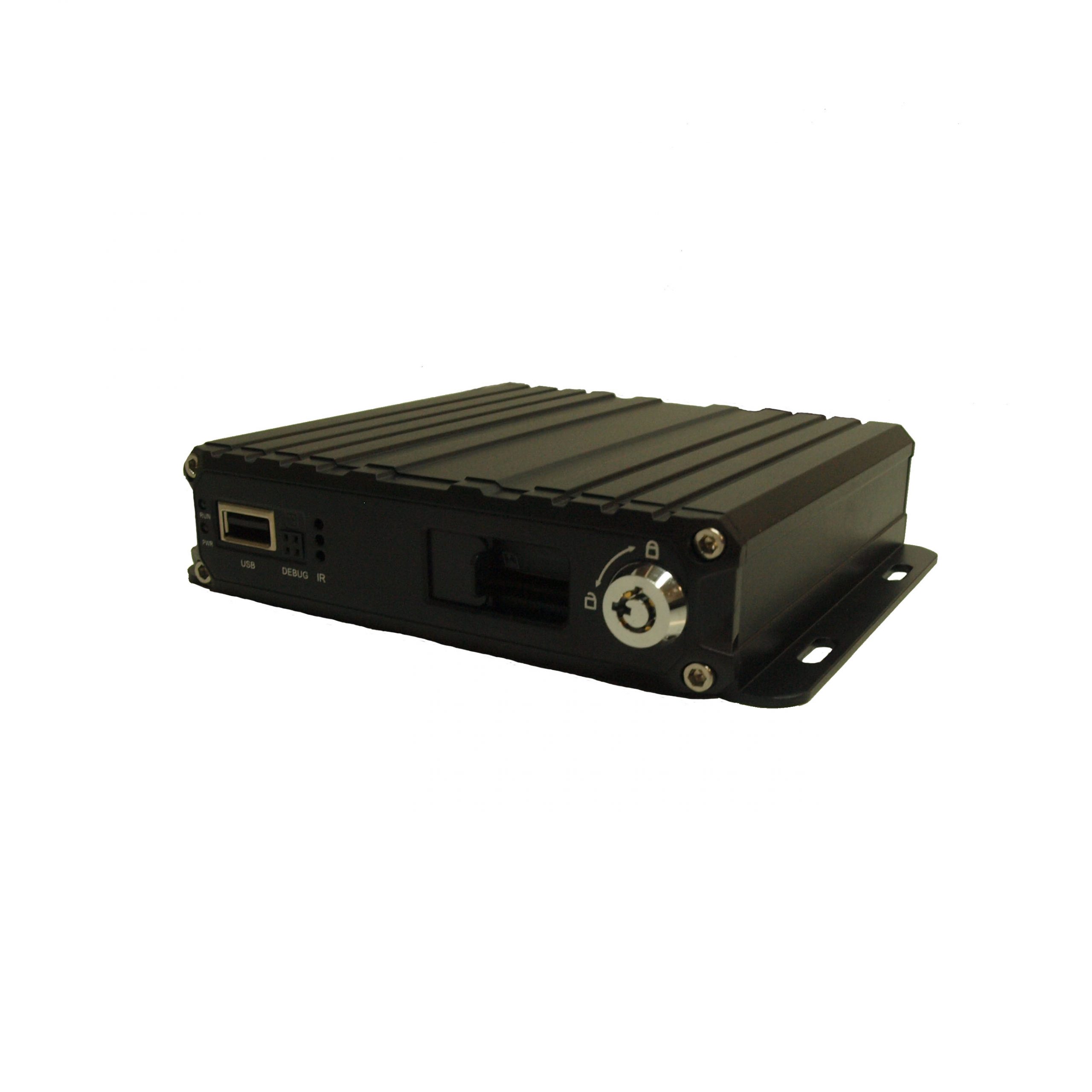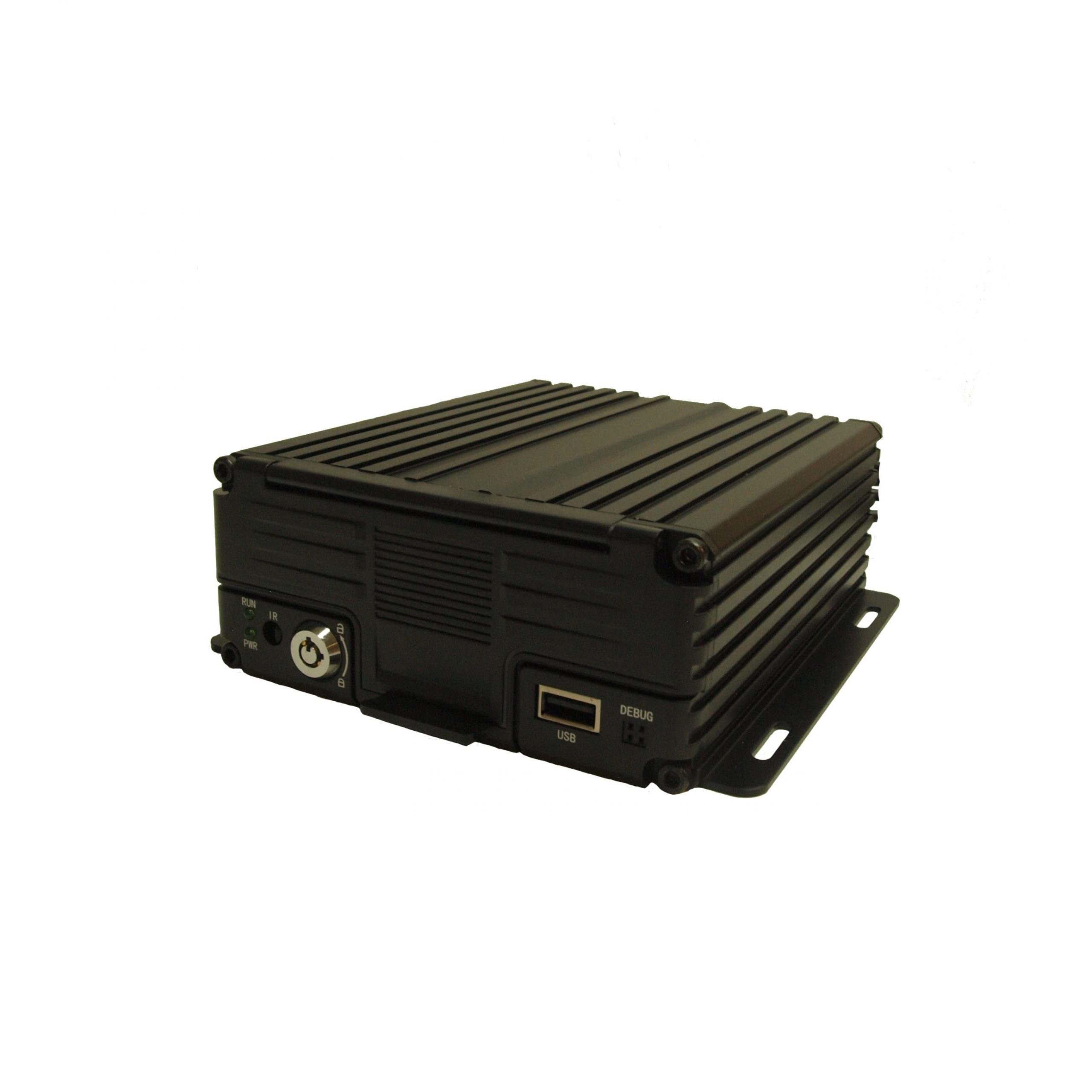
An MDVR (mobile digital video recorder) records every camera on the vehicle to tamper-proof storage, stamps each frame with GPS position and G-sensor events, and streams live to the office when you need to see the vehicle now. Backwatch supplies 4-channel and 8-channel MDVRs with SD, SSD or HDD storage for HGVs, vans, buses and plant, configured to the evidence requirements of DVS, FORS and CLOCS.
An MDVR is the integration hub of a fleet camera system — every camera feed flows through it, every G-sensor event triggers it, every GPS coordinate is stamped on the footage by it. Specifying the wrong MDVR for the operating environment doesn’t just produce inferior footage; it can produce footage that the rolling overwrite cycle deletes before a claim is filed.
Backwatch supplies MDVRs across three configurations — 4-channel with 1 additional IP port, 8-channel with 2 additional IP ports, and SD-card configurations — available with HDD, SSD, SD, or a combination of storage options. All units are 12/24V compatible; G-sensor thresholds are calibrated for the operating environment; and portal-accessed footage retrieval is available without requiring the vehicle to return to depot.
Three factors matter most when specifying MDVR units for UK fleet vehicles:
| Model | Channels | Storage | G-sensor | 4G live view | Operating range | Best for |
|---|---|---|---|---|---|---|
| BWMS585E MDVR | 4 | SD only (128GB max, ≈55 hrs) | Standard | Optional | Road | Standard fleet HGV |
| MR9704E MDVR | 4 | SSD | Standard | Yes (4G built-in) | Road | Live View Platform fleets |
| BW4140-4 MDVR | 4 | SSD | Standard | Optional | Road | Cost-controlled standard |
| BW95L MDVR | 2 | SD (512GB max) | Standard | Optional | Road | Vans, light commercial |
| BWMini3 MDVR | 1 (single channel) | SD (128GB max) | Standard | Optional | Road | Vans, cost-controlled |
| BWCMAG MDVR | 2 | SSD | Standard | Optional | Road | Compact magnetic-mount |
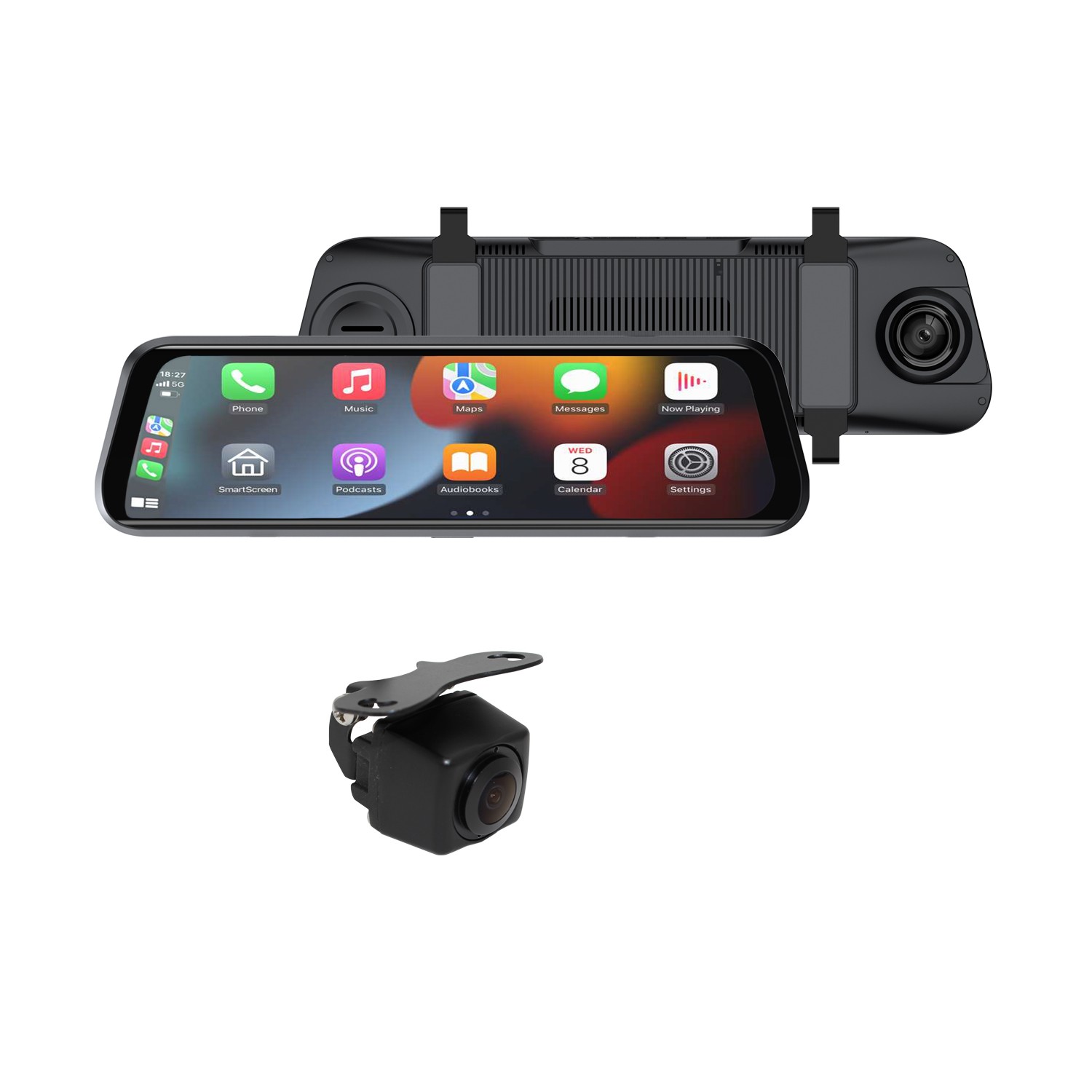
| BW4358 Smart Monitor | 2 | SD | Standard | No | Road | Hybrid monitor + DVR (CarPlay/Android Auto) |
Recommended: BWMS585E or BW4140-4 4-channel MDVR (each with 1 additional IP port). Storage sized for 30–60 days of multi-channel rolling footage. Standard G-sensor thresholds (0.5–1.0G). Cellular connectivity optional — recommended for fleets with active claims management or live view portal use.
Recommended: MR9704E with built-in 4G modem. Footage uploads to the Backwatch fleet portal in real-time; G-sensor events can trigger immediate clip upload. Suitable for fleets running active claims defence, council operations under public accountability, or contractor fleets where compliance documentation is audited remotely.
Recommended: 8-channel MDVR (with 2 additional IP ports) covering nearside, rear, front, hopper, and bin lift zone. High-capacity storage — up to a 2.5TB HDD in the spring-suspended holder plus an additional 512GB SD card — to accommodate delayed-report claims (residents reporting damage after a delay). G-sensor calibrated for the compaction cycle to avoid false event triggers on every bin lift.
Recommended: 8-channel MDVR covering nearside, rear, front, both sides, and grab arm zone. SSD or SD storage suits the vibration profile; where HDD capacity is wanted, the spring-suspended drive holder helps protect the drive. G-sensor thresholds raised slightly above road-vehicle defaults to help prevent false triggers from tipping cycles.
Recommended: Off-road 8-channel MDVR with shock-rated mounting and expanded operating temperature range (-30°C to +70°C). G-sensor thresholds raised to 1.5–2.5G to help prevent continuous false triggers on rough terrain. Where HDD storage is fitted, the spring-suspended drive holder protects it from the vibration profile.
Recommended: BW95L, BWMini3, or BWCMAG depending on cab space and feature requirements. A rear camera is not mandatory for these vehicle types — on tight budgets, the BW95L (2-channel, up to 512GB SD) or the BWMini3 (single channel, up to 128GB SD) cover forward dashcam recording with the option of a second channel where wanted. Cellular connectivity optional.
Storage capacity determines how much footage is retained before the rolling overwrite cycle deletes the oldest content. As a guide, a 128GB SD card holds approximately 55 hours of 4-channel recording (one 1080p forward camera plus three 720 AHD cameras at 25 fps per channel). Practical configuration points:
For UK fleet operations, 30–60 days is the typical retention target — long enough to accommodate delayed claim reports without exceeding GDPR retention proportionality. For incident footage that must be kept longer (potentially 2–5 years for personal injury claims), export the footage before the rolling cycle overwrites it — via the portal on cellular-equipped units, or locally from the storage media. Backwatch MDVRs do not hold a separate protected clip store, so prompt export is part of the incident procedure.
MDVRs with built-in 4G connectivity (MR9704E and cellular-equipped variants of others) integrate with the Backwatch Live View Platform, providing:
A dashcam is a single-camera, single-channel device typically mounted on the windscreen, recording the forward view only. An MDVR (Mobile Digital Video Recorder) is a multi-channel recorder accepting feeds from several cameras simultaneously — 4-channel and 8-channel are common — and integrating GPS, G-sensor, and cellular connectivity for fleet management. For DVS PSS, FORS Silver/Gold, or any compliance framework requiring multi-position camera coverage, an MDVR is the required technology, not a dashcam. Single-camera dashcams are appropriate for cars and very light commercial vehicles where only forward-view event recording is needed.
Channel count should match the camera positions required by your vehicle type and compliance framework. Standard road HGVs typically need 4 channels (nearside, rear, front, offside). Refuse collection vehicles benefit from 6–8 channels (adding hopper, bin lift zone, and grab arm). Coaches with interior passenger saloon coverage typically need 8 channels. Adding cameras later is simpler than replacing the recorder — the additional IP ports on Backwatch units (one on 4-channel units, two on 8-channel units) provide expansion headroom beyond the standard channels.
The storage choice balances capacity against the operating environment. Hard drives offer the largest capacity — up to 2.5TB — for the longest rolling retention, and every HDD in a Backwatch MDVR is mounted in a spring-suspended drive holder that helps protect the spinning drive from vehicle vibration. Solid-state storage (SSD or SD card) has no moving parts, which suits high-vibration duty cycles where capacity needs are lower. Combination configurations pair an HDD with an additional SD card (up to 512GB) for extended retention. Backwatch specifies the storage configuration to the vehicle’s duty cycle at the site survey.
Yes, where the MDVR is configured with cellular (4G) connectivity. The Backwatch Live View Platform provides browser-based access to camera feeds, footage clips, and event logs from any vehicle with active 4G connection — without requiring the vehicle to return to depot or an engineer to physically download the storage. For fleets without cellular coverage (rural quarry sites, deep agricultural fields), store-and-forward operates: the MDVR records locally and uploads triggered event clips when the vehicle re-enters coverage.
Most Backwatch MDVRs support extended recording outside the standard ignition-on cycle. Configuration options include: hardwired to battery with voltage cutoff (records until battery voltage drops to a defined threshold); supercapacitor-backed graceful shutdown (60–120 seconds of operation after power cut for clean file closure); separate auxiliary battery for genuinely extended overnight recording. For high-value vehicles where security monitoring is required, the auxiliary battery option is most reliable. For fleet vehicles parked at depot, the voltage cutoff is sufficient.
Compatibility depends on the telematics platform and the data exchange required. Most Backwatch MDVRs output GPS position and event data via standard API that many third-party telematics platforms can consume. For specific integrations (Teletrac Navman, Samsara, Webfleet, MICHELIN Connected Fleet), compatibility should be confirmed at the specification stage — Backwatch can advise on integration options during the initial site survey. The most common pattern is to keep telematics for vehicle/driver data and Backwatch for camera/footage data, with the two systems linked by a vehicle ID lookup rather than a deep integration.
Yes, where the chain of custody is maintained. Footage in original format (with embedded GPS metadata and timestamp) from a properly maintained MDVR is admissible in UK civil and criminal proceedings. The chain of custody requires documenting: who copied the footage, from which device (MDVR serial number), at what time, and in what format. Footage that has been transcoded or edited since original capture requires explanation. Backwatch portal-retrieved footage retains original format and metadata; physical extraction of the storage media requires the same chain of custody documentation as any forensic data recovery.
Tell us what vehicles you run and what you need — we will come back with a recommendation and a price. Prefer to talk? Call 01656 721871.
An MDVR is a mobile digital video recorder: a ruggedised recorder fitted in the vehicle that takes the feeds from every camera, stores them with GPS position, speed and G-sensor data, and protects footage of an incident from being overwritten. It is the hub of a fleet camera system; the cameras are only as useful as the recorder behind them.
A dashcam is a single forward-facing camera with its own small memory card. An MDVR records four or eight cameras at once, including side, rear and in-cab views, to a removable or built-in drive, adds GPS and G-sensor data, and can be connected for live view and remote download. For compliance schemes such as DVS, FORS and CLOCS, an MDVR is what the auditor expects.
It depends on storage size, the number of cameras and the recording quality. As a guide, a four-channel system on a 1 TB hard drive typically holds two to four weeks of continuous footage before the oldest recordings are overwritten; event clips triggered by the G-sensor or a panic button are locked and kept. See our MDVR storage guide for the SD, SSD and HDD options.
17 July 2026
Monday to Friday:
8.30am-5.30pm