
Construction vehicles present a monitoring challenge that most other fleet types do not: the vehicle often leaves the depot in the morning and stays at a construction site for the rest of the day, or for days at a time. The transport manager’s line of sight ends when the vehicle leaves the yard. What happens on site — the delivery, the tip, the interaction with banksmen and site workers, the incident that nobody called in about — is invisible until the vehicle returns.
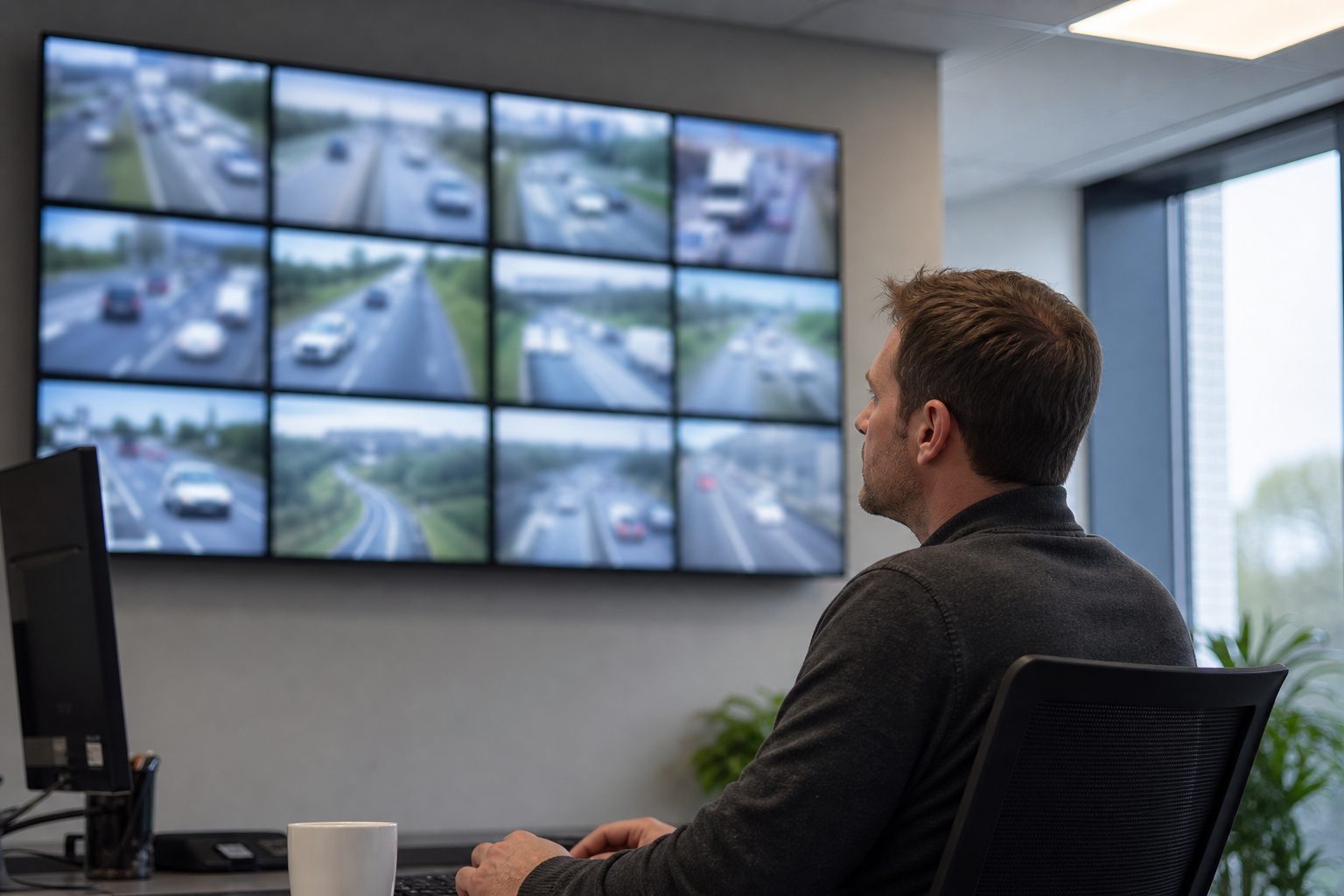
Live view changes that. With a connected MDVR and 4G connectivity, the transport manager can open any vehicle’s camera feed at any point during the working day, regardless of whether the vehicle is on a public road or parked inside a construction site. The site boundary does not end the monitoring capability.
This guide covers the specific value live view provides for construction fleets — the use cases that come up most frequently, the compliance considerations that make it relevant beyond ordinary fleet management, and the practical limitations that are worth knowing before deployment.
In a standard road freight operation, the transport manager has a reasonably continuous view of fleet activity through GPS telematics. Vehicles move, deliver, and return. The gaps are short.
Construction fleet operations work differently. A tipper delivering to a city centre regeneration site may make three or four trips in a day, but between trips it is parked at the site. A crane carrier may be based at a single site for a week. A concrete mixer may be dispatched to a site in the morning and not return to depot until late afternoon. During those static periods, GPS shows the vehicle at a fixed point. The manager has no visibility of what is happening unless the driver calls in — or unless they open a live camera feed.
This is the monitoring gap live view addresses for construction fleets. Not the movement events, which MDVR systems capture automatically, but the site-based activity that happens between GPS pings — the tip operation, the interaction with the banksman, the near-miss in the loading area that the driver did not report because it did not feel serious at the time.
Fleet managers running construction vehicles describe a consistent set of scenarios where live view has changed the quality of their response:
Incident on site: An incident is reported from a vehicle that is parked on-site. Without live view, the fleet manager has to call the driver to understand what happened. With live view, the manager opens the camera feed. They can see the vehicle’s current state, whether anyone is near it, and — if the MDVR is configured with driver-facing and rear cameras — the wider context around the vehicle. This shapes the response before the situation develops further.
Banksman and crew welfare: On a busy construction site, workers move around vehicles in conditions that create significant pedestrian risk. A live check of the nearside and rear cameras confirms whether site workers are clear of the vehicle’s operating envelope during loading, tipping, or movement within the site. This check does not require the transport manager to be on-site; it happens from the operations office over a 4G feed.
Delivery and tip verification: A customer queries whether a delivery was made or whether a tip was completed correctly. Live view of the vehicle at the time, combined with recorded footage from the MDVR, provides the factual record. For construction fleets where delays, aborted deliveries, and disputed loads are a regular operational occurrence, the ability to check the vehicle remotely closes disputes quickly.
Unexpected stoppage or welfare check: A vehicle’s GPS shows it stationary in an unexpected location. The driver is not answering calls. Live view of the driver-facing camera gives an immediate read on whether the driver is present and alert. A question that comes up regularly when fleet managers consider driver welfare is how quickly they can assess the situation without sending someone to the vehicle — live view is typically the answer.
Remote site departure check: For vehicles stationed at remote sites overnight or for extended periods, a pre-departure check via live view confirms the vehicle’s condition before the driver starts the day. No supervisor needs to be at the remote location; the check happens from the operations office.
CLOCS — Construction Logistics and Community Safety — sets out camera and monitoring standards that are increasingly used as site entry requirements by major contractors and developers. Most fleet managers working with CLOCS-governed contracts are primarily focused on the camera specification required for site access. What is less commonly understood is how live view capability extends the CLOCS compliance value of a connected MDVR system.
The CLOCS camera standard addresses the Moving Off Information System (MOIS) requirement — confirmation that the nearside is clear before the vehicle moves. A connected MDVR with nearside camera and in-cab monitor meets this standard. What live view adds is the ability for the fleet manager to access that same nearside camera feed remotely, to verify driver behaviour at site access points, and to produce footage evidence for any CLOCS-related incident investigation.
FORS Gold uses the same camera and sensor specification as Silver — the additional requirement at Gold is that members publish a case study. Connected MDVR with live view gives operators strong material for that case study: an audit trail of live monitoring activity alongside the recorded footage archive.
Construction vehicles generate G-sensor events from normal operational activity that would be unusual in a road freight context. Tipping operations move the body of the vehicle. Driving across unpaved site access roads creates impacts that trigger sensors calibrated for road use. A concrete mixer’s drum rotation creates vibration profiles that require different sensitivity settings than a standard HGV.
A question that comes up regularly when fleet managers configure connected MDVR systems for construction fleets is how to reduce false G-sensor events without reducing genuine incident sensitivity. The answer specific to construction is calibration by context: G-sensor thresholds appropriate for on-road operation are often too sensitive for site operation and need to be raised for site-based activity. This is a configuration decision, not a platform limitation.
Live view complements G-sensor calibration in practice. The platform does not create G-sensor alerts or upload footage automatically — but when an incident or concern is reported from site, the transport manager can open a live camera feed to assess the current state of the vehicle and confirm whether the report represents a genuine incident. This check avoids the false escalation that occurs when site events are treated as road-incident events without context.
Live view requires 4G connectivity. Most major construction sites in the UK have adequate 4G coverage from at least one network, though signal quality varies between sites and between locations within a site. A vehicle parked in the shadow of a large structure may have intermittent signal; the same vehicle in the main site access area will typically have reliable connectivity.
The practical implication for construction fleet managers is that live view is available for most vehicles in most site conditions, but it is not guaranteed for every position on every site. For vehicles in areas with weak signal, the MDVR’s local recording provides the fallback — footage is retained on the vehicle and can be reviewed or downloaded once signal improves, even if live view is unavailable at the moment of the event.
Where live view is unavailable due to coverage gaps, the recorded footage on the MDVR’s local storage remains intact. Connectivity affects live access; it does not affect recording. The MDVR continues to record regardless of 4G signal quality.
Yes. Live view monitoring works wherever the vehicle has 4G coverage — on public roads, on private construction sites, at depot. The monitoring capability is not limited to road-based operation. Most major construction sites in the UK have sufficient 4G coverage for reliable live view access.
A connected MDVR with nearside camera meets the CLOCS camera standard for site entry. Live view extends this by providing remote access to those same camera feeds, enabling transport managers to verify driver behaviour at site access points and providing footage evidence for CLOCS-related incident investigations. FORS Gold uses the same camera specification as Silver; connected MDVR with live view provides useful material for the case study that Gold members publish.
Tipping operations and unpaved site roads generate G-sensor events from normal operational activity. Construction MDVR configurations typically require higher sensitivity thresholds than road freight to reduce false events from tipping body movement and rough site surfaces. Live view does not generate alerts from these events — but when a concern is reported, it allows the transport manager to check the vehicle’s current state before escalating a response.
For live view monitoring purposes, driver-facing and nearside cameras are the highest priority — the driver-facing camera for welfare checks and driver state assessment, the nearside camera for site access monitoring and CLOCS-relevant footage. Rear camera access is valuable for tip operations and banksman verification. Forward-facing camera provides road and site approach context.
Yes. The MDVR records continuously to local storage regardless of 4G connectivity. Signal loss affects live view access but does not interrupt recording. Footage is retained locally and can be reviewed or downloaded once connectivity is restored. The recorded footage archive is always complete; live view availability depends on current signal quality.
A practical checklist for deploying live view monitoring on construction vehicles — camera positions, CLOCS compliance, G-sensor calibration, and 4G verification.
Tell us what vehicles you run and what you need — we will come back with a recommendation and a price. Prefer to talk? Call 01656 721871.
Related guides: Live View for Waste Collection Fleets · Live View for Delivery and Last-Mile Fleets
4 August 2026
Monday to Friday:
8.30am-5.30pm