
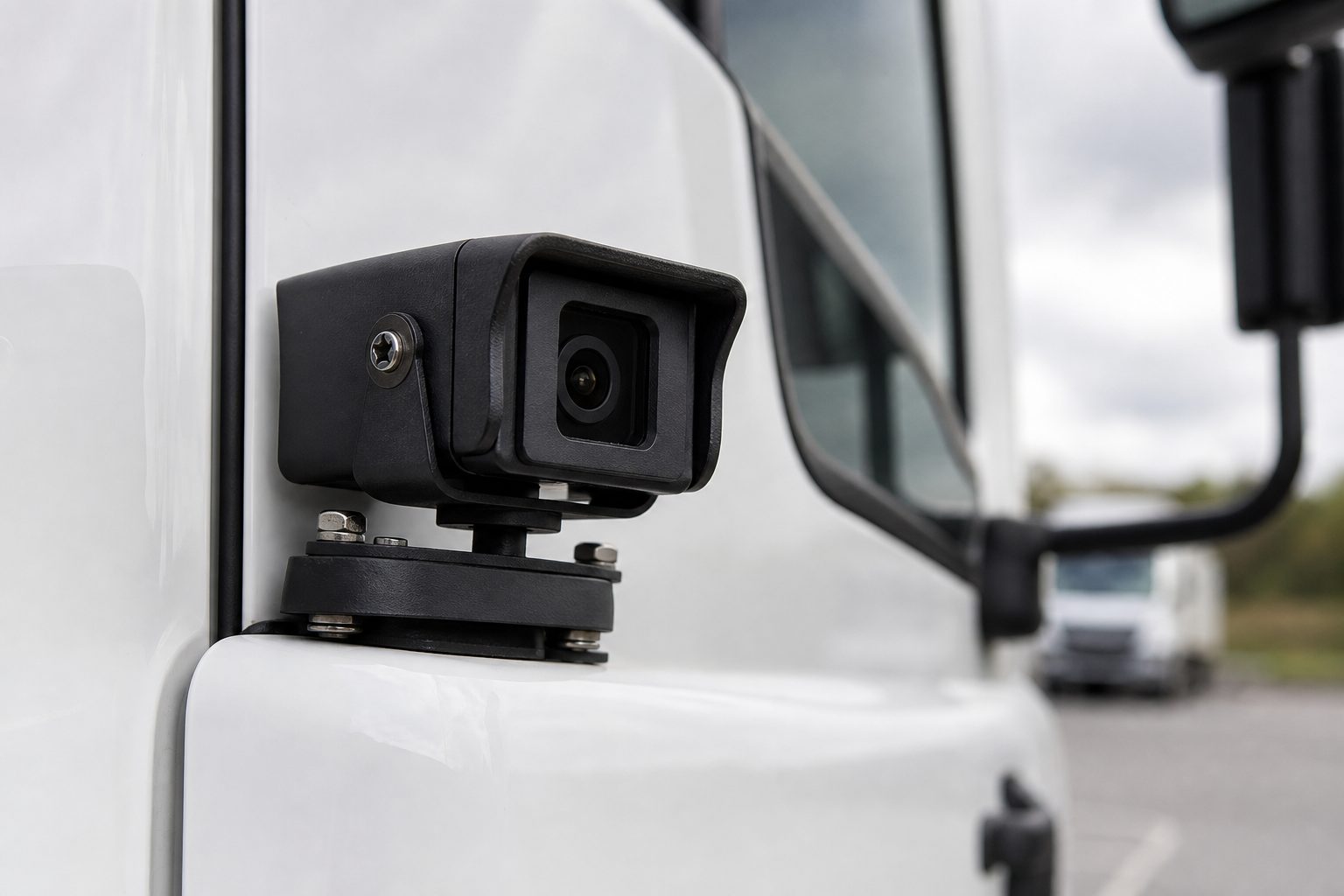
A fleet manager calls after a nearside incident. The vehicle had a rear camera and a forward-facing dashcam. The footage from both cameras is clear and shows nothing relevant. The incident happened down the nearside — the one position not covered. The claim goes to insurance undefended.
This is the most common camera selection failure: not the absence of cameras entirely, but cameras fitted to positions that do not match the actual risk profile of the vehicle. Choosing the right camera is not primarily a question of resolution or brand — it is a question of which positions your vehicle actually needs covered, and why.
This guide works through the decision by vehicle type, explains the role each camera position plays, and covers what DVS and FORS compliance require before you spec a system.
A transit van on urban delivery routes and a 44-tonne articulated HGV on overnight trunking have almost nothing in common from a camera coverage perspective. The van has modest blind spots, a single driver, and routes through urban environments where pedestrian risk is highest. The artic has a nearside blind spot that extends metres beyond the cab, a trailer that blocks the rear view entirely, and a total vehicle length that creates risk during every lane change and left turn.
Camera manufacturers often present their products as universal solutions. The practical reality is that the camera layout that protects a rigid HGV offers inadequate coverage for an artic, and the setup required for a refuse vehicle — where the working environment wraps completely around the vehicle — is different again. The starting point for any camera specification is the vehicle’s blind spot profile, not a standard package.
Before choosing positions, it is useful to be clear on what each camera type is designed to accomplish.
Forward-facing dashcam: Records the road ahead from windscreen height. Provides evidence for road incidents, near-misses, and third-party claims. On HGVs with high cabs, a second lower-mounted front camera may be needed to capture pedestrians and cyclists directly in front of the vehicle that the windscreen camera cannot see.
Rear camera: Covers the area directly behind the vehicle during reversing and parking manoeuvres. Essential for all vehicle types. On articulated trailers, the rear camera should be mounted on the trailer itself to remain effective regardless of trailer swap.
Nearside (passenger-side) camera: Covers the largest single blind spot on commercial vehicles — the area down the left side of the vehicle invisible to the driver in normal mirrors. Critical for left turns, lane changes, and slow-speed manoeuvres in urban areas. The nearside camera is the second-highest priority position after the rear for most UK fleets operating in urban environments.
Driver-facing (in-cab) camera: Monitors driver behaviour — fatigue, distraction, phone use, seatbelt compliance. Evidence value in incidents where driver condition is disputed. Subject to separate GDPR compliance requirements and requires proper disclosure to drivers before installation.
MOIS (Moving Off Information System) camera: A low-mounted forward or nearside camera that activates when the vehicle moves off from stationary. Required under DVS for HGVs that do not meet a 3-star direct vision rating. Designed specifically to detect pedestrians and cyclists in the immediate forward and nearside blind spots at junctions.
Load/cargo camera: Monitors load security, trailer door status, or cargo bay access. Relevant for refrigerated transport, high-value goods, and any operation where cargo condition on delivery is disputed.
The minimum effective coverage for an articulated HGV is four cameras: forward-facing, nearside, rear (trailer-mounted), and MOIS if DVS compliance requires it. The nearside camera is the most operationally significant — the blind spot down the left of an artic during a left turn is the position most associated with serious cyclist and pedestrian incidents.
For artics operating regularly in London, DVS compliance is a hard requirement. Vehicles under the 3-star direct vision threshold must have a camera-monitor system as part of their Safe System. A nearside camera and an MOIS camera are the standard solution for vehicles that cannot achieve 3-star through cab design alone.
Rigid HGVs typically require forward-facing, nearside, and rear cameras as a minimum. The shorter vehicle length simplifies rear monitoring compared to artics, but the nearside blind spot remains significant on vehicles over 7.5 tonnes. A driver-facing camera is increasingly standard on rigids operating for major retailers and logistics operators — many client contracts specify it as a condition of engagement.
For vans on urban delivery routes, a rear camera and nearside camera typically provide the coverage that matters most. Forward-facing is worth adding for any van operating on faster roads or dual carriageways where road incident risk is higher. Multi-camera MDVR systems are less commonly fitted to vans than to HGVs, but connected dashcam solutions that provide live view and incident notification are increasingly standard in managed fleets.
Passenger-carrying vehicles have a specific coverage requirement: internal cabin cameras as well as external. External requirements follow the same logic as HGVs — forward-facing, nearside, rear. Internal cameras covering the saloon and entrance door area provide evidence for passenger injury claims, which are a higher-frequency event on PSVs than on freight vehicles. Door-activation triggers on the entrance camera are standard practice.
Refuse collection vehicles, tippers, and plant vehicles operate in environments where the vehicle is surrounded by workers and pedestrians as part of normal operations. The standard camera positions are necessary but not sufficient — 360° coverage with a surround-view MDVR system is the appropriate specification. Rear cameras alone do not cover the pedestrian risk profile of a vehicle with workers to the side and front throughout the working day.
A question that comes up regularly when fleet managers are specifying cameras is whether a given camera layout meets DVS or FORS requirements — and the answer depends on the specific requirements for each vehicle and operation.
The Direct Vision Standard applies to HGVs over 12 tonnes operating in Greater London. Vehicles under a 3-star direct vision rating must implement a Safe System, which includes a camera-monitor system that covers the nearside and forward blind spots at minimum. The camera system must be functional and in use — it is not sufficient to fit cameras and disable the in-cab monitor display.
FORS (Fleet Operator Recognition Scheme) requires Class V and VI mirrors and side under-run protection at Bronze level for HGVs; camera and sensor equipment enters the specification at Silver. Gold uses the same equipment specification as Silver. If your fleet operates for clients who require FORS accreditation, the camera specification must meet the relevant level before auditing.
A pattern that surfaces when reviewing existing fleet camera installations is the mismatch between camera provision and actual risk. These are the most common errors.
Fitting only a forward-facing dashcam on an HGV. The dashcam addresses the forward road risk, which matters for motorway incidents. It does not address the nearside blind spot, which is the position most associated with serious urban incidents. For an HGV operating in urban environments, the nearside camera is a higher priority than the forward-facing dashcam.
Using the same camera spec for every vehicle class in a mixed fleet. A blanket “two cameras per vehicle” policy applied equally to artics and vans will leave the artics under-covered and the vans over-specified for their actual risk profile. The camera spec should follow the vehicle risk profile, not the vehicle count.
Not specifying trailer-mounted rear cameras on artics. A rear camera mounted on the tractor unit points at the trailer. At maximum articulation, it provides no useful coverage of the area behind the trailer. Trailer-mounted cameras on the rear of the trailer itself are the correct installation for artic rear coverage — and must be considered in trailer swap operations.
Treating DVS compliance as a one-time installation check. DVS compliance requires a functional camera-monitor system. Cameras that have failed, monitors that have been switched off, and systems with corrupted footage storage are non-compliant even if the correct hardware was originally fitted. Fleet maintenance schedules should include camera system checks.
A minimum of three for most UK HGVs: forward-facing, nearside, and rear. Articulated HGVs on London routes will typically require four, including an MOIS camera to meet DVS Safe System requirements. Specialist vehicles with 360° operational environments may require more.
For vans on urban delivery routes, a rear camera and nearside camera address the highest-priority risks. A forward-facing dashcam adds road incident evidence capability and is worth fitting for vans on faster roads. For most urban delivery vans, the rear and nearside positions matter most.
Vehicles that cannot achieve a 3-star direct vision rating must implement a Safe System including a camera-monitor system. The system must cover the nearside and immediate front blind spots at minimum. Specific DVS requirements depend on the vehicle’s star rating — check with your supplier before specifying.
Yes, for effective rear coverage. A camera mounted on the tractor unit points at the trailer at most articulation angles and does not monitor the area behind the trailer. Trailer-mounted cameras on the trailer’s rear face are the correct installation — with consideration for trailer swap logistics if trailers are shared across a fleet.
A Moving Off Information System camera activates when the vehicle moves off from stationary, providing the driver with a view of the immediate forward and nearside blind spot at junctions. It is required as part of DVS Safe Systems for HGVs under 3-star in London. Outside London, it is optional but increasingly common as a standard safety measure on new vehicles.
External camera positions are the same in principle, but PSVs require internal cabin cameras for passenger monitoring that HGVs do not. Camera compatibility with your MDVR manufacturer’s system should be confirmed regardless — not all cameras are compatible with all systems, and specifying cameras that require separate recording systems creates unnecessary maintenance complexity.
FORS Bronze requires Class V and VI mirrors and side under-run protection — no cameras or sensors are mandatory until Silver, and Gold uses the same equipment specification as Silver. If your operation requires FORS accreditation for client contracts, confirm your camera specification against the current FORS vehicle standards document — requirements can change between audit cycles.
A one-page checklist for specifying vehicle cameras by type — HGVs, rigids, vans, PSVs, and specialist vehicles, with DVS and FORS compliance notes.
Tell us what vehicles you run and what you need — we will come back with a recommendation and a price. Prefer to talk? Call 01656 721871.
Related guides: Aviation Connectors vs RCA: Why the Connection Type Matters · How Camera Systems Improve Driver Behaviour
4 August 2026
Monday to Friday:
8.30am-5.30pm