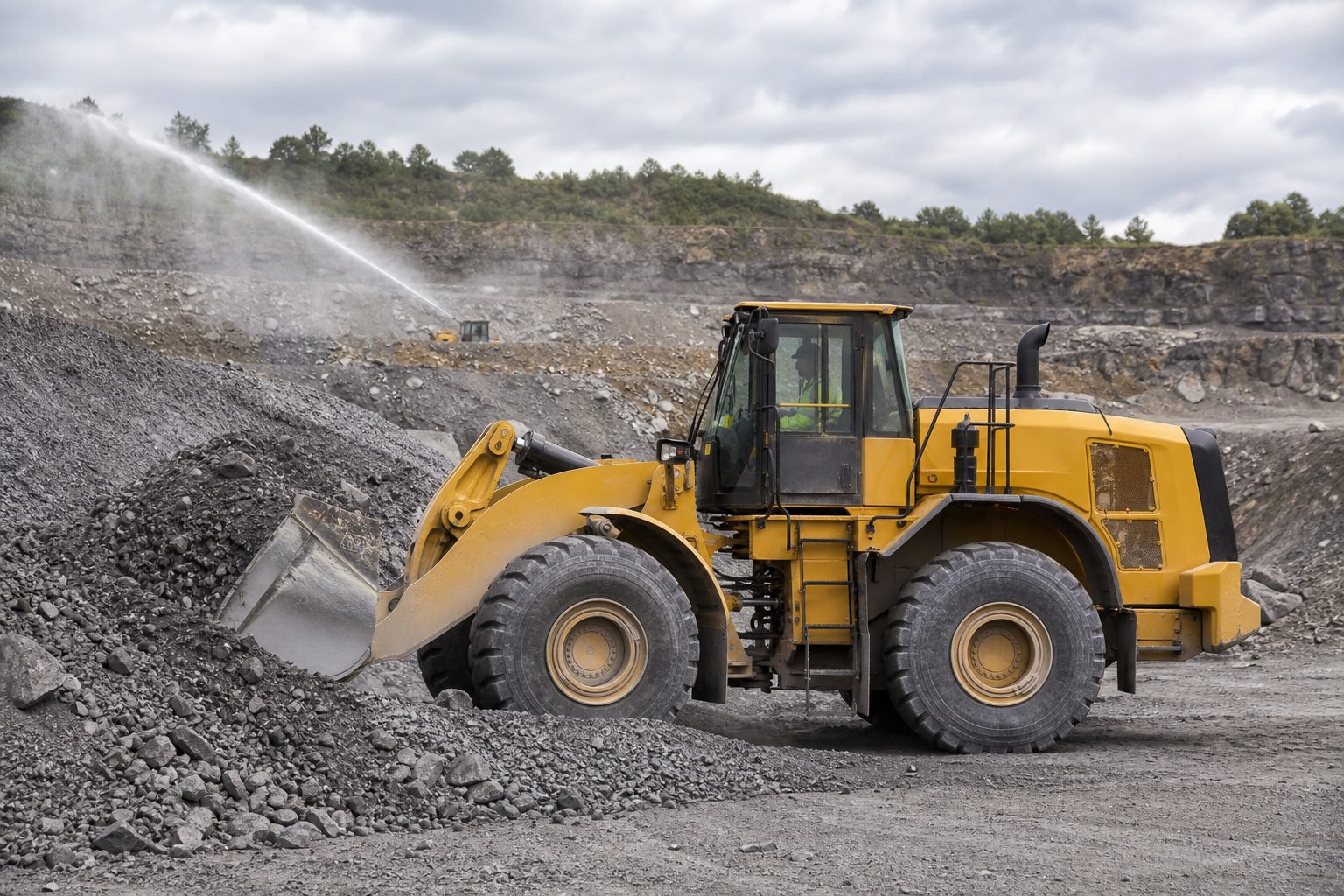
The blind spot problem on industrial machinery is not a single problem. A 360-degree slewing excavator has a completely different blind zone profile from a counterbalance forklift. A telehandler’s hazard zone changes with boom angle and extension. A road roller creates risks for the person walking immediately behind it that are invisible to the operator. Each machine type requires its own camera and sensor analysis — and applying the wrong specification from the wrong machine category is a common source of false confidence about what is actually covered.
This guide works through the principal categories of industrial machinery and the specific blind zones each creates, identifies which camera and sensor technologies address each zone effectively, and explains what LOLER, PUWER, and HSE workplace transport guidance require in practice.
A tracked excavator creates two distinct blind zone categories:
Rotation zone: When the upper structure slews, the tail of the machine swings in an arc behind the cab. The operator’s rearward sightline moves with the upper structure — but the tail sweeps through the area where ground workers may be standing. A worker positioned 2 metres behind the excavator’s tracks at the start of a slew cycle may be inside the swing radius of the counterweight within seconds, with no warning from the cab.
Below-the-cab zone: Directly beneath the operator’s position and immediately in front of the boom foot, there is a ground-level zone that the operator cannot see. On a long-reach excavator with a deep bucket, the zone immediately under the cab can extend 3–4 metres — large enough to conceal a person from any direct sightline.
Camera coverage for excavators should include: rear camera on the counterweight (covering the slew tail zone); both side cameras on the upper structure (rotating with the machine); and a downward-facing cab camera covering the area immediately below the operator’s position. Slew warning — an audible alarm that activates on rotation — supplements cameras by alerting nearby ground workers to the hazard.
A telehandler’s blind zone changes with boom configuration. Fully retracted and horizontal, the primary blind zone is the standard forklift pattern — directly ahead at ground level under the forks. Extended and elevated, the boom creates an additional blind zone above the operator and to the front that blocks sightlines forward and upward.
Camera requirements for telehandlers:
Counterbalance forklifts are responsible for a significant proportion of UK workplace transport fatalities — they are common, widely operated by workers who drive many other vehicle types, and their rear-steer behaviour creates a swing zone that is non-intuitive compared to road vehicles.
Key blind zones on a counterbalance forklift:
Road rollers and soil compactors create a specific hazard: the drum profile means the operator cannot see the area immediately behind the rear drum without camera assistance. On a reversing compactor on a highway resurfacing site, a worker completing a join behind the machine is at significant risk if the operator cannot see the rear zone clearly.
Camera requirements: rear camera with wide field of view covering the full width of the drum; rear proximity sensor (radar or ultrasonic) triggering audible alert when an object is detected behind the drum. On drum-only visibility sites, a separate operator spotter or observer may be required — camera systems supplement but do not replace human observation where the task requires precise coordination between the machine and workers on the road surface.
Two regulations directly apply to camera and sensor systems on industrial machinery:
PUWER (Provision and Use of Work Equipment Regulations 1998) requires that work equipment is suitable for the intended use, maintained in a safe condition, and that risks from its use are controlled. Where camera and sensor systems are identified in a risk assessment as the appropriate control for a specific blind zone hazard, they become part of the required safe system of work under PUWER. Equipment that is identified as the control measure but not fitted, or fitted but not maintained, is a PUWER compliance failure.
LOLER (Lifting Operations and Lifting Equipment Regulations 1998) applies to telehandlers, excavators (in their lifting role), and forklifts. LOLER requires that lifting operations are planned, supervised, and carried out safely — including managing the zone around the lifting equipment during operation. Camera coverage of the lift zone contributes to this supervision requirement, and load cameras directly address the operator’s ability to monitor the lift safely from the cab.
Cameras reduce but do not eliminate the need for a banksman in some situations. Where a camera provides clear, real-time coverage of all zones relevant to an operation, and the driver can confirm those zones are clear before moving, the camera may be sufficient. Where the operation involves complex coordination between the machine and ground workers — crane lifts, precise reversing to a structure, reversing on a surface with active pedestrian traffic — a banksman provides a level of active communication and judgement that camera monitoring alone does not replicate. The site risk assessment should specify when cameras are sufficient and when a banksman is additionally required.
There is no prescriptive regulation requiring cameras on specific machine types. The legal requirement under PUWER and MHSWR is that risks from equipment use are controlled by appropriate engineering measures. Where a risk assessment identifies the excavator’s slew zone as a hazard to ground workers, engineering controls are required — and camera coverage plus audible slew warning is the industry-recognised engineering control for this hazard. HSE investigations following excavator-related incidents consistently ask whether appropriate controls were in place. The absence of controls the risk assessment identified as necessary is a specific and significant finding.
Slew zone detection typically uses an audible alarm triggered by rotation, rather than object-in-zone detection. The rotation trigger activates when the excavator begins to slew, regardless of whether a person is present — alerting ground workers to move clear. Object-detection sensors in the slew zone are also available, using radar to detect persons within the counterweight’s swing radius. The effective range should cover the full counterweight swing arc, which on a large excavator can extend 3–4 metres from the machine’s centreline. Sensor configuration must distinguish between the machine’s own track structure (exclusion zone) and persons or objects at risk.
Any modification to a machine’s body profile — whether a new bucket, a specialist attachment, or a structural modification — should trigger a review of camera and sensor coverage. The risk assessment for the original configuration may not apply to the modified machine. Specific attachment-related camera changes to consider: an auger or hammer attachment extends the front zone where persons could be struck; a ripper attachment on a dozer extends the rear hazard zone; a hedge trimmer on an agricultural tractor extends the offside zone. After any attachment change, walk around the modified machine from each camera position to confirm coverage is still adequate.
RFID proximity systems complement cameras rather than replacing them. RFID detects only workers who carry active tags — it does not detect visitors, contractors without tags, or structural hazards. Cameras detect any object in the covered zone regardless of whether it carries a tag. The strongest protection combines both: cameras for broad-coverage object detection, RFID for specific detection of known workers in controlled sites where tag allocation can be managed. Neither system replaces the other, and neither system replaces a site traffic management plan that separates vehicles from pedestrians by design where the consequence of contact is severe.
Download this free checklist to apply the guidance in this article to your fleet.
Tell us what vehicles you run and what you need — we will come back with a recommendation and a price. Prefer to talk? Call 01656 721871.
Related guides: Best MDVR Systems for Off-Road Industrial Vehicles · Live View for Quarry and Mining Operations
4 August 2026
Monday to Friday:
8.30am-5.30pm