
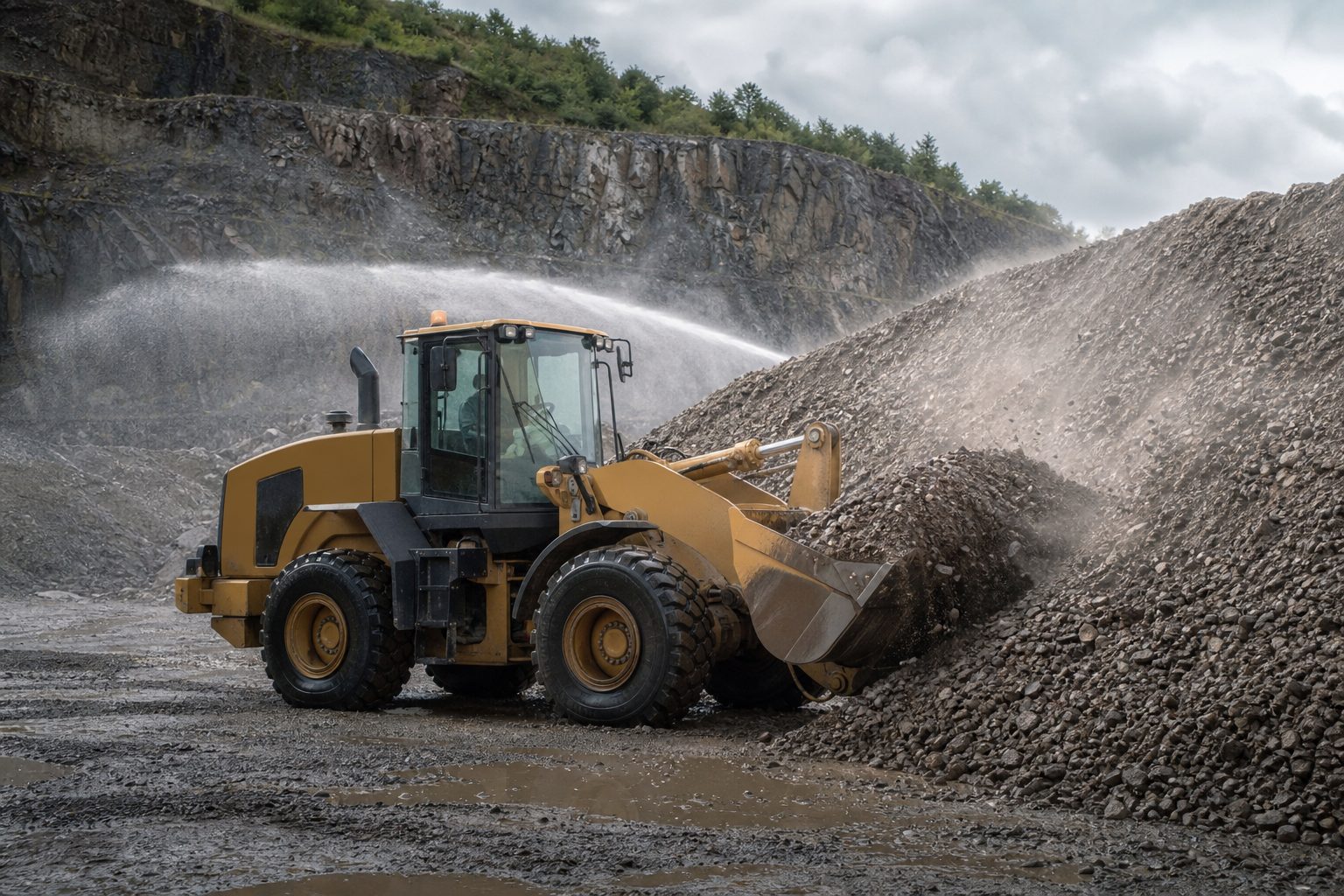
Mining vehicle proximity detection is not a single problem. On surface mines, the hazard is a multi-tonne tipper truck reversing at speed into a person who is obscured by the vehicle’s own body. In an underground mine, the hazard is a loader in a development heading where the only exit is behind the machine. These are different environments with different sensor requirements — and a sensor system that performs well in one may be entirely unsuitable for the other.
This guide covers what proximity sensors mining vehicles need, why the underground environment demands a different technical specification, and how the Management of Health and Safety at Work Regulations frame the duty to implement engineering controls on mining sites.
Surface mining vehicles — tipper trucks, loading shovels, water bowsers, and support vehicles — operate in a hazard environment that resembles quarrying: open haul roads, reversing in confined tipping zones, and foot traffic in the same space as large vehicles.
Sensor requirements for surface mining vehicles follow the quarry vehicle pattern:
Underground mine vehicles — LHD loaders, underground tipper trucks, roadheaders, and support vehicles — operate in conditions that create specific sensor challenges:
The Management of Health and Safety at Work Regulations 1999 require employers to assess risks and implement control measures in the hierarchy: elimination, substitution, engineering controls, administrative controls, personal protective equipment. For vehicle-pedestrian interface hazards in mining, engineering controls are the required approach — the hazard cannot be eliminated or substituted, and administrative controls (banksmen, speed limits, traffic management) alone are not sufficient where the consequence of failure is fatal.
Proximity sensors are the engineering control that addresses the vehicle-pedestrian blind zone hazard. An HSE mining inspection following a vehicle-related incident will assess whether engineering controls appropriate to the identified risk were in place and functional. The absence of proximity sensing on a vehicle with known blind zone hazards — particularly where the mine’s risk assessment identified this hazard — is a significant finding under MHSWR.
Three sensor technologies are relevant for mining vehicle applications:
Radar sensors perform well in dust, darkness, and damp. The signal is not affected by airborne particles. Programmable detection zones allow calibration for different heading geometries. This is the standard technology for mining proximity detection.
Ultrasonic sensors are lower cost but affected by dust concentrations at high levels, and cannot be programmed with complex exclusion zones. Suitable for supplementary close-range detection on specific positions, but not as the primary sensor on underground vehicles in high-dust headings.
Tag-based proximity systems — where workers wear RFID or UWB tags that trigger alerts when they enter a defined zone around the vehicle — are increasingly used in underground mining because they work in complex confined geometries where standard sensor patterns fail. The detection field follows the tag-holder, not the tunnel wall geometry. The system requires all workers in the mine to carry active tags, which is achievable in a controlled underground access environment. Tag-based systems complement rather than replace sensor-based detection — they detect tagged persons; sensors detect any object regardless of whether it carries a tag.
Key specifications for mining-rated proximity sensors:
DVS PSS applies to HGVs operating in Greater London. Surface mine vehicles that operate exclusively on-site are not within TfL’s jurisdiction. Vehicles that travel on public roads — for example, tippers moving materials between surface sites — are subject to DVS PSS for any Greater London operations. Most surface mine vehicles operate under a private roads exemption and do not require road registration. The relevant compliance framework for on-site vehicles is the Quarries Regulations 1999, MHSWR, and the site’s own safety document requirements.
ATEX Zone 1 is an area where a flammable atmosphere is likely to occur during normal operation. Zone 2 is where it is not likely to occur in normal operation but may occur in abnormal conditions. Equipment for Zone 1 must meet a higher ignition protection standard than Zone 2. For underground mining, the zone classification must be established by a competent person before any electrical equipment is specified. Using Zone 2-rated equipment in a Zone 1 area is a legal compliance failure under DSEAR (Dangerous Substances and Explosive Atmospheres Regulations).
Not reliably used alone. Tag systems detect workers who carry active tags. They do not detect contractors who have not been issued tags, broken or discharged tags, visitors in the mine, or any object that is not a tag-carrier. In an underground mining context where the hazard includes workers, contractors, and maintenance personnel who all need to be detected, tags supplement sensor coverage but should not be the sole detection method. The most robust underground configurations combine tag detection for known personnel with radar sensors for broad-coverage detection of any object.
Mining vehicles undergo far more severe operating conditions than road vehicles. Calibration checks should be performed at every scheduled maintenance interval — typically every 250 operating hours — and after any incident, impact, or body repair. In underground environments, recalibration is also required after any change to the heading geometry that the sensor was configured for. A sensor calibrated for a 4.5m heading will generate continuous false alerts in a 3.8m section, and will have inadequate coverage in a wider cross-cut. Calibration is not a one-time installation step on underground vehicles.
For MHSWR compliance and HSE inspection readiness, operators should maintain: the risk assessment identifying vehicle-pedestrian blind zone hazards; the engineering controls implemented (sensor types, positions, detection zones) and the dates of installation; maintenance records showing calibration checks and any faults found and resolved; and records of pre-shift checks that include sensor system function. Where an incident has occurred, the sensor system’s detection log — if the MDVR records sensor events — should be preserved immediately alongside the camera footage. The evidential package for a vehicle incident investigation is the risk assessment, the control measures, and the operational evidence that those controls were in place and functioning at the time.
Download this free checklist to apply the guidance in this article to your fleet.
Tell us what vehicles you run and what you need — we will come back with a recommendation and a price. Prefer to talk? Call 01656 721871.
Related guides: Cameras for Quarry Vehicles · Operating Cameras in Dusty Environments
4 August 2026
Monday to Friday:
8.30am-5.30pm