
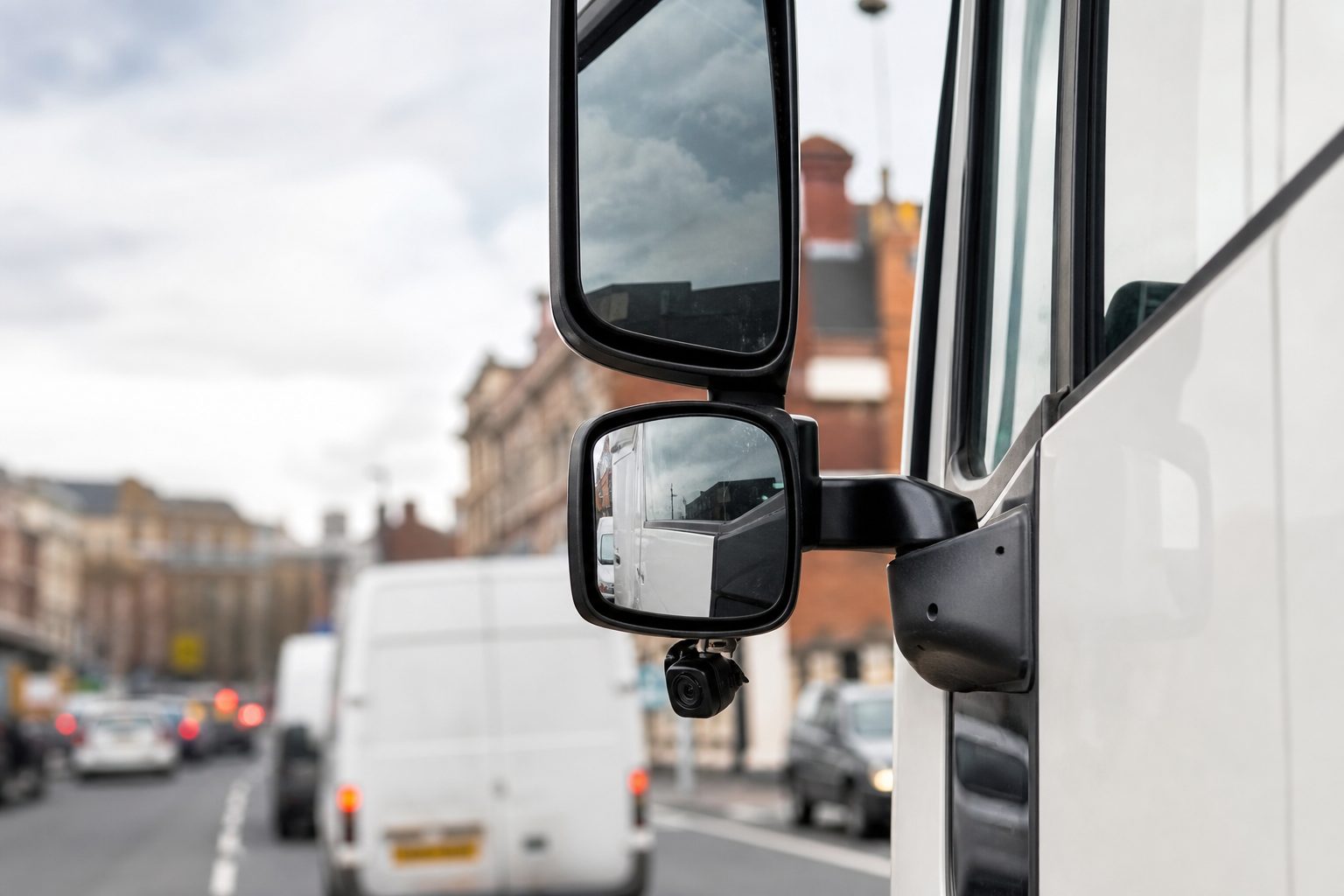
Fleet operators fit camera systems primarily for safety and insurance purposes, but the legal value of in-vehicle recording extends beyond those two applications. Camera footage with GPS timestamp and embedded telematics data is admissible as evidence in civil courts, criminal proceedings, employment tribunals, and Traffic Commissioner public inquiries. The legal benefit is not simply that footage helps with insurance claims — it is that footage transforms disputed incidents from a position of no evidence to a position of documented fact. That transformation has financial, legal, and operational consequences that unfold across multiple parallel proceedings from a single incident.
Dashcam and MDVR footage is admissible as evidence in UK civil and criminal proceedings, in the same legal category as CCTV. For footage to be accepted by a court without challenge, four conditions must be met:
Meeting all four conditions is a system configuration and maintenance task, not something that happens automatically. The camera must be positioned to cover the relevant zone, must be maintained at sufficient resolution, and must have GPS synchronisation active. Footage that fails any of these conditions can still be introduced as supporting evidence, but it will carry less weight than footage that meets all four.
Most commercial fleet insurance policies contain a duty of cooperation clause — a contractual obligation to provide relevant evidence when a claim is made. This obligation applies both ways: footage that supports the fleet operator’s position must be submitted, and footage that shows the driver was at fault must also be submitted if the insurer requests it.
Fleet managers sometimes ask whether they can choose not to submit footage if it is unfavourable. The answer is that deliberate non-disclosure of relevant footage in response to an insurer’s formal request risks claim rejection and, where litigation follows, may constitute contempt of court if a disclosure order is in place. The duty of cooperation is not discretionary. The correct approach is to submit footage promptly regardless of what it shows — a claim that settles quickly with footage that is partially unfavourable costs less in total than a claim that drags for months without it.
Some fleet insurers include explicit dashcam or telematics requirements as policy conditions. Where the policy specifies that cameras must be operational and footage must be preserved and submitted when relevant, non-compliance with those conditions is a separate ground for claim rejection that applies before the duty of cooperation question is even reached.
The most common legal benefit cited by fleet managers is protection against fraudulent and exaggerated claims — and the mechanism by which footage provides that protection is more specific than simply “proving what happened.”
50/50 liability is the default outcome in a disputed claim where neither party can provide objective evidence. In a 50/50 settlement, the fleet operator pays 50% of the third party’s claim costs, pays their own excess, and absorbs a premium impact — on an incident that may have been entirely the third party’s fault. Camera footage with GPS speed data breaks the 50/50 default by providing objective evidence that the insurer can use to argue the fleet driver bore no fault.
GPS-embedded speed data specifically defeats a category of exaggerated claims that is common against commercial vehicles: the claim that the HGV was travelling at twice its actual speed. When footage shows approach speed via GPS, the third party’s claim that the vehicle was doing 40mph in a 20mph zone — when GPS records 11mph — gives the insurer grounds to contest the claim on quantum. This is not just an insurance benefit: in cases where a third party has made a false statement in proceedings, the footage may provide the basis for a contempt application or referral for insurance fraud investigation.
When a fleet vehicle is involved in an incident that results in a serious injury or fatality, the legal proceedings extend beyond civil claims to potential criminal investigation. The offences that may be charged in serious HGV incidents include causing serious injury by dangerous driving, causing death by dangerous driving, and corporate manslaughter under the Corporate Manslaughter and Corporate Homicide Act 2007.
In criminal proceedings, the evidential standard is higher than in civil claims — beyond reasonable doubt rather than balance of probabilities. Camera footage that clearly shows the driver’s behaviour in the moments before impact is primary evidence. Where footage shows the driver was responding appropriately, it is the most powerful form of defence evidence available. Where footage shows dangerous driving, it is evidence that the prosecution will rely upon heavily — and which the fleet operator must disclose under criminal procedure rules.
The broader legal benefit for fleet operators is the due diligence defence. Under the Health and Safety at Work Act 1974, an employer may argue in mitigation that they took all reasonable steps to ensure safety. A fleet with documented camera systems, maintained walk test records, driver coaching based on near-miss footage, and a functioning incident reporting process has a demonstrably stronger due diligence position than a fleet that fitted cameras but did not use them. The camera evidence and the process records together constitute the due diligence argument — neither alone is sufficient.
Driver-facing cameras record driver behaviour at work. That footage is relevant to employment proceedings where a driver’s conduct is in dispute — a dismissal for using a mobile phone while driving, an allegation of dangerous driving on company time, or a disciplinary for falsifying walkaround records while telematics data shows the vehicle was not stationary long enough for the check to have been completed.
Employment tribunal proceedings are civil proceedings. Footage from a driver-facing camera is admissible in a tribunal provided it was collected lawfully — meaning the driver was informed that internal cameras were fitted, the cameras were operated under a documented legitimate interest basis, and the data was processed in accordance with a written retention policy. A fleet operator who recorded driver-facing footage without informing the driver, or who cannot demonstrate a lawful basis for the recording, faces a double problem: the footage may be challenged for admissibility, and the data protection breach may be a separate liability.
A question that arises consistently in this context is whether driver-facing footage can be used as evidence without the driver’s consent. The answer is that consent is not the correct legal basis for processing in a fleet context — legitimate interests is. Consent can be withdrawn, which creates an impossible position if the driver revokes consent after an incident. Legitimate interests, properly documented in a DPIA, allows the fleet operator to process driver-facing footage for safety and claims evidence purposes without requiring the driver’s agreement at the point of use.
Where a serious incident triggers a Traffic Commissioner public inquiry, or where DVSA undertakes a fleet investigation, camera footage and telematics records become part of the compliance evidence package. A fleet operator who can demonstrate that cameras were fitted, functional, and actively used — and that footage was preserved for the incident under review — is presenting a more credible compliance picture than one who fitted cameras that were not operational at the material time.
DVSA’s cooperation with criminal investigations means that footage from fleet vehicles may be requested by police as part of a serious incident investigation. Operators have a legal obligation to preserve footage that may be relevant to such an investigation once they are aware of it — deleting footage after receiving a police preservation request is a criminal offence. The practical implication is that the incident reporting process must include a step for legal hold: when an incident occurs that may result in criminal investigation, footage must be extracted and preserved immediately, regardless of what it shows.
Dashcam footage is admissible in UK civil and criminal courts, but it is not automatically admitted without scrutiny. The footage must be authentic (unedited, with verifiable metadata), relevant to the proceedings, of sufficient clarity to be interpretable, and accurately timestamped. Footage that fails any of these conditions may be challenged or given less weight. MDVR systems with GPS-synchronised timestamps and embedded telematics data meet the authenticity and timestamp conditions more reliably than standalone dashcams with internal clocks.
Yes. The duty of cooperation clause in commercial fleet policies requires the policyholder to provide relevant evidence in support of a claim. Where footage exists and is relevant to an incident, the insurer can require its submission. Refusing to submit footage when requested under this clause risks claim rejection. The duty applies regardless of whether the footage is favourable or unfavourable to the fleet operator — selective disclosure is not permitted.
Footage showing fault lies with the fleet driver accelerates claim settlement and reduces ancillary costs — hire charges, legal fees, and dispute costs accumulate while a claim is contested and stop accruing once liability is established. A claim that settles in two weeks with clear footage costs materially less than a claim that runs for eight months without it, even where fault is the driver’s. The additional benefit is operational: the fleet manager knows what happened and can take corrective action, which has a claims prevention value for future incidents.
Yes, provided the footage was collected lawfully — the driver was informed that driver-facing cameras were fitted, the lawful basis for processing (legitimate interests) was documented, and the footage was retained in line with a written data retention policy. Footage collected without driver notification, or without a documented lawful basis, may be challenged on admissibility grounds, and the data protection breach may create a separate liability. Employment tribunal claims must be brought within three months of the act complained of, which means footage relevant to a disciplinary case must be preserved for at least that period.
Camera evidence that was preserved for a specific incident strengthens the fleet’s compliance position in a Traffic Commissioner inquiry by demonstrating that the safety system was operational at the material time. The broader benefit is that a fleet with documented camera walk tests, near-miss footage used for driver coaching, and an incident reporting process that generates a footage preservation trail is presenting a compliance picture that supports the due diligence argument under HSWA 1974. A fleet where cameras were fitted but footage was not preserved and processes were not documented does not benefit from the same evidential position.
A printable checklist covering five areas: camera configuration for court admissibility, footage preservation and chain of custody, insurance duty of cooperation, driver-facing camera lawful basis, and criminal proceedings readiness.
Tell us what vehicles you run and what you need — we will come back with a recommendation and a price. Prefer to talk? Call 01656 721871.
Related guides: Preparing Your Fleet for an Audit · FORS Requirements for Camera and Sensor Systems
4 August 2026
Monday to Friday:
8.30am-5.30pm